Clear Sky Science · en
Improving seepage characteristics of strongly weathered mudstone slopes with rice husk ash
Why hillside roads can suddenly fail
Highways that wind through mountains often cut directly into steep hillsides. In northern Hebei Province, China, many of these slopes are made of a fragile rock called strongly weathered mudstone, which swells when wet and shrinks when dry. Heavy rain can quickly soak into this material, weaken it, and trigger small landslides that threaten roads and drivers. This study explores a surprisingly simple helper—rice husk ash, an agricultural waste—to see whether it can slow down rainwater movement inside these slopes and make them safer.
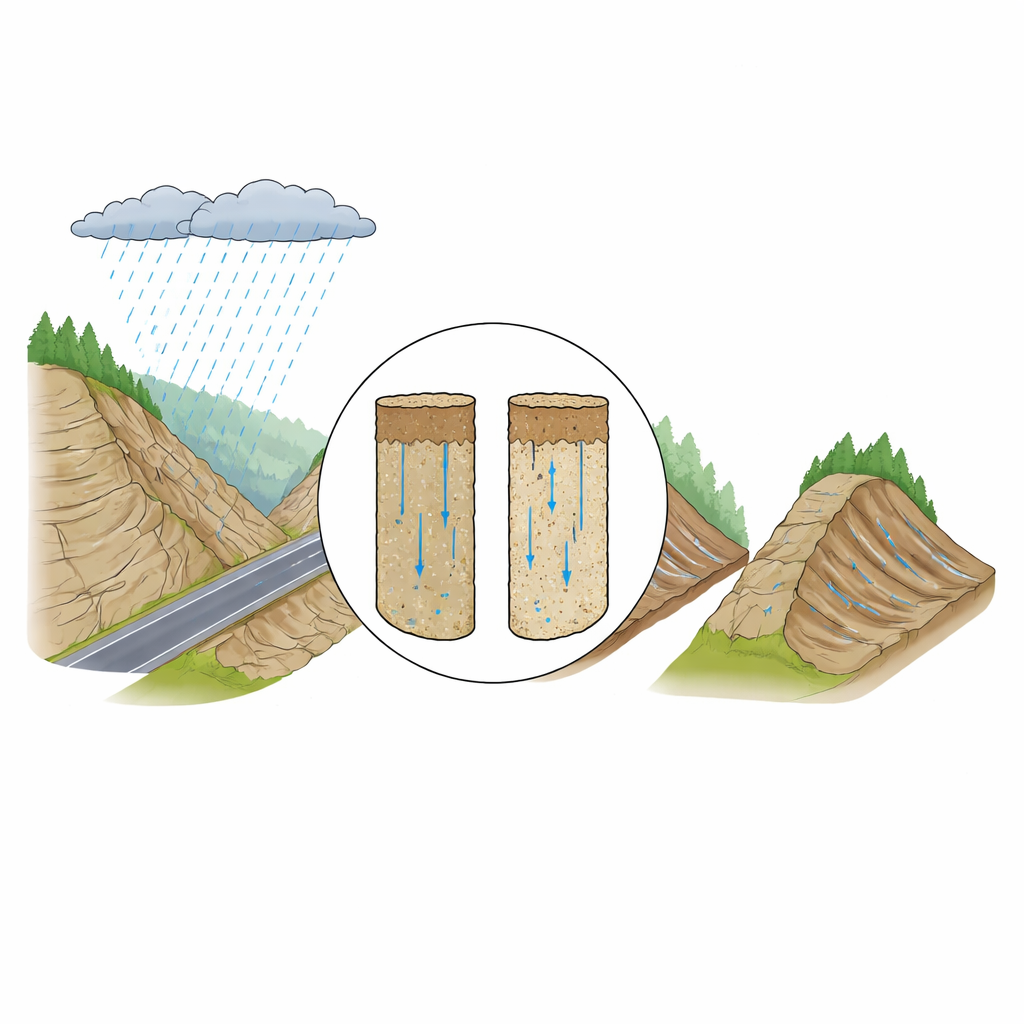
Turning farm waste into a slope protector
Rice husk ash is produced when rice husks are burned under controlled conditions. It is rich in silica and has a fine, porous structure. The researchers mixed different amounts of this ash (from 2% to 8% by weight) into samples of weathered mudstone taken from highway cut slopes in northern Hebei. A small amount of lime was added as an activator, and the mixtures were compacted and cured for nearly a month, mimicking how they might be placed in real construction. The goal was to see how this simple blend would change how water enters and moves through the soil, and whether there is an ideal dose that gives the best protection.
Watching water move through soil columns
To track what rain would do inside a slope, the team built vertical soil columns about 65 centimeters tall, equipped with moisture and suction sensors at four depths. A special bottle arrangement supplied water from the top at a constant pressure, simulating steady rainfall. As water seeped in, the sensors recorded how quickly the “wetting front” – the boundary between dry and wet soil – moved downward, and how the internal water pressure changed over time. In parallel, the scientists measured how strongly the soil held onto water (its water retention) under different tension levels, and used mathematical curves to describe this behavior.
How ash changes the path of water
Adding rice husk ash dramatically altered the way water moved. The treated mudstone held more water before it began to drain, and lost moisture more slowly as suction increased. This means the pore structure became finer and better at gripping water. In the infiltration tests, the wetting front advanced more and more slowly as the ash content increased. At an ash dose of 6%, the time for the wetting front to reach 40 centimeters nearly doubled compared with untreated soil. In other words, water took much longer to penetrate deep into the column. The measured hydraulic conductivity – a key indicator of how easily water flows – dropped by up to two orders of magnitude under dry conditions, especially at higher ash contents. Microscopic images showed why: at 6% ash, the pores between particles were evenly narrowed, making more twisted, resistant pathways for water.
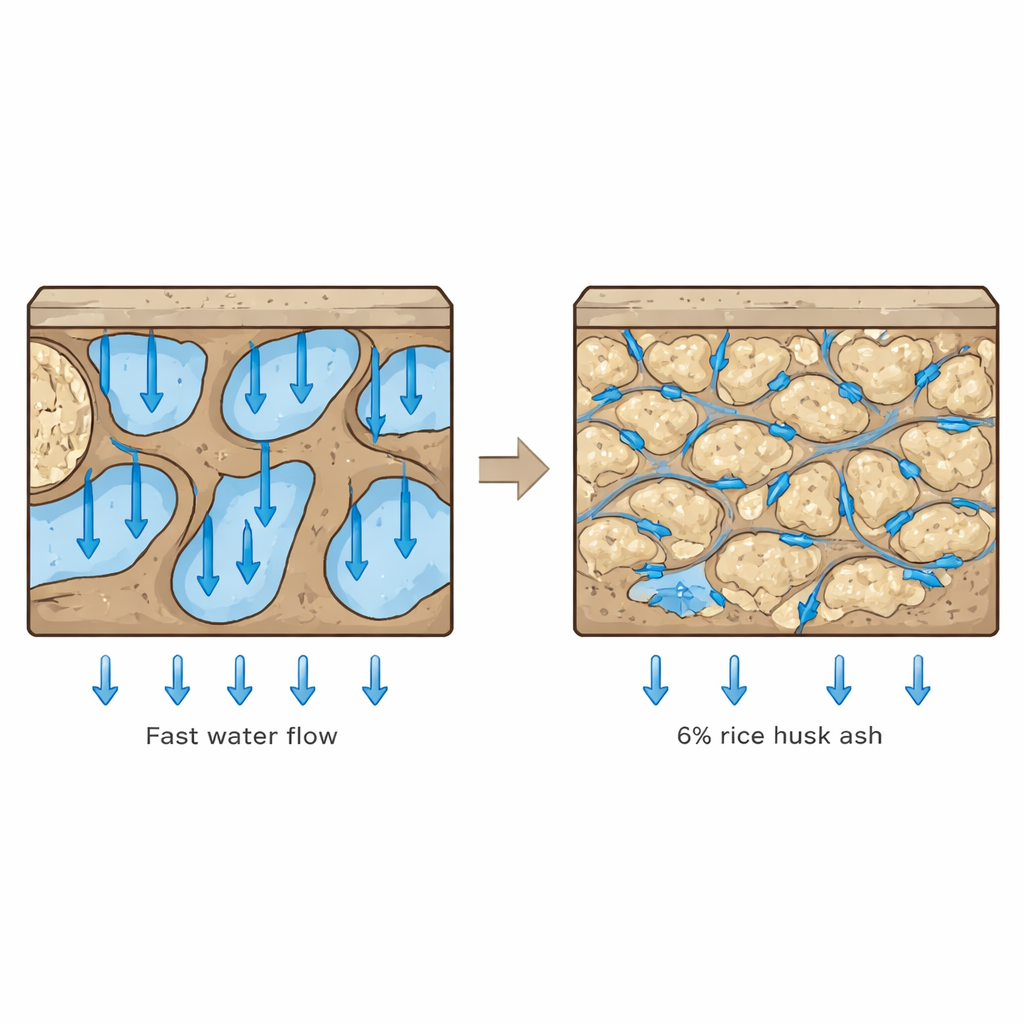
Finding the sweet spot for safety
Interestingly, more ash was not always better. At 8% ash, particles began to clump together and block some pores unevenly. This created patches that saturated quickly and zones where the soil’s strength fell, slightly raising water flow again and reducing cohesion compared with the 6% mix. To better predict these complex effects, the team refined a classic infiltration formula, the Green–Ampt model, by weaving in both the ash dosage and a measure of soil plasticity. This updated version matched the experimental data much more closely than the traditional model and outperformed other common formulas, giving engineers a more reliable tool to estimate how fast water will move through treated slopes.
What this means for real roads
The study shows that a moderate amount of rice husk ash – around 6% by weight – can significantly improve the water-handling behavior of weak mudstone slopes: rainwater enters more slowly, penetrates less deeply, and builds up less destabilizing pressure. Combined with the fact that rice husk ash is a low-cost waste from rice farming, this approach offers a promising, greener way to reduce rainfall-triggered landslides along highways and other earthworks in similar expansive mudstone regions, while turning an agricultural byproduct into a protective shield for infrastructure.
Citation: Cui, H., Ma, B., Hu, Z. et al. Improving seepage characteristics of strongly weathered mudstone slopes with rice husk ash. Sci Rep 16, 11966 (2026). https://doi.org/10.1038/s41598-026-40499-2
Keywords: rice husk ash, slope stability, rainfall infiltration, expansive mudstone, sustainable soil improvement