Clear Sky Science · en
MAGUK p55 subfamily member 7 attenuates allergic airway inflammation by modulating lung dendritic cells functions
Why this matters for people with asthma
Asthma affects hundreds of millions of people worldwide, yet most treatments only ease symptoms instead of changing the disease itself. This study looks at a little-known protein called MPP7, found in lung tissue and immune cells, and asks a big question: could it act as a natural brake on allergic inflammation in the airways? By understanding how this single molecule shapes the body’s response to common triggers like house dust mites, the research points toward new ways to diagnose, track, and possibly calm difficult-to-control asthma.
A hidden helper in the airways
The researchers began by measuring MPP7 levels in people with and without asthma. They found that patients with asthma had noticeably lower amounts of MPP7 in their blood cells. To see what this might mean inside the lungs, they turned to a mouse model of allergic asthma triggered by house dust mite particles. In these animals, exposure to the allergen also reduced MPP7 levels in lung tissue. Microscopic imaging showed that MPP7 was especially abundant in dendritic cells — sentry-like immune cells that decide whether inhaled particles are treated as harmless or dangerous — but was scarce in other allergy-linked cells such as mast cells and eosinophils. 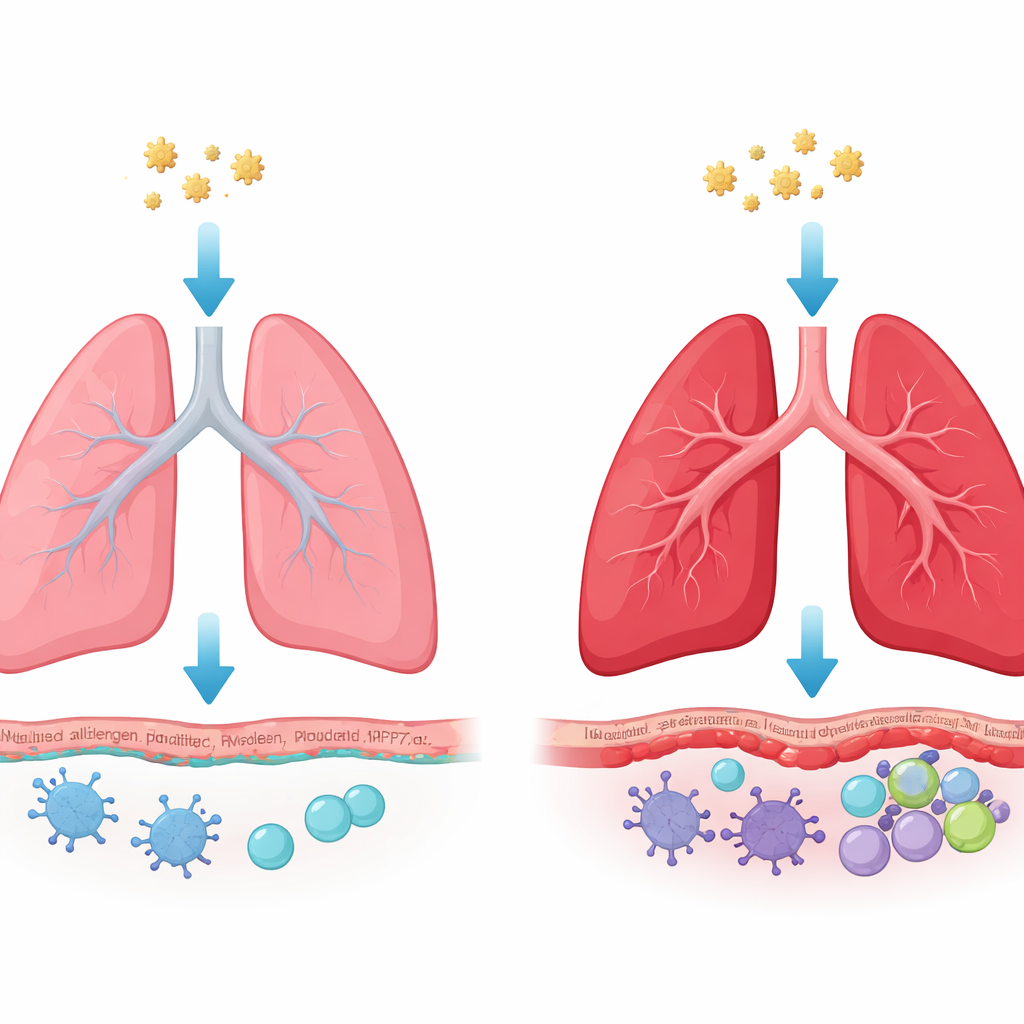
When the brake is missing
To test whether MPP7 actually protects the lungs, the team used mice that completely lacked the MPP7 gene. When these animals inhaled house dust mite extract, their asthma-like illness became much worse than in normal mice. Their airways filled with more inflammatory cells, their blood contained higher levels of allergy-specific IgE antibodies, and their lungs showed thicker airway walls, heavier cell buildup, and more mucus-producing goblet cells. Fluid washed from their airways contained sharply increased amounts of classic allergy-driving signals such as IL-4, IL-5, and IL-13. Together, these changes mirror a severe, type 2–skewed allergic reaction, suggesting that normal MPP7 acts like a protective buffer against overreaction.
Immune sentries pushed into overdrive
Because MPP7 is strongly expressed in dendritic cells, the scientists focused next on how these cells were altered when MPP7 was missing. In the lungs of allergen-exposed mice without MPP7, one particular subset of dendritic cells — known for promoting allergy-type responses — expanded markedly, while another subset remained unchanged. These dendritic cells also produced higher levels of inflammatory messenger molecules. In parallel lab experiments using bone-marrow–derived dendritic cells, those lacking MPP7 were more eager to swallow up particles and displayed more of the surface molecules needed to activate T cells. They also secreted greater amounts of inflammatory factors after stimulation. In effect, without MPP7, dendritic cells shifted into a hyper-alert state that strongly favors the development of allergy-driving T helper cells. 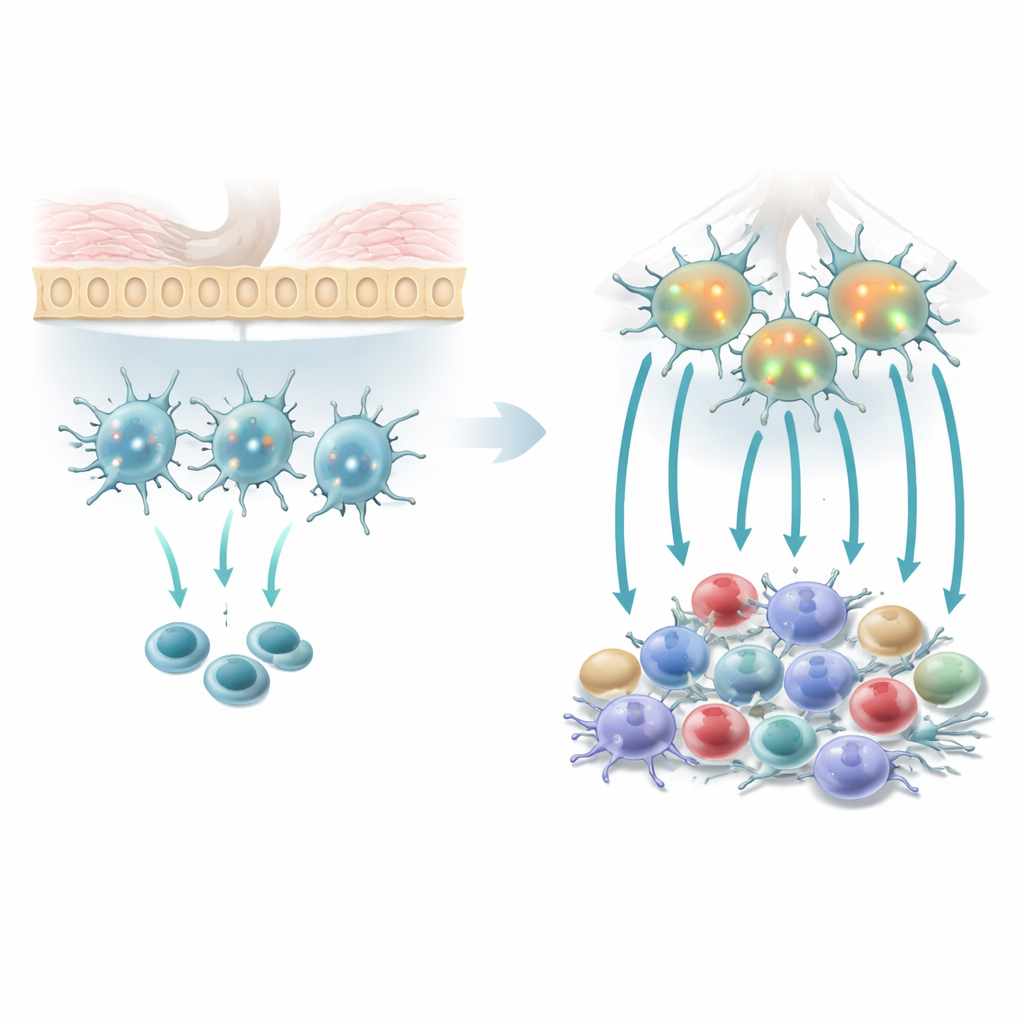
Signals inside cells that fan the fames
To uncover what was happening inside dendritic cells at the molecular level, the team compared gene activity patterns between normal and MPP7-deficient cells after stimulation. Hundreds of genes changed, especially those tied to immune receptors and inflammatory signals. Pathway analysis pointed to several well-known inflammatory routes, including TNF, IL-17, and NF-κB. Follow-up protein tests showed that losing MPP7 boosted the activation of the PI3K–AKT–NF-κB signaling axis, a chain of events already linked to asthma. When this pathway lit up more strongly, dendritic cells matured more fully and sent stronger danger signals to T cells, helping to explain the exaggerated allergic responses seen in the animals.
What this could mean for future care
In simple terms, this study suggests that MPP7 helps keep the immune system in the lungs from overreacting to common airborne triggers. When MPP7 levels drop, dendritic cells become more numerous, more active, and more likely to drive the type of T cell response that leads to wheeze, swelling, and mucus. Although the human data are still limited and the work was done mainly in female mice, the results point to MPP7 as a potential biomarker for allergic airway disease and a possible target for new treatments aimed at calming the immune system without shutting it down completely.
Citation: Men, Y., Chen, Y., Shao, Y. et al. MAGUK p55 subfamily member 7 attenuates allergic airway inflammation by modulating lung dendritic cells functions. Sci Rep 16, 11473 (2026). https://doi.org/10.1038/s41598-026-40491-w
Keywords: asthma, allergic inflammation, dendritic cells, MPP7, airway immunity