Clear Sky Science · en
Cacao clones modulate pod tolerance to witches’ broom and nutritional imbalances, enhancing cocoa production in the Amazon
Why cocoa lovers should care
Cocoa trees, the source of chocolate, are under pressure in the Brazilian Amazon from a damaging fungus called witches’ broom and from poor soil nutrition. Both problems can sharply reduce the number of healthy pods a tree produces. This study asked a practical question with big implications for farmers and chocolate consumers alike: can carefully chosen cocoa varieties, or clones, stay productive and healthier even in disease-prone, nutritionally unbalanced Amazonian soils?
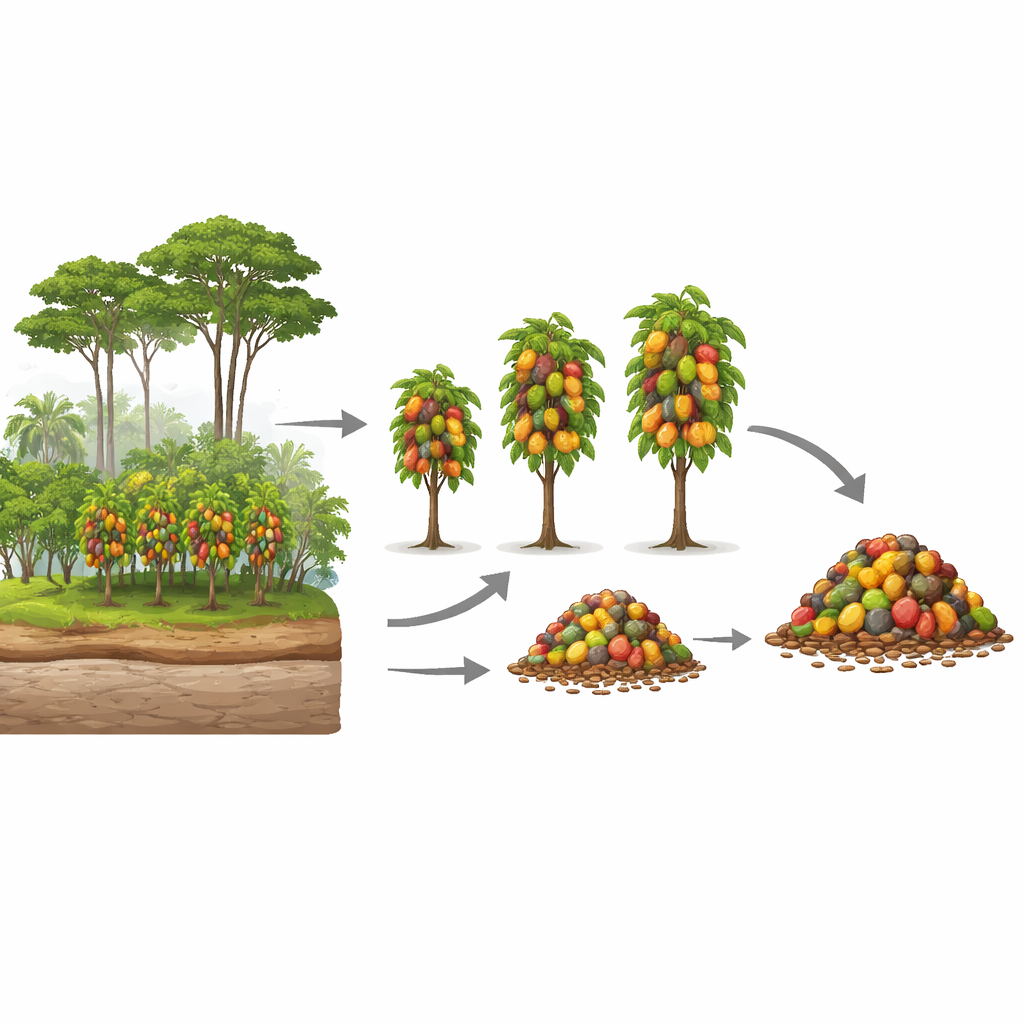
Chocolate trees in a tough neighborhood
The researchers worked at an experimental station in Rondônia, in the southwestern Amazon, where cocoa is grown under shade trees in hot, humid conditions that favor fungal disease. The local soils are acidic and weathered, with low reserves of key nutrients such as phosphorus and the micronutrient boron. In 2016, agronomists planted 25 different cocoa clones, representing a wide range of genetic backgrounds from Brazil and neighboring countries. All trees were managed with the same farming practices so that differences in performance would come mainly from the plants themselves rather than from how they were treated.
Comparing many cocoa families at once
In 2024, during the fruiting season, the team counted pods on every tree and recorded how many were healthy, how many were damaged by insects, and how many were ruined by witches’ broom. They weighed pods and seeds to estimate yield per hectare. At the same time, they took standardized samples of mature leaves to measure concentrations of major nutrients such as nitrogen, phosphorus, potassium, calcium, and magnesium, as well as trace elements like copper, zinc, iron, and boron. To move beyond simple “too low” or “too high” labels, they used a statistical tool called Compositional Nutrient Diagnosis, which looks at nutrients in combination and summarizes how far a plant’s overall nutrient mix strays from the pattern seen in high-yielding trees.
Strong performers and weak links
The 25 cocoa clones differed sharply in both disease levels and harvests. One clone, EEOP 96, suffered by far the most witches’ broom damage and lost about a third of its potential yield, even though its nutritional profile was not especially poor. Several clones showed no diseased pods at all. Two locally bred clones, EEOP 63 and EEOP 65, stood out as stars: they produced many more pods and a higher mass of seeds per hectare while keeping witches’ broom incidence low. These high performers tended to have more balanced levels of phosphorus, potassium, calcium, and magnesium in their leaves and a lower overall “nutrient imbalance” score. Across all trees, nitrogen tended to be in excess and boron was consistently deficient, but the best clones appeared better able to cope with this background problem.
How nutrition, disease, and yield fit together
By analyzing all traits together, the authors showed that clones clustered into groups: one dominated by high pod numbers and seed yield, another with intermediate performance, and a third with lower yields and stronger signs of nutritional imbalance. Witches’ broom tended to align with this imbalance and with poorer yield, but not perfectly; some clones were quite susceptible yet still reasonably productive, while others were disease-tolerant but limited by weak nutrition. The patterns suggest that what really matters is a clone’s ability to keep its internal nutrient balance steady—its nutritional homeostasis—under Amazonian soil and climate stresses. Clones like EEOP 63 and EEOP 65 seem to regulate nutrient uptake and use more efficiently, maintaining sturdy cell walls and defense systems that help contain disease while filling pods.
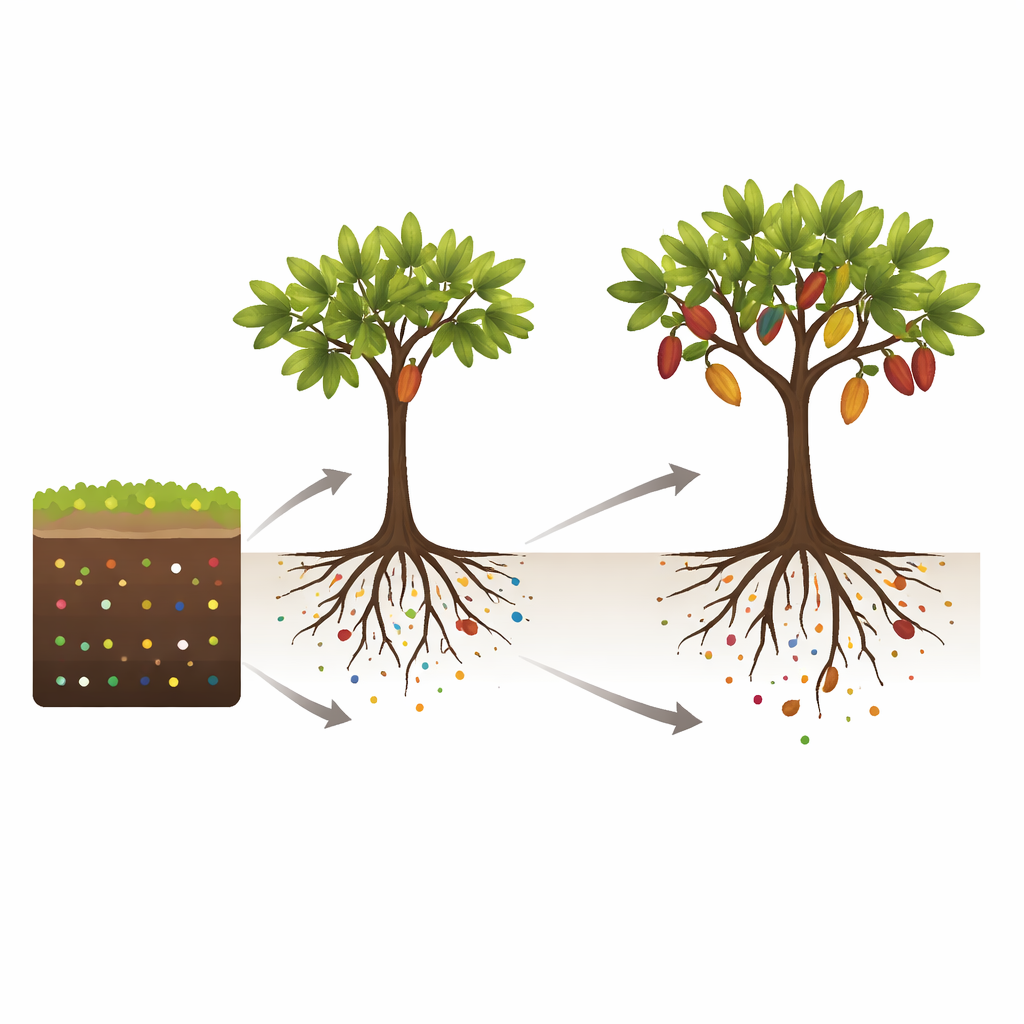
What this means for future cocoa harvests
For farmers and breeders, the message is hopeful but nuanced. There is no single “silver bullet” nutrient or clone that automatically resists witches’ broom and guarantees high yields. Instead, cocoa genotypes differ in how well they combine disease tolerance with the ability to stay nutritionally balanced in challenging soils. Selecting and planting clones such as EEOP 63 and EEOP 65, alongside regionally tuned fertilizer strategies, could significantly boost cocoa production in the Amazon without pushing farmers to overuse inputs. In simple terms, choosing the right cocoa family for the local soil can mean more healthy pods, fewer losses to disease, and a more reliable supply of chocolate from a fragile rainforest landscape.
Citation: Traspadini, E.I.F., de Mello Prado, R., Wadt, P.G.S. et al. Cacao clones modulate pod tolerance to witches’ broom and nutritional imbalances, enhancing cocoa production in the Amazon. Sci Rep 16, 9997 (2026). https://doi.org/10.1038/s41598-026-40483-w
Keywords: cocoa clones, witches broom disease, plant nutrition, Amazon agriculture, cacao productivity