Clear Sky Science · en
Butterflies use humidity as a cue for wing-pattern and life history trait plasticity when temperature is unreliable
Why butterfly wing spots change with the weather
Walk through a tropical forest in the rainy season and you may see butterflies flashing bold eye-like spots on their wings. Visit the same place in the dry season and the same species can look drab and plain. This study asks a simple but important question: how do butterflies know which version to grow, and does that decision change from place to place as the climate shifts?
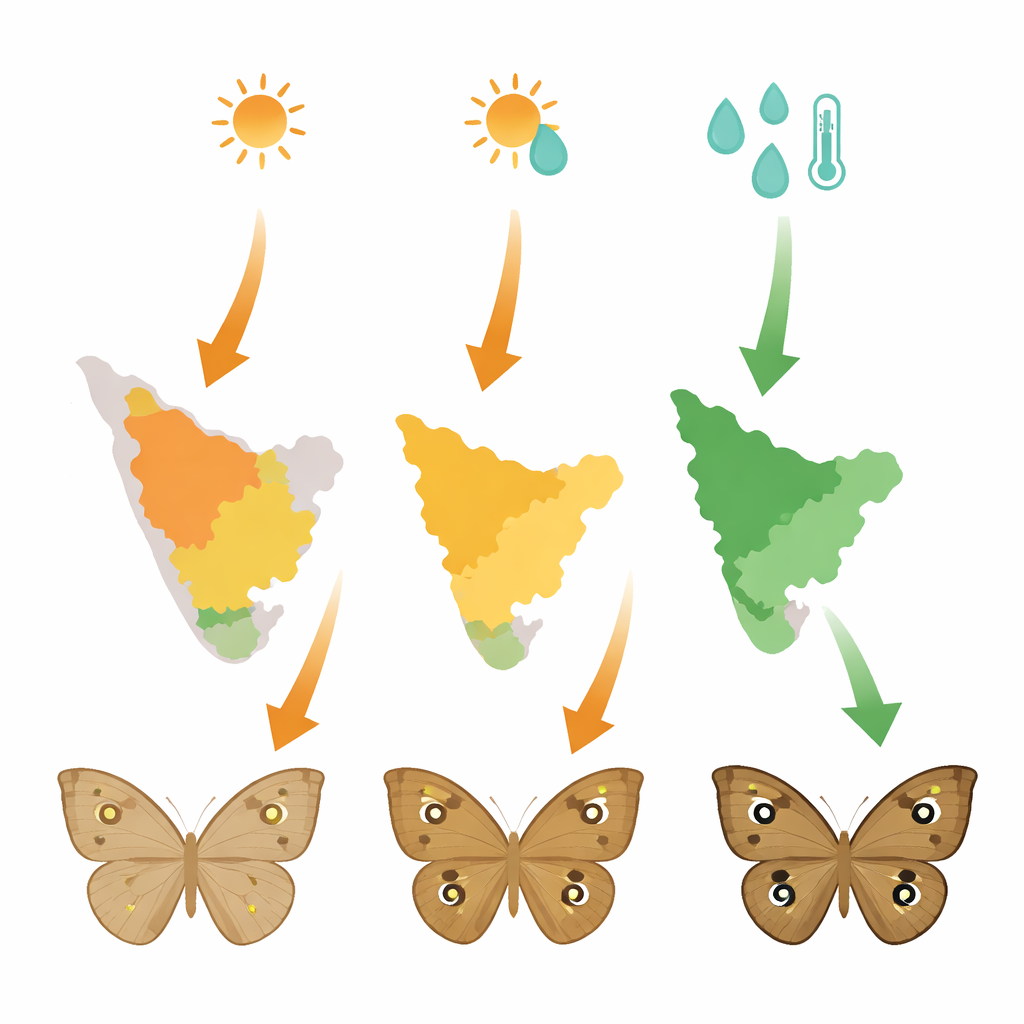
Two seasonal looks for one butterfly
The researchers focused on the common evening brown, a widespread butterfly found across Asia and Africa. Like many tropical species, it has two seasonal forms. In the wet season, it sports large, bright eyespots that can startle or misdirect predators. In the dry season, when leaves are brown and predators hunt differently, the butterfly develops much smaller, less obvious spots that help it blend into its surroundings. This ability to grow different forms depending on early-life conditions is a kind of shape-shifting called plasticity, and it can be vital for survival in changing environments.
Putting climate signals to the test
To understand which environmental signals guide this shape-shifting, the team collected butterflies from three regions in southern India that differ in how temperature and humidity change through the year: Coimbatore, Tirunelveli, and Vithura. They then raised the offspring in climate-controlled rooms under three combinations of temperature and moisture in the air. This “common garden” setup allowed the scientists to test, side by side, whether temperature, humidity, or both mattered for wing pattern and for basic life traits such as how fast the insects grew and how big they became.
Humidity emerges as a hidden guide
Across many earlier studies, temperature had been seen as the main cue: cooler rearing conditions usually led to smaller eyespots. In this experiment, however, a different picture emerged. In two of the three butterfly populations, lower humidity consistently produced smaller eyespots, matching the dry-season form, even when temperature did not change. Only females from the Coimbatore population showed a strong response that involved temperature, and even there, the pattern suggested that dry air still played an important role. These results reveal, for the first time, that humidity alone can steer the development of wing spots and that different populations of the same species can rely on different cues depending on the climate of their home region.
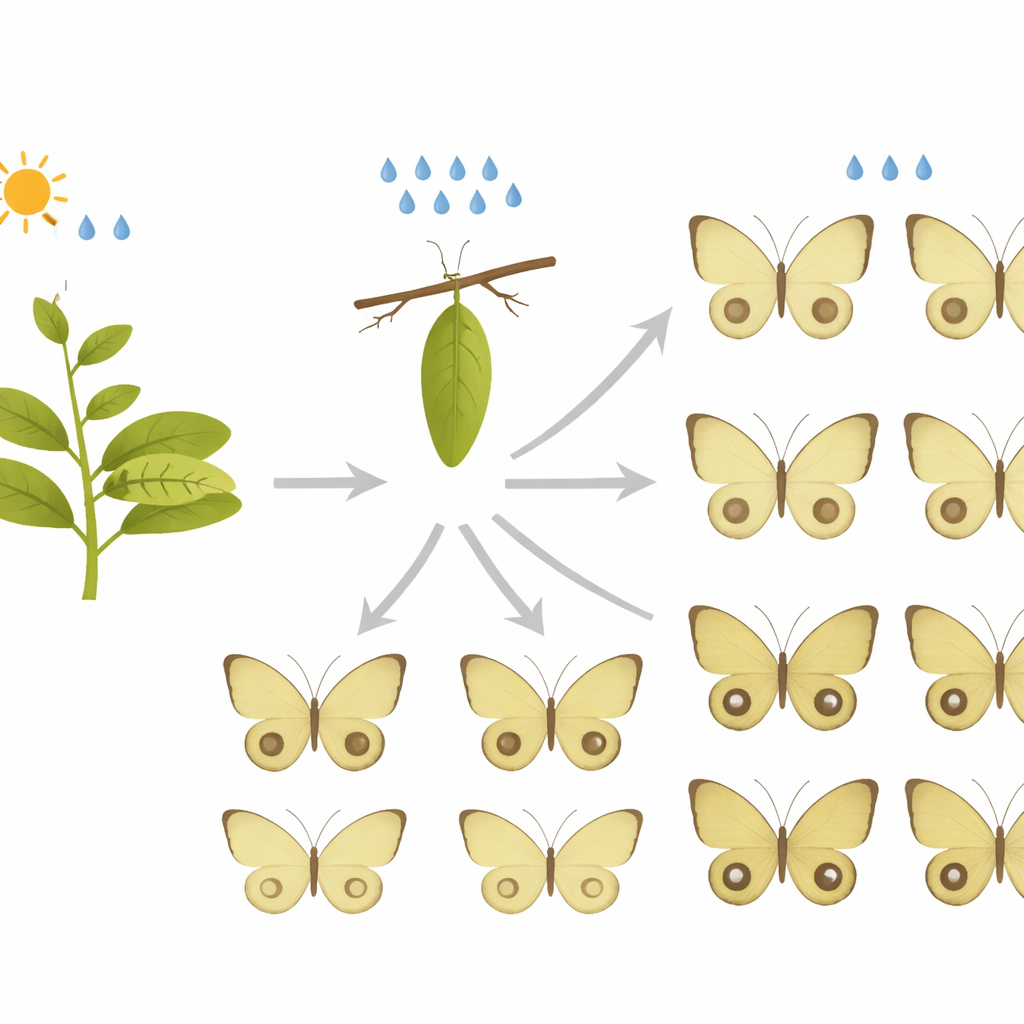
Growing up fast and big in dry places
The study also uncovered differences in how quickly the butterflies developed and how heavy they were as pupae. Individuals from the drier regions tended to grow faster and reach larger body size than those from the wetter site, especially when raised under dry conditions. Growing quickly is likely beneficial where lush host plants are available only for a short time each year. A larger body can also help insects hold more water and withstand drying out. These patterns suggest that local climates have shaped not just wing patterns but the entire life schedule of these butterflies.
What this means for butterflies in a changing world
In simple terms, the work shows that some butterflies read the air’s moisture, not just its warmth, to decide which seasonal outfit to wear and how to pace their growth. Different populations of the same species have tuned this sensitivity to match the weather patterns where they live. As climate change alters the link between rain, temperature, and humidity, such flexible responses could help populations keep up—at least for a while. The study also warns that focusing only on temperature can miss key pieces of the story, and that understanding how animals respond to climate will require paying attention to humidity and other subtle environmental cues.
Citation: Prasannakumar, I., Molleman, F., Walczak, U. et al. Butterflies use humidity as a cue for wing-pattern and life history trait plasticity when temperature is unreliable. Sci Rep 16, 10909 (2026). https://doi.org/10.1038/s41598-026-40471-0
Keywords: butterfly eyespots, humidity cues, seasonal forms, phenotypic plasticity, local climate adaptation