Clear Sky Science · en
Study on the influence of stress relief in close-distance coal seam Goaf and roadway excavation disturbance on surrounding rock
Why underground stress matters
Modern mines must reach ever deeper to tap remaining coal reserves, where the rock behaves in complex and sometimes unpredictable ways. When a large tunnel is cut beneath an older, mined‑out coal seam, the surrounding rock can either collapse or remain stable depending on how stresses shift through the layers. This study examines a real project in eastern China to understand how an empty, collapsed zone left by earlier mining can actually help protect a new, extra‑wide roadway below, and what kinds of supports keep the tunnel roof safe for workers.
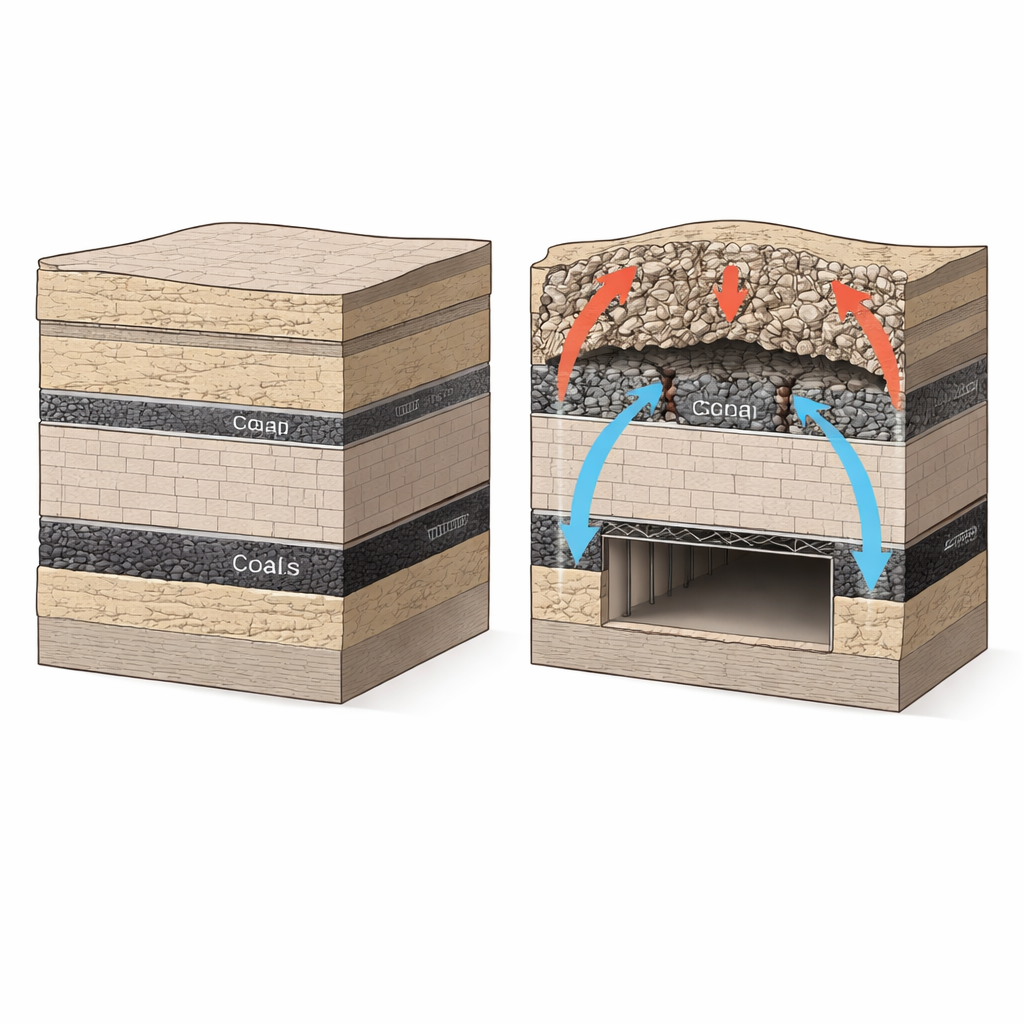
Layers of rock above a wide tunnel
The researchers focused on a large roadway known as an open‑off cut, which is roughly twice as wide as a typical mine tunnel and lies 12 to 18 meters beneath an older, mined‑out coal seam. Between the coal layers are beds of sandstone, siltstone, and mudstone, each with different strengths. By drilling cores and rating their quality, the team found that some roof rocks were of moderate strength, while others, especially near the old seam floor, were very weak and heavily broken. Knowing which layers are strong and which are fragile is essential, because these layers together form the beam of rock that must bridge over the new opening.
How an old mined‑out seam changes the load
Using computer simulations, the authors recreated the sequence of mining the upper coal seam and then excavating the lower roadway. Once the upper seam was mined, it left behind a goaf—an empty zone partly filled with collapsed roof rock. This goaf did not increase pressure on the lower roadway; instead, it acted as a stress‑relief zone. The rock between the goaf floor and the new tunnel roof experienced much lower stress, typically only a few megapascals, compared with the highly loaded rock on either side. A three‑meter‑thick band of rock between the two openings remained unbroken, and the long roof cables anchored above the tunnel stayed within compressed, stable rock, while shorter bolts worked in a tension zone closer to the opening.
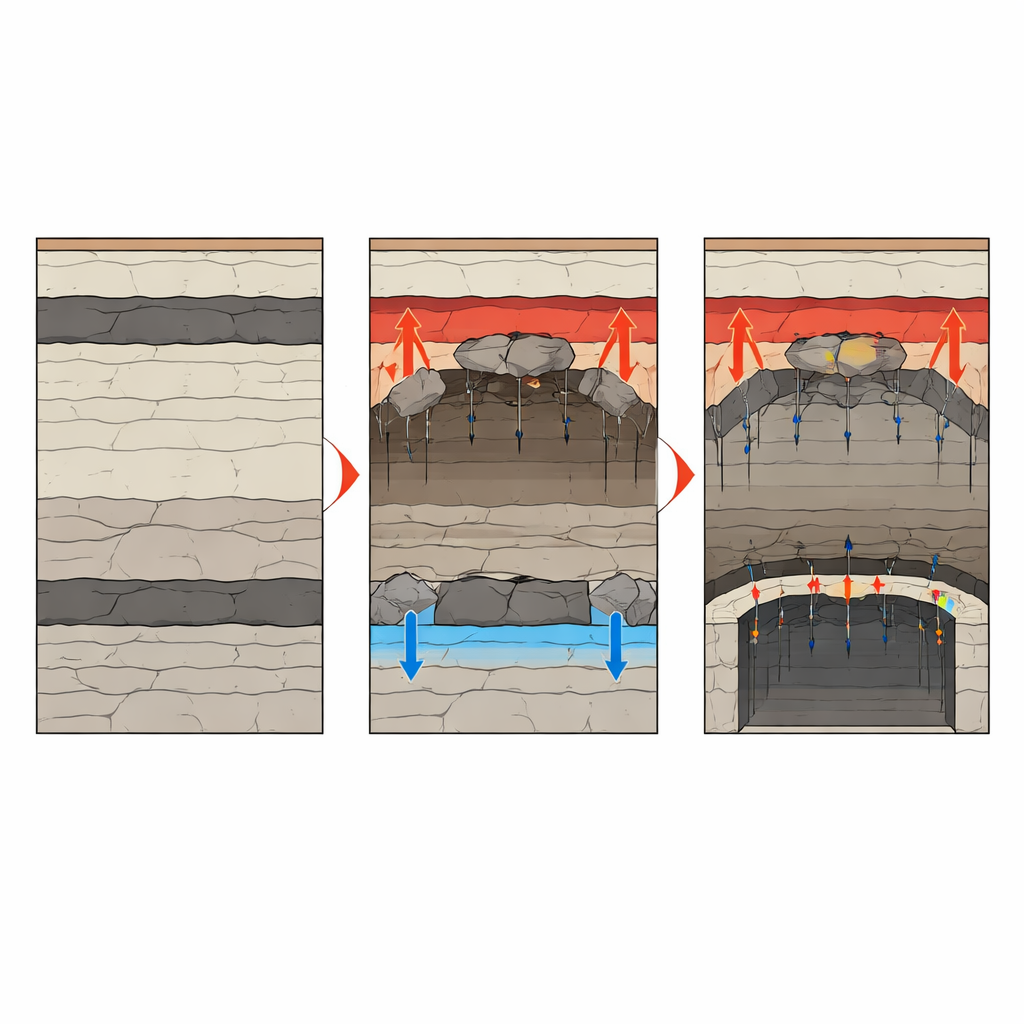
Model tunnels and slow‑motion roof collapse
To test these ideas physically, the team built a scaled‑down, meter‑sized model of the layered rock and coal seams using sand‑based materials. They first mined out the upper seam in the model and then slowly increased the weight pressing down from above to mimic deeper burial. As the load grew, the roof over the upper seam gradually broke from a fixed beam into hinged blocks and then into a masonry‑like arch of fallen rock. Once the load exceeded a certain threshold, the upper roof collapsed completely, forming a stable pile whose sides sloped at about 60 to 65 degrees. Sensors embedded near the future roadway position showed that stresses in the floor below the goaf eventually changed from compression to tension and then settled to steady values, confirming that the old mined‑out zone had largely shed its load.
Watching stress build as the roadway grows
The researchers then simulated the excavation of the large roadway itself in stages, mirroring how it would be cut underground. Stress gauges in the model roof showed that each step of widening the tunnel caused a new wave of disturbance, with compressive and tensile stresses alternating before gradually stabilizing. The center of the roof, directly above the roadway, carried the highest stretching (tensile) stresses, and these stresses increased further when extra load was applied from above. However, this high‑tension zone lay mostly within the range of the shorter bolts, while the longer cables anchored deeper into compressed rock that acted as a firm backbone. Field observations with a borehole camera in the real mine supported this picture: only a few circular cracks were seen in the roof, and most of the rock around the opening remained intact.
What this means for safer deep mining
For non‑specialists, the key message is that an old, mined‑out seam above a new tunnel is not always a threat; if understood correctly, it can actually relieve pressure and help protect the opening below. In this case, the goaf above the large roadway created a low‑stress buffer, while careful design of bolts and cables ensured that the weak, cracked layers near the tunnel were tied to stronger rock higher up. By combining core drilling, numerical modeling, scaled laboratory models, and on‑site camera checks, the study shows that even very wide underground roadways can remain stable under deep conditions when the rock layers and stress paths are thoroughly mapped and the support is tailored to the actual stress zones.
Citation: Liu, Z., Chen, M. Study on the influence of stress relief in close-distance coal seam Goaf and roadway excavation disturbance on surrounding rock. Sci Rep 16, 12291 (2026). https://doi.org/10.1038/s41598-026-40469-8
Keywords: underground coal mining, rock stability, roadway support, goaf stress relief, deep tunnels