Clear Sky Science · en
Numerical simulation study on the cooperative movement of overburden and fracture healing mechanisms in shallow-buried coal seams
Why sinking ground matters to everyday life
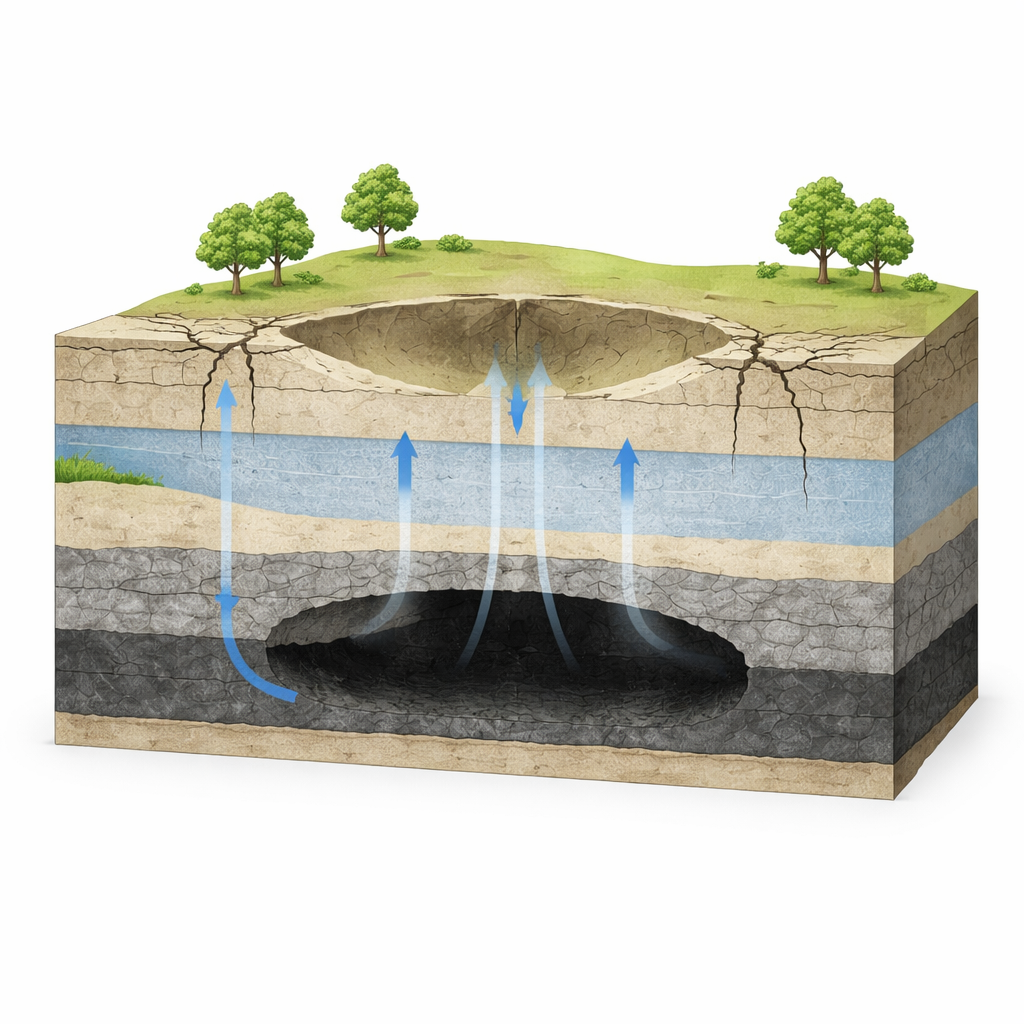
Across many dry regions, communities depend on shallow rivers, ponds and groundwater that lie just above coal seams. When coal is mined close to the surface, the land above can crack and sink, opening hidden pathways for water to drain away and for soil to break apart. This study looks inside that hidden zone of rock and soil to understand how it bends, breaks and partly heals during mining, with the goal of better protecting water resources and the surface environment.
Layers of earth above a hidden mine
In the coalfield examined in Inner Mongolia, the coal lies under a relatively thin band of hard rock and a thicker blanket of loose sand and soil. This stacked structure is common in western China, where shallow coal seams sit beneath fragile desert and grassland ecosystems. The hard rock acts like a stiff shell, while the overlying loose material behaves more like a packed but crumbly cushion. When miners remove coal along a long underground panel, they leave behind an empty space that gradually collapses. How the shell and cushion move together determines whether the ground above settles gently or cracks open into damaging fissures that can disturb roads, farmland and surface water.
Virtual digging to see the unseen
Because these processes happen dozens of meters below ground, the authors used a detailed computer simulation to recreate the mining steps at a real working face in the Ulan Mulun Coal Mine. They built a cross-sectional model that represents rock layers as interlocking blocks and the loose layer as many small grains. As the simulated coal face advanced, the model tracked how the layers bent, broke and shifted, and how cracks opened or closed. The team checked their virtual results against careful measurements of how much the surface actually sank above the mine. The agreement was close, giving confidence that the simulation faithfully captured the hidden movements.
How the rock shell and soil blanket move together
The simulations show that the overlying rock does not fail all at once. At first, only the thin roof directly over the coal collapses. Once a thicker, stronger band of rock known as the key layer finally snaps, the entire overlying stack begins to sag together. The area of internal damage then jumps sharply and later grows more steadily. Within the hard rock zone, cracks first spread as the layers break, but later some of these cracks squeeze shut as the collapsed area compacts, so overall cracking there rises, then falls, and finally levels off. In the loose soil and sand above, by contrast, cracking grows in a different way: it increases roughly in a slowing, stepwise fashion and is especially sensitive to how the rock shell underneath settles.
A temporary protective arch in loose ground
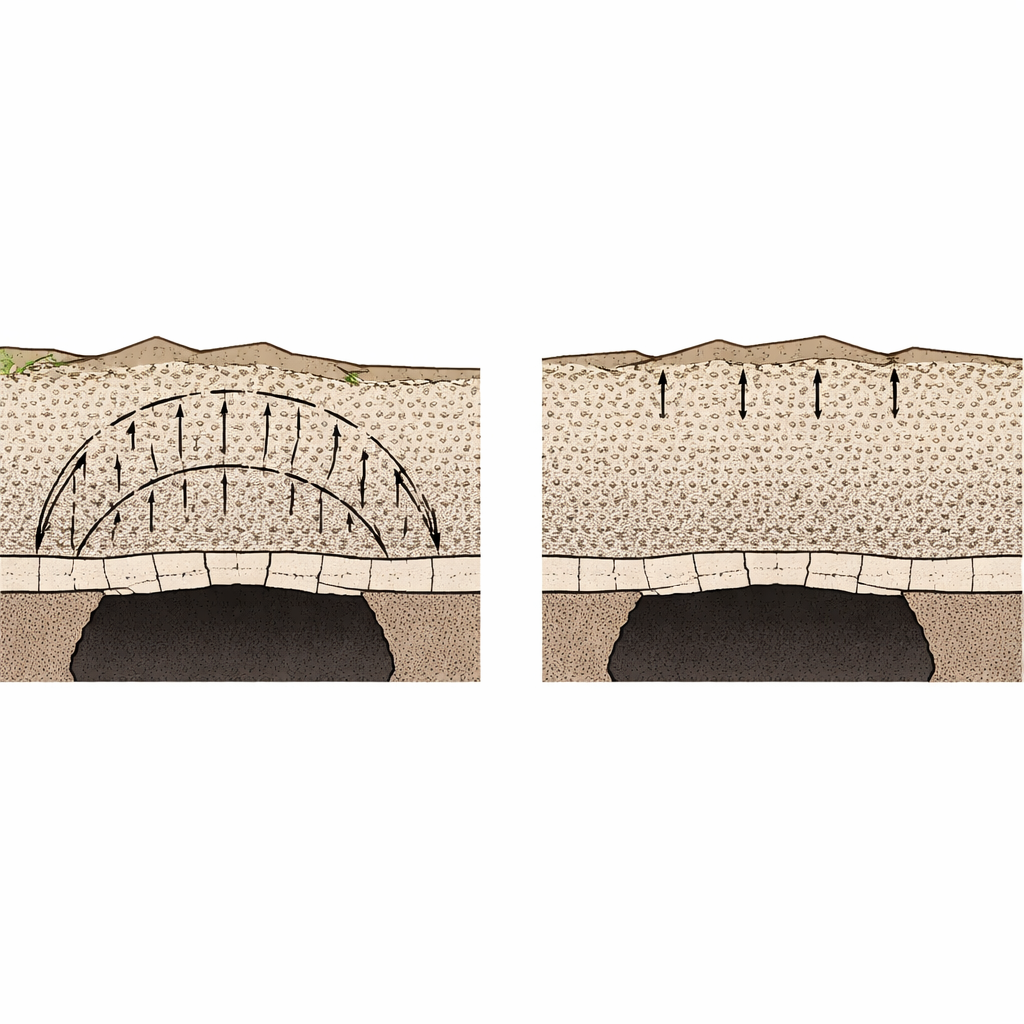
One of the most striking findings is the appearance of a curved arch of fractures within the loose layer above the collapsed mine. After the key rock layer breaks and drops, the loose material partly settles and forms an arc-shaped zone of broken particles that can still carry weight. This arch temporarily channels some of the load away from the middle and toward the sides, slowing the sinking of the ground directly overhead. However, as mining continues and the collapsed zone below gets more tightly packed, the arch becomes unstable. Its cracks gradually close, the arch loses its support role, and the surface above begins to sink faster. At the edges of the sinking bowl, the stretching ground opens visible tension cracks that can connect down to deeper fractures.
What this means for land and water protection
By coupling simulations with field data, the study explains how a strong rock band deep underground and a fragile fracture arch in the loose cover work together to control when and where the ground settles. The key rock layer acts as an active trigger: once it fails, the entire overburden starts to move as a unit. The arch in the loose layer is a passive, short-lived support that delays but does not prevent surface sinking. As the arch closes and heals, surface subsidence speeds up and edge cracks become more pronounced, threatening shallow water bodies and ecosystems. Understanding these stages offers engineers clearer guidance on when surface damage is likely to accelerate and how to design mining plans and protections that reduce harm to land and water above shallow coal seams.
Citation: Pang, C., Kong, Z., Chen, L. et al. Numerical simulation study on the cooperative movement of overburden and fracture healing mechanisms in shallow-buried coal seams. Sci Rep 16, 10131 (2026). https://doi.org/10.1038/s41598-026-40465-y
Keywords: shallow coal mining, ground subsidence, fracture healing, overburden movement, water resource protection