Clear Sky Science · en
Backbone agnostic Pareto evidential networks for trustworthy fault diagnosis and out of distribution detection
Why smarter fault alarms matter
Modern factories rely on sensors and algorithms to listen for early signs of trouble in machines, from tiny bearings to large rotating shafts. These systems work well when they encounter familiar problems seen during training, but they can become dangerously overconfident when something truly new happens. This paper introduces a method called the Pareto‑driven Evidential Dual‑head Network (PEDNet), designed to help diagnostic algorithms know not only what fault is most likely, but also when they should admit, “I’m not sure,” so that people can step in before damage or accidents occur.
The challenge of unknown faults
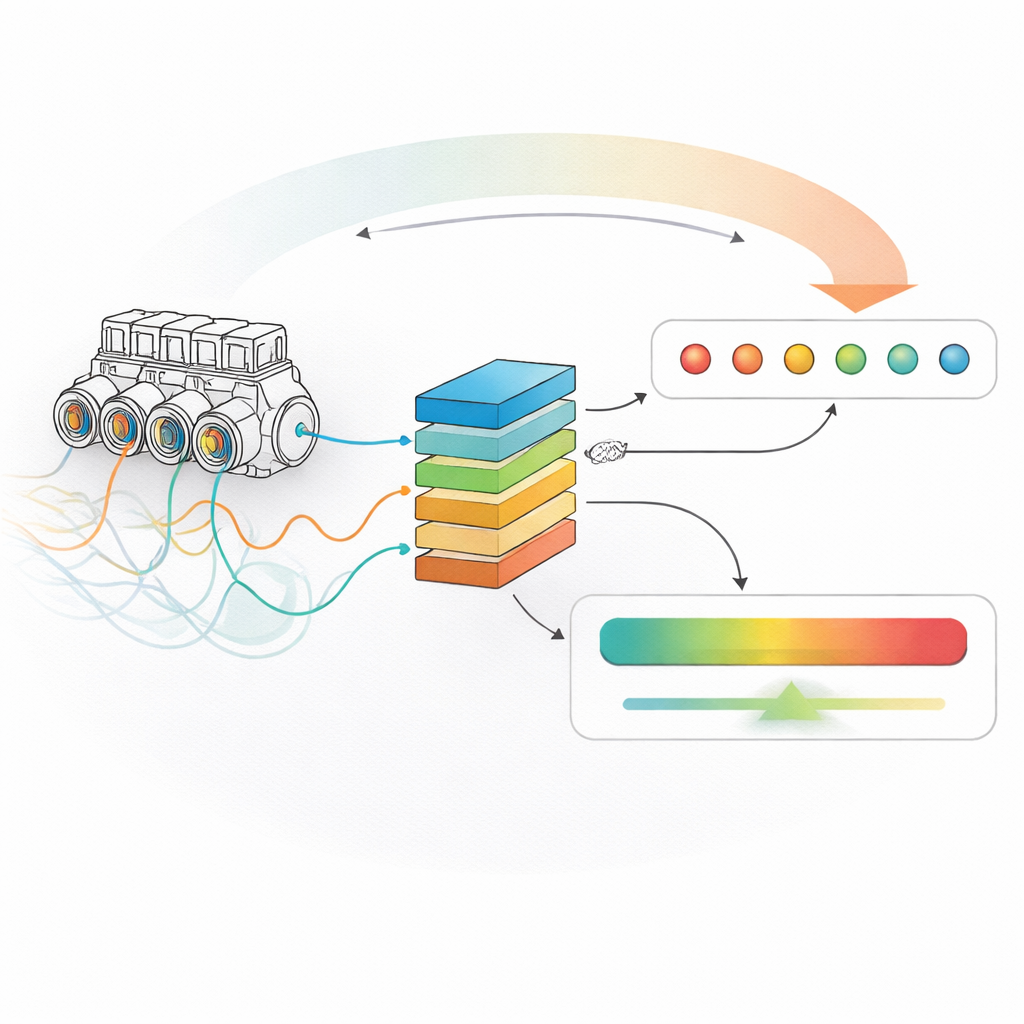
Traditional fault diagnosis systems treat the world as if all possible fault types are already known. They are trained on labeled vibration signals—from healthy bearings and a limited set of fault conditions—and then expected to classify every future signal into one of those categories. In real factories, however, equipment ages, loads change, and new combinations of failures appear that were never in the training set. These unfamiliar situations are called out‑of‑distribution (OOD) events. Conventional deep networks tend to force these unknown cases into the closest known label with high confidence, which can mislead maintenance staff and undermine trust in automated monitoring.
Two heads are better than one
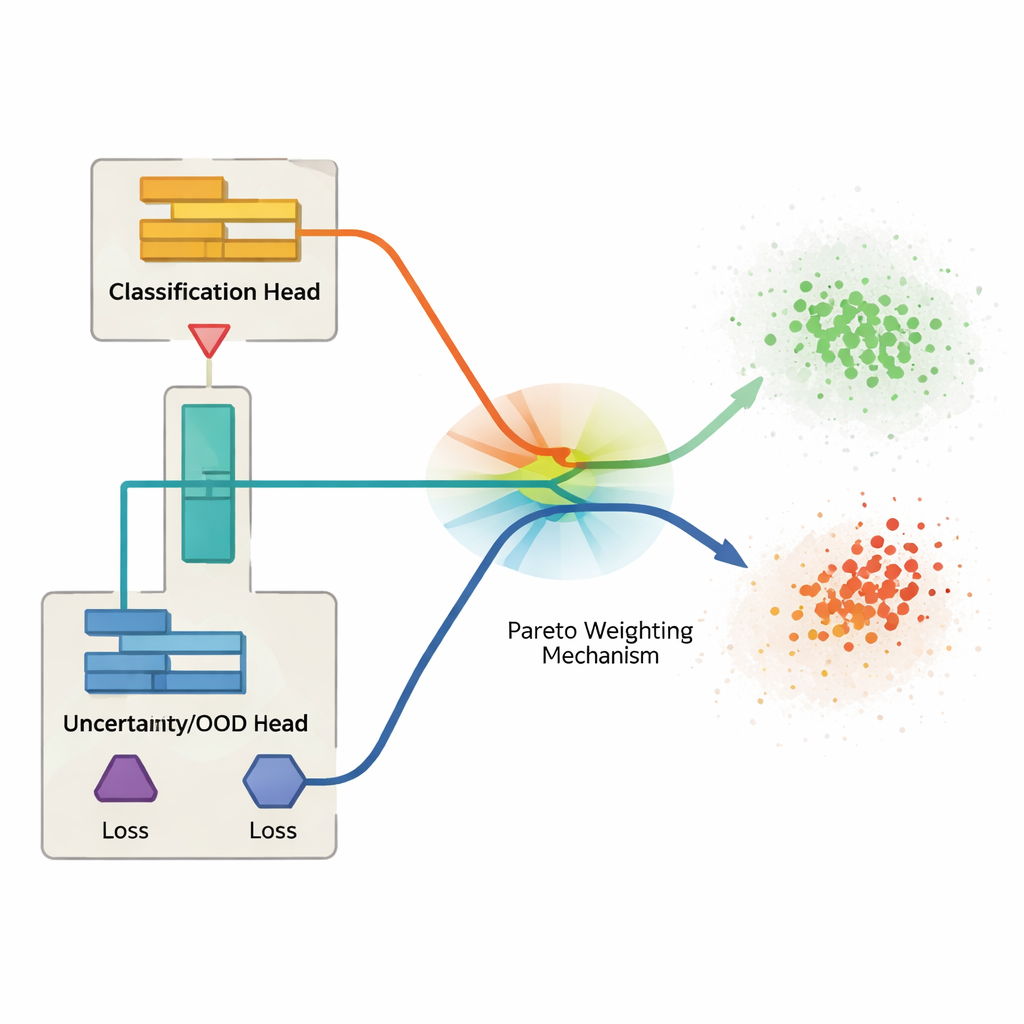
To tackle this, PEDNet uses a simple but powerful idea: split the network’s decision making into two coordinated parts, or “heads,” that share the same learned features. One head focuses on the usual job—deciding which fault pattern best matches the incoming signal. The other head estimates how trustworthy that decision is, by modeling uncertainty in a principled way. Instead of producing a single hard score, this uncertainty head represents how much supporting “evidence” the model has for each possible class. When the evidence is weak or inconsistent, the model’s overall confidence drops, signaling that the input may be unusual or outside past experience.
Balancing accuracy and caution
Simply adding a second head does not automatically produce reliable behavior: the two tasks—being accurate on known faults and being cautious on unknown ones—can pull the shared network in different directions during training. PEDNet addresses this with a Pareto‑based weighting scheme that looks at the gradients, or update directions, coming from each head on every training batch. Instead of using fixed or hand‑tuned weights, the method analytically finds a compromise direction that reduces both objectives as much as possible at once. This “dynamic truce” steers learning toward solutions where the model is both sharp at recognizing known patterns and honest about its uncertainty when something looks off.
Proving its value on real machine data
The authors test PEDNet on two public bearing datasets that mimic realistic factory scenarios. One captures mixtures of single and compound faults across two bearings, so that certain combinations appear only at test time and behave like truly new fault modes. The other gradually increases damage severity, treating the most severe level as unseen during training. Across four different backbone architectures—from a small convolutional network to more specialized designs—PEDNet consistently improves fault classification accuracy while substantially lowering the rate at which unknown cases are falsely accepted as normal. It also produces confidence scores that are better calibrated, meaning its stated certainty more closely matches how often it is actually correct. Even under harsh tests where the model is trained on one dataset and evaluated on another with different sensors and machine structures, its uncertainty signals remain informative, though the authors stress that some domain‑specific tuning is still needed.
What this means for safer machines
In practical terms, PEDNet offers a plug‑in training strategy that can sit on top of many existing neural network designs without altering their internal structure. That makes it easier to retrofit current diagnostic systems with a second sense: not just detecting likely faults, but also flagging readings that fall outside familiar territory. While the approach does not remove the need for careful threshold setting or human oversight—especially when equipment or operating conditions change drastically—it provides a more trustworthy foundation for automated monitoring. By helping algorithms learn when to be confident and when to defer, PEDNet moves industrial fault diagnosis a step closer to the kind of cautious, transparent behavior required for safety‑critical applications.
Citation: Shi, J., Tang, M. & Tan, L. Backbone agnostic Pareto evidential networks for trustworthy fault diagnosis and out of distribution detection. Sci Rep 16, 10096 (2026). https://doi.org/10.1038/s41598-026-40463-0
Keywords: fault diagnosis, out-of-distribution detection, uncertainty-aware AI, industrial monitoring, multi-task learning