Clear Sky Science · en
Study on the mining stress field distribution law beneath isolated coal pillar in close coal seam and reasonable location of the roadway
Why the Shape of Underground Stress Matters
Deep underground, coal mines rely on narrow tunnels, or roadways, to move people, equipment, and air. In many Chinese coalfields, several coal seams lie close together, so when one seam is mined, the rock above and below it is disturbed. This study looks at what happens beneath a leftover “island” of coal in an upper seam and asks a practical question with life‑or‑death consequences: where should engineers place the next roadway in the lower seam so that it stays stable and safe over time?
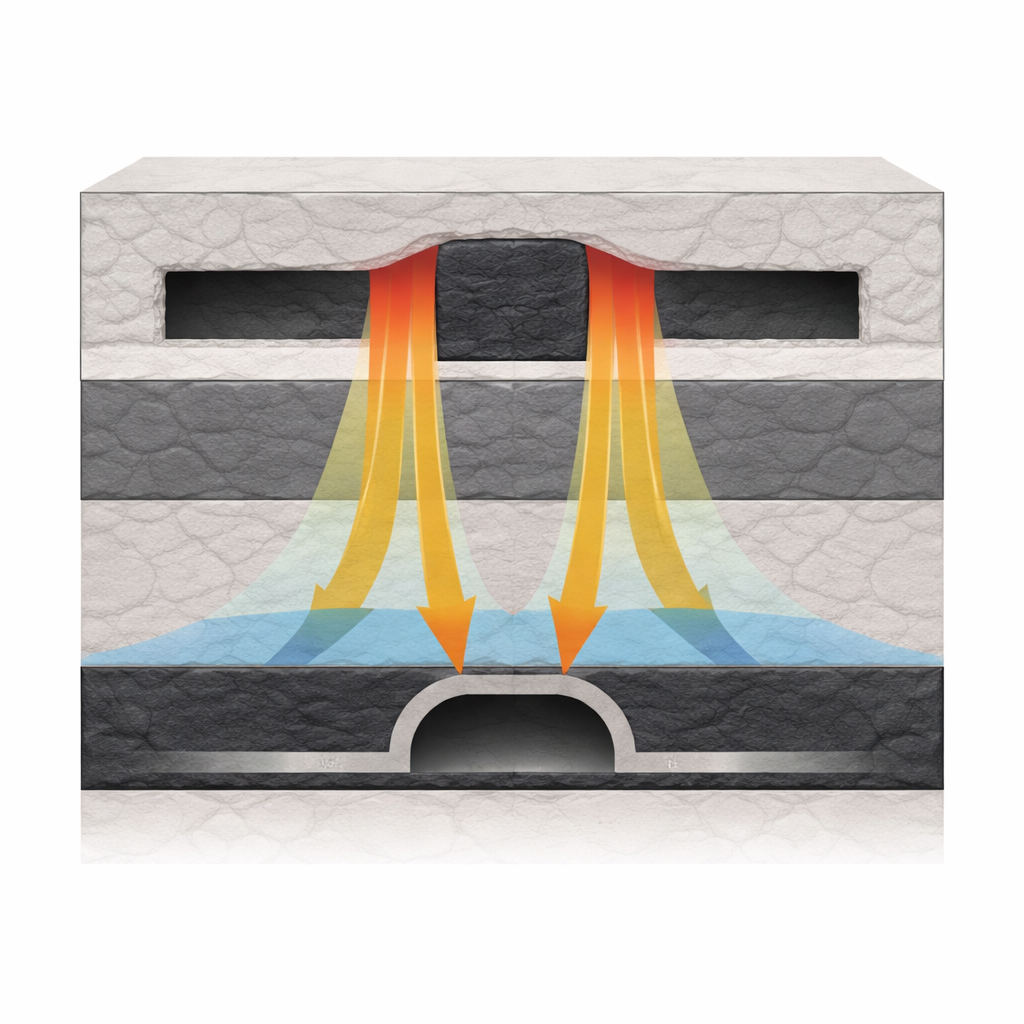
Layers of Rock and Leftover Coal
The researchers focused on a mine in Guizhou Province, China, where an upper seam (called No. 1) has already been mined, leaving a thick, isolated coal pillar between two collapsed, compacted voids (goafs). About 12 meters below lies a thinner lower seam (No. 3), where a new mining roadway must be driven. Because the seams are close together and the mine is deep, the stresses caused by the earlier mining do not simply vanish—they concentrate around the isolated coal pillar and travel downward through the rock, changing how the lower seam behaves. Understanding this pattern is crucial for deciding where to put the roadway so that the surrounding rock deforms gently rather than failing violently.
Mapping Invisible Forces in the Rock
To track how stress moves through the rock beneath the pillar, the team combined three approaches. First, they built an analytical mechanical model that treats the rock below the upper seam as an elastic medium loaded by the weight of overlying strata, the coal pillar, and the compacted rubble in the mined-out areas. This model gives formulas for how horizontal, vertical, and shear stresses vary with depth. Next, they used FLAC3D, a widely used numerical simulation program, to create a three‑dimensional digital mine, complete with the upper pillar, goafs, and the lower seam. Finally, they compared these theoretical and numerical results with field observations and measurement data from the real mine. The two methods agreed well, showing strong stress concentration at the edges of the isolated pillar and a characteristic saddle‑shaped stress pattern in the floor rock.
Finding the Calm Zone Beneath the Pillar
The simulations revealed that stress from the isolated coal pillar does not simply press straight down. Instead, it fans out into the floor rock in an inclined fashion and gradually weakens with depth. Close to the upper seam, the differences between the main compressive stresses are large and show a twin‑peak pattern on either side of the pillar’s centerline. Deeper down, this double peak evolves into a single, flatter peak. Notably, at the level of the lower No. 3 seam directly under the middle of the pillar, the difference between the principal stresses is relatively small—significantly lower than under the pillar’s edges or near the goaf boundaries. This means that the rock there is less prone to intense shearing and cracking, suggesting a natural “quiet zone” for roadway placement.
How Roadway Position Changes Rock Damage
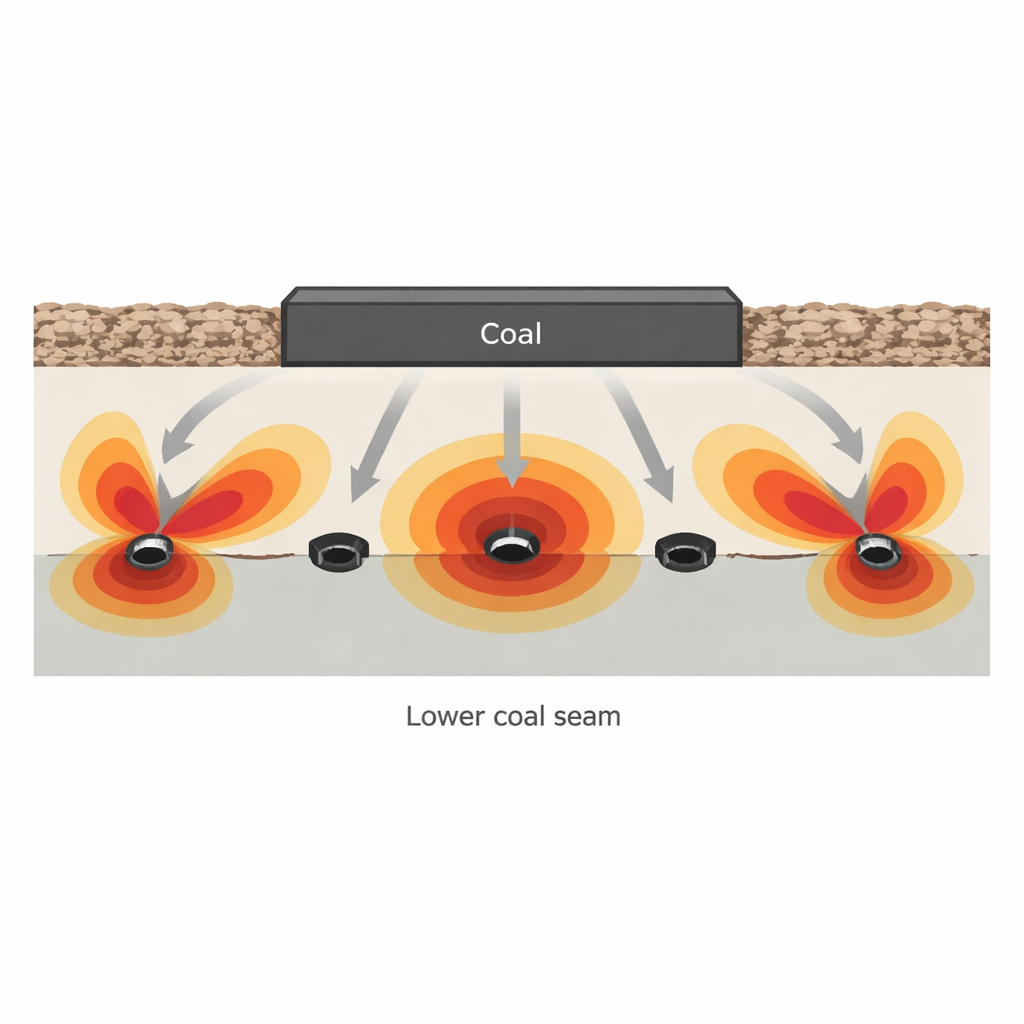
To test how roadway position affects damage, the authors simulated tunnels cut at various lateral offsets beneath the pillar. They examined two related quantities: the deviatoric stress (which drives shape‑changing deformation) and the plastic zone (where the rock has yielded and undergone permanent damage). When the roadway was placed directly beneath the pillar centerline, the pattern of deviatoric stress around it was nearly symmetric, and the plastic zone formed a compact, roughly elliptical halo focused on the roof and sides. As the roadway was moved step by step toward either side, the stress pattern rotated and stretched, and the plastic zone evolved from this tidy ellipse into a distorted, butterfly‑like shape that extended toward the nearby goaf floor. In these off‑center positions, damaged zones linked up with weakened regions above, greatly increasing the risk of large, uneven deformation and making support much more difficult.
Choosing the Safest Roadway Zone
Building on this insight, the researchers used a “butterfly‑shaped failure” framework to divide the potential roadway region into three zones based on two indicators: the ratio of principal stresses and their difference. One zone is dominated by high stress ratio and prone to unstable, butterfly‑type failure; another is strongly affected by both indicators and is the worst choice for roadway layout. The third, called R‑III, corresponds to locations where both stress ratio and stress difference are relatively small. In their case study, this optimal zone lies directly beneath the isolated coal pillar. A roadway excavated there, supported with long roof cables and bolts, showed manageable deformation in field monitoring: roof‑floor closure and side convergence stayed within acceptable limits over a 40‑day observation period. For lay readers, the key message is that by “hiding” the roadway in the calmest part of a complex stress field—right under the pillar rather than beside it—engineers can significantly improve safety and reduce maintenance problems in deep, closely spaced coal seams.
Citation: Shu, S., Wang, W., Liu, C. et al. Study on the mining stress field distribution law beneath isolated coal pillar in close coal seam and reasonable location of the roadway. Sci Rep 16, 12281 (2026). https://doi.org/10.1038/s41598-026-40452-3
Keywords: coal pillar, underground roadway, rock stress, mine stability, numerical simulation