Clear Sky Science · en
Kuroshio Corridor: larval dispersal networks explain geographically independent connectivity among coral habitats in Japan
Why tiny drifters matter for coral survival
Across southern Japan, coral reefs cling to scattered islands that together host some of the richest marine life on Earth. Yet these reefs are under growing pressure from warming seas and other human-driven changes. When corals are damaged, their recovery depends on clouds of microscopic larvae drifting on currents from healthier reefs. This study asks a deceptively simple question with big implications for conservation: how exactly do those baby corals move between islands, and which places quietly hold the network together?
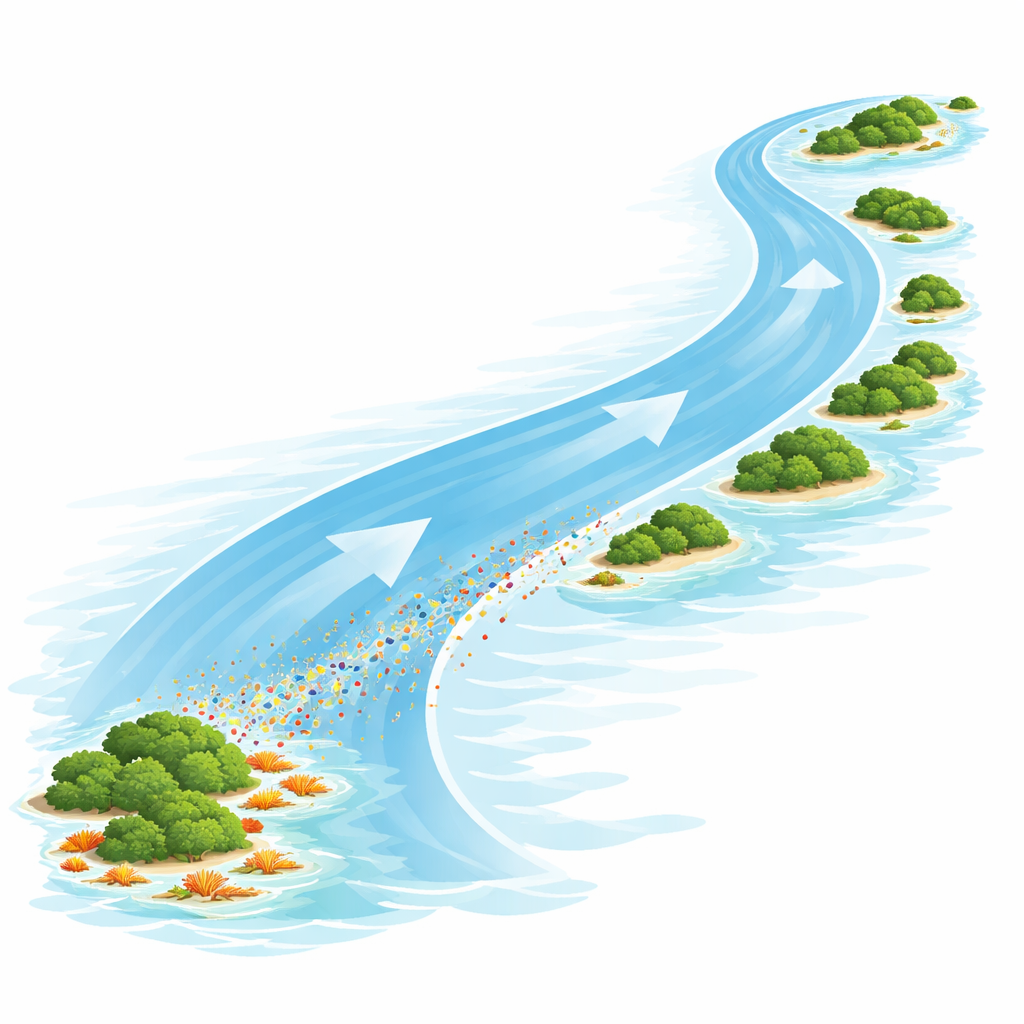
A hidden highway in the sea
The Nansei Islands form an almost straight, 1,000‑kilometer chain stretching from the tropics toward cooler waters. You might expect nearby islands to share more larvae than distant ones, just as towns are better connected to their neighbors than to faraway cities. Earlier genetic work on a common reef‑building coral, however, hinted at a surprise: corals in the far south and far north were closely related, as if joined by an invisible express route that skipped the middle of the chain. Oceanographers suspected the powerful Kuroshio Current—an ocean stream sometimes likened to a western Pacific Gulf Stream—but no one had firmly tied this idea to detailed genetics along the full archipelago.
Following virtual larvae on ocean currents
To trace these pathways, the authors built a computer model that released millions of virtual “larvae” from 68 coral reef locations across the islands. These particles drifted with realistic hourly currents from a high‑resolution ocean model for five recent years. The team tested a range of larval lifespans in the open ocean, paying special attention to about one month after spawning, when coral larvae are still good at settling onto a reef. They then used graph theory—a way of representing reefs as dots and connections as lines—to identify which islands act as crucial connectors in this network.
A corridor that leaps over the middle
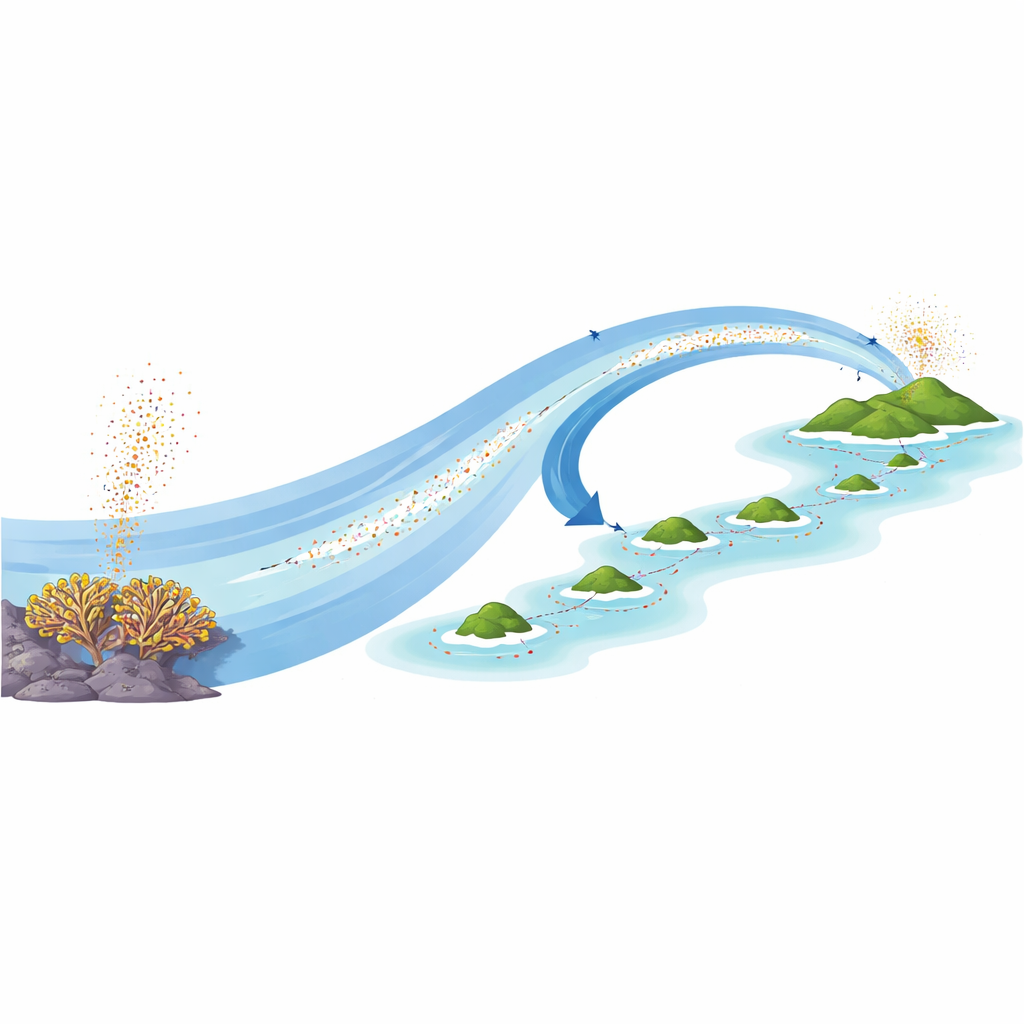
The virtual larvae revealed a striking pattern. Many particles released from the southern Sakishima Islands were swept directly into the fast‑flowing core of the Kuroshio Current. From there, they bypassed the central Okinawa and Amami Islands and arrived more often at the distant Osumi Islands in the north than at those closer, central reefs. In numbers, larvae were more than six times likelier to make the end‑to‑end journey than to settle in the middle. At the same time, the current formed a barrier in the opposite direction: larvae from the northernmost islands almost never crossed southward. The authors name this one‑way, long‑distance pathway the “Kuroshio Corridor,” a kind of marine highway linking the archipelago’s opposite ends while skipping stops in between.
Genes confirm the ocean map
Next, the researchers compared these model predictions with real genetic data from Acropora digitifera corals collected across the islands. Genetic differences between sites were generally small, indicating ongoing exchange of larvae over hundreds of kilometers. Importantly, these differences lined up better with the model’s estimated larval connections than with simple geographic distance. In other words, how strongly two reefs were linked genetically depended more on whether the modeled currents carried larvae between them than on how far apart they sat on a map. The match was especially strong when the team considered rare, long‑lasting larvae that survive for many weeks and can make epic journeys—just a few such migrants per generation are enough to keep populations genetically connected.
Hidden stepping stones for conservation
Within this corridor, some islands emerged as quiet linchpins. Using network metrics, the authors found that Kume Island—located near Okinawa but not inside any national park—plays an outsized role as a stepping stone, helping larvae reach many other sites even though it is not the biggest source or sink itself. Other central islands showed high importance when both the number and variety of connections were considered. These results suggest that traditional conservation plans, which often focus on spectacular reefs or simple distance‑based “spreading out” of protected areas, may miss less glamorous but structurally vital reefs that keep the whole system connected.
What this means for protecting reefs
By marrying physics‑based ocean models with coral DNA, this study shows that a fast, narrow current can stitch together far‑flung reefs while leaving some nearer ones comparatively sidelined. The Kuroshio Corridor helps explain why corals at the southern and northern tips of the Nansei Islands share so much genetic material, and it highlights key stepping‑stone islands, like Kume, whose protection could benefit reefs many hundreds of kilometers away. For policymakers and local communities, the message is clear: safeguarding coral reefs in this region means planning around invisible pathways in the sea, not just lines on a map.
Citation: Saito, N., Kise, H., Nakajima, Y. et al. Kuroshio Corridor: larval dispersal networks explain geographically independent connectivity among coral habitats in Japan. Sci Rep 16, 11757 (2026). https://doi.org/10.1038/s41598-026-40448-z
Keywords: coral connectivity, ocean currents, larval dispersal, Kuroshio Current, marine conservation