Clear Sky Science · en
A practical ML framework for biomass torrefaction analysis and simulator deployment
Turning Farm Waste into Better Fuel
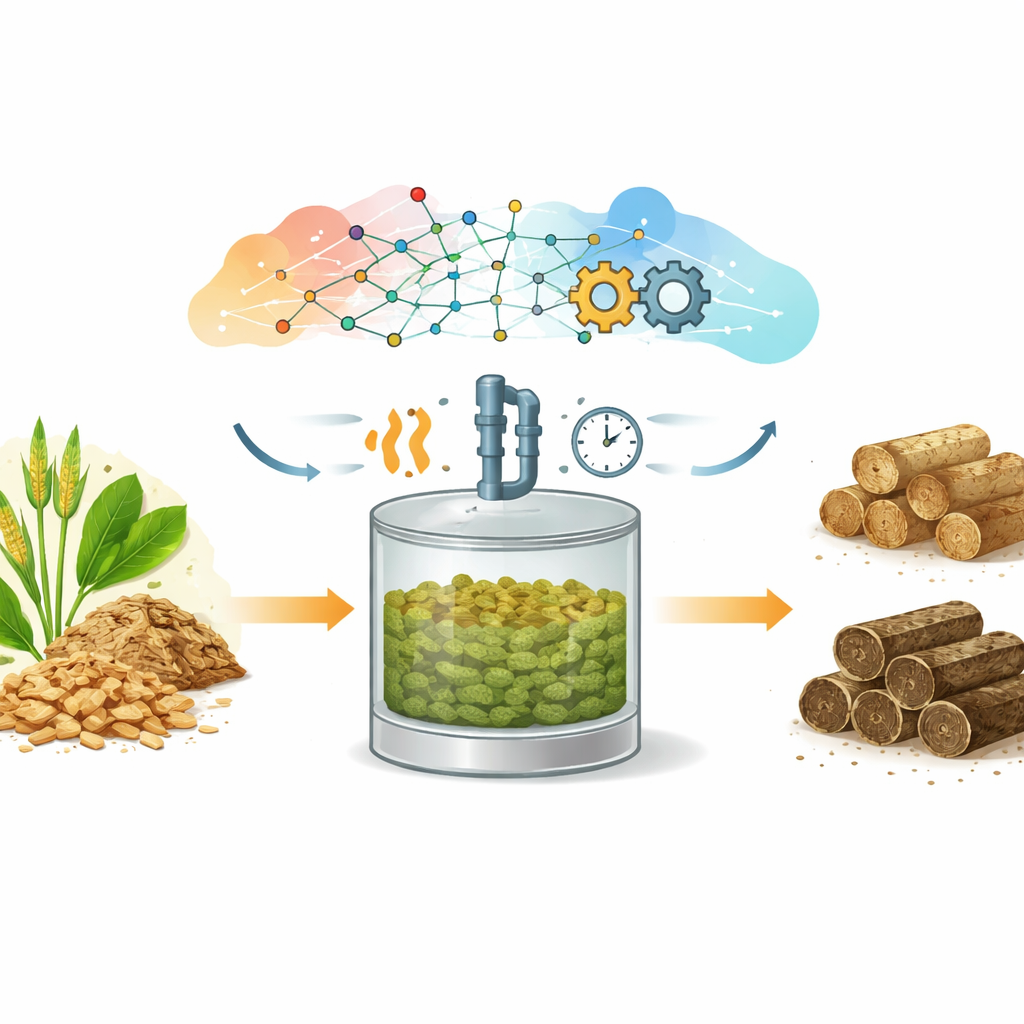
As the world looks for ways to cut fossil fuel use, mountains of agricultural and forestry leftovers are piling up. These plant residues can be burned for energy, but in their raw form they are bulky, damp, and burn poorly. This study shows how modern machine learning can help transform such waste into a cleaner, denser solid fuel by fine-tuning a gentle heating step called torrefaction, and then wraps that intelligence into an easy-to-use simulator for engineers and plant operators.
Why Tuning the Heat Really Matters
Torrefaction gently “toasts” biomass at a few hundred degrees Celsius in the absence of oxygen. Done well, it drives off water and some light components, leaving a darker, drier material that stores and burns more like coal. But operators face a stubborn dilemma: hotter and longer treatment makes the fuel richer in energy, yet also reduces how much solid material remains. Balancing this trade-off between mass yield (how much solid product you keep) and energy density (how much heat it releases) has traditionally required lengthy, trial-and-error testing for each new feedstock. Simple equations exist, but they often miss the complex, nonlinear ways that plant composition, temperature and time interact in real systems.
Feeding Real Experiments into Smart Models
The authors tackled this problem by assembling nearly 800 real measurements from torrefaction experiments on a wide range of agricultural and forestry residues. For each case they gathered process conditions such as temperature and reaction time, and fuel properties such as carbon, hydrogen, oxygen and ash content, along with basic combustion measures. They then engineered additional inputs that combine these quantities, like ratios of elements and products of temperature and time, to better reflect how torrefaction actually proceeds. Outliers were carefully removed using standard statistical tests, so that obviously inconsistent measurements would not mislead the models.
Letting Algorithms Learn the Patterns
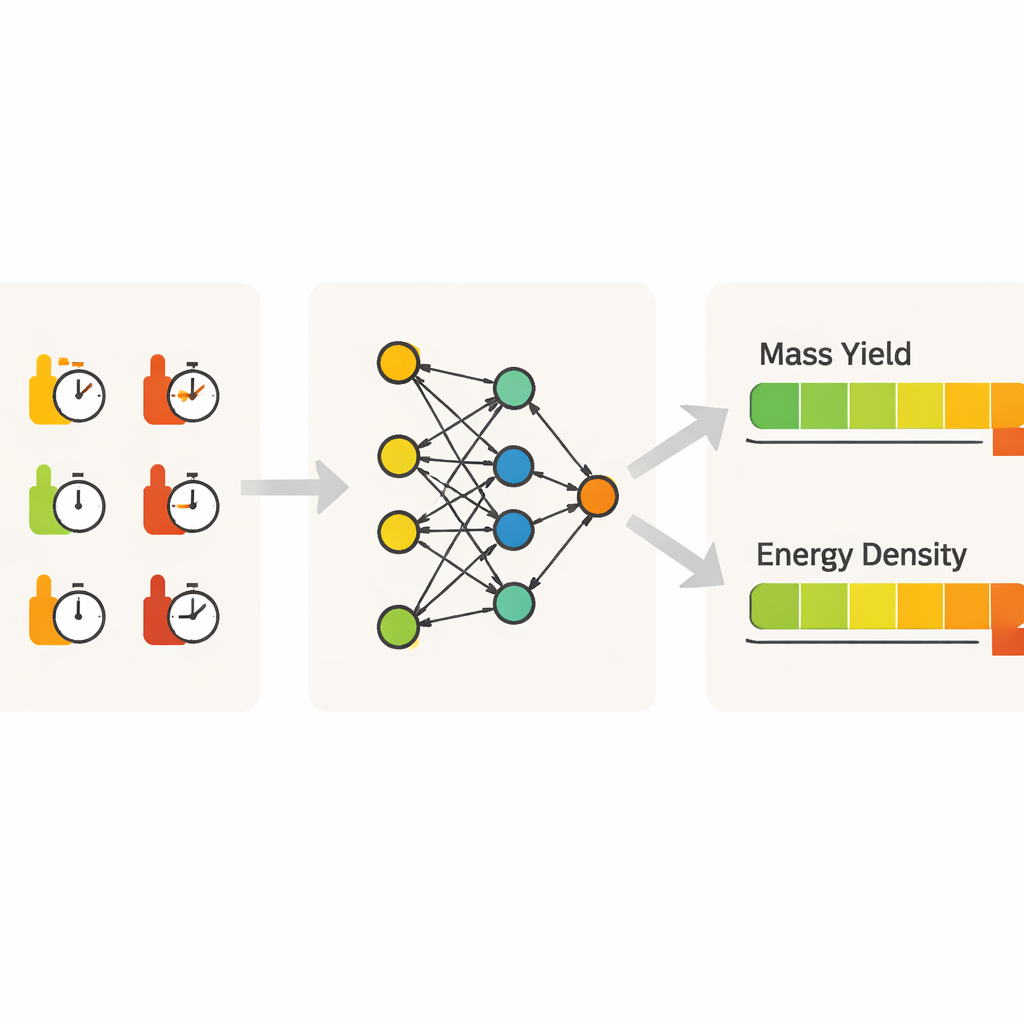
With this cleaned and enriched dataset, the team compared nine different machine learning approaches for predicting both mass yield and higher heating value, a standard measure of fuel energy content. They included familiar linear fits, more flexible tree-based ensembles, boosting methods that stack many simple models, and support vector machines with curved decision boundaries. Each method was tested in basic form and again after a careful search over key settings such as tree depth and learning rate. To go beyond raw accuracy scores, the authors used a modern explanation tool called SHAP on the tree-based models to see which inputs most strongly drove the predictions and in which direction.
What the Models Discovered About the Fuel
The analysis revealed that how much carbon, fixed carbon and volatile material a sample contains—and how these change with temperature and time—largely governs both yield and energy content. For mass yield, a higher ratio of hydrogen to carbon, along with moderate temperatures and shorter times, tended to preserve more solid material; very high temperatures consistently pushed yield down. For heating value, carbon-related variables had the strongest positive influence, while oxygen-rich components generally reduced energy density. Linear methods struggled to capture these intertwined effects, and support vector machines remained hard to interpret and less accurate. By contrast, modern tree-based ensembles and boosting models, especially CatBoost, reproduced the experimental trends with high reliability on unseen data while offering stable and intuitive importance rankings for the input variables.
From Equations to a Practical Control Panel
Rather than stopping at accuracy numbers, the researchers packaged their best-performing models into a graphical simulator built with a lightweight web framework. Users can type in their planned torrefaction conditions and biomass properties, and instantly see the predicted mass yield and heating value. The tool can scan across temperature and time ranges to draw simple decision maps that reveal where two basic targets are met at once: keeping at least 60% of the solid mass, and reaching an energy content comparable to lower-grade coal. Instead of pointing to a single "optimal" point, the simulator highlights a band of feasible operating choices that users can navigate based on their own cost, time or emissions priorities.
What This Means for Cleaner Energy
In plain terms, the study shows that machine learning can turn scattered torrefaction data into a dependable guide for turning plant waste into better solid fuel. By learning how composition, heat and time jointly shape both how much material remains and how much energy it holds, the models help operators avoid blind experimentation. Wrapped in a simple simulator, this framework lets practitioners explore realistic, coal-like fuel options from residues while keeping losses in check. The result is not a black-box replacement for engineering know-how, but a practical decision aid that tightens the link between lab measurements, process settings and real-world low-carbon fuel production.
Citation: Park, S., Yang, J., Kim, S. et al. A practical ML framework for biomass torrefaction analysis and simulator deployment. Sci Rep 16, 13141 (2026). https://doi.org/10.1038/s41598-026-40442-5
Keywords: biomass torrefaction, machine learning, bioenergy, solid biofuels, process optimization