Clear Sky Science · en
Influence mechanism of thick hard layer on fracture and energy release characteristics of composite roof
Why roof rocks matter for mine safety
Deep coal mines do not just rely on steel supports to stay open—the natural rock layers above the coal seam act as the mine’s "roof." When these layers bend and break, they can suddenly release large amounts of energy, sometimes triggering violent rockbursts that endanger workers and equipment. This paper explores how a single thick, hard rock layer hidden in that roof can quietly store energy and then fail in a snap, turning an otherwise manageable roof into a dangerous one.
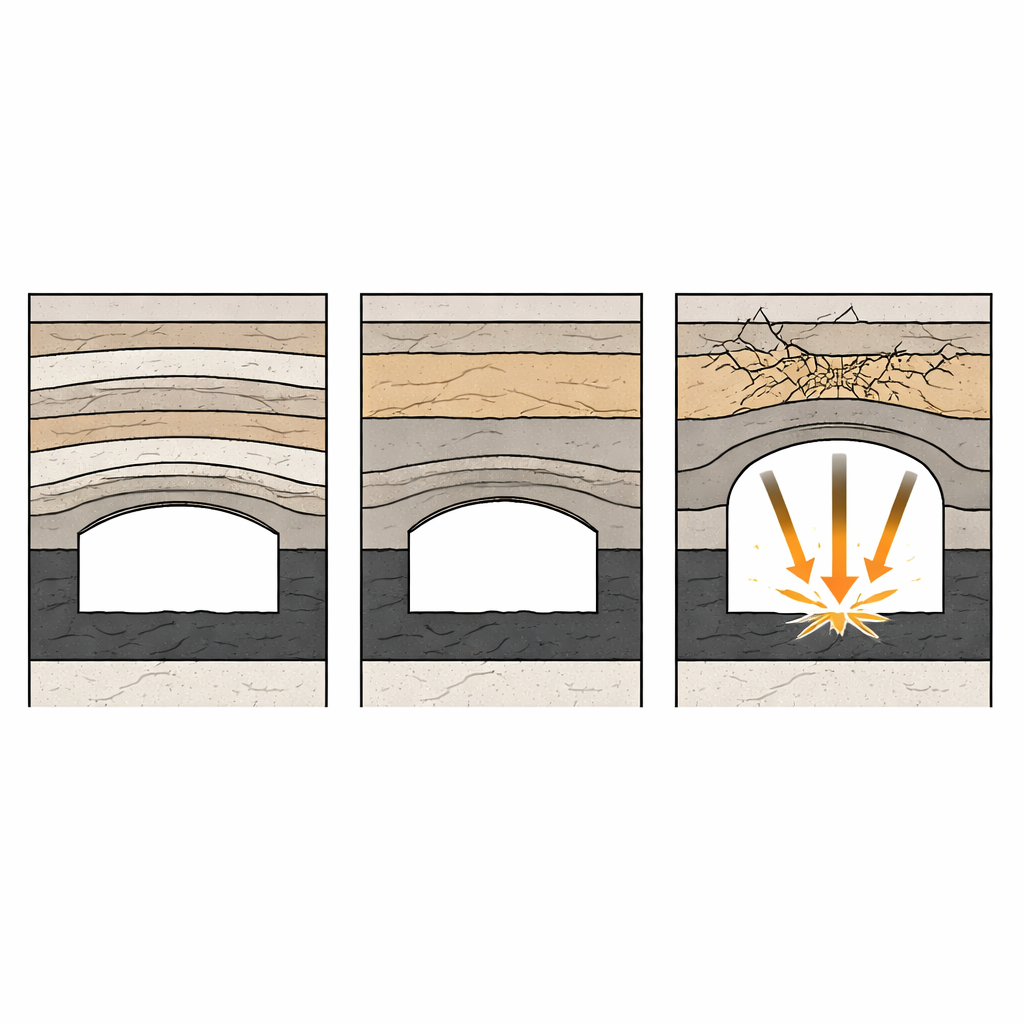
Stacks of rock above a coal seam
Above many coal seams, the roof rock is built like a layer cake, with softer and harder rocks stacked together. In China’s deep mines, engineers have noticed that rockbursts often occur where there is a particularly thick and strong rock layer embedded in this stack. The authors set out to understand exactly how such a layer changes the way the layered roof bends, cracks, and releases energy. They combined controlled laboratory tests on small rock beams with detailed field observations in an actual mine to connect what happens on the workbench with what happens hundreds of meters underground.
laboratory beams that mimic a mine roof
In the lab, the team created miniature “roofs” by bonding blocks of two real roof rocks from a coal mine: a stronger fine sandstone and a weaker limestone. Each composite beam had the same total height, but the proportion and position of the thicker hard layer were changed from specimen to specimen. The beams were then bent using a three-point loading device, while two advanced tools watched them fail: a digital speckle imaging system tracked surface deformation, and acoustic emission sensors recorded tiny cracking sounds inside the rock, revealing when and where fractures formed.
How a thick hard layer changes breaking behavior
The tests showed that a thick hard layer does not just make the roof stronger—it changes how it breaks. When no thick hard layer was present, the beams behaved in a relatively simple way: they bent, slipped slightly along the interface between layers, and then fractured in one quick, brittle event. Their load–time curves had a single peak, and most of the energy was released only at the final break. By contrast, when a thick hard layer was included, the breaking process unfolded in four stages: smooth overall bending, cracking of the weaker rock layer, a stress “reshuffling” period as load shifted into the hard layer, and finally a sudden, unstable fracture of the entire beam. On graphs, this appeared as a clear double peak—first the soft part failed, then the hard part snapped.
Energy build‑up and crack patterns
Acoustic emission data revealed that beams with thick hard layers stored and released far more energy than those without. Not only were the total energy and number of high‑energy signals much higher, but the explosive final stage was dominated by strong tensile cracking inside both rock layers. Imaging and crack localization showed that initial cracks always began in the weaker rock, regardless of whether it sat on top or below. The way the layers bent against each other produced two distinct deformation styles: in some combinations the layers separated (delamination), while in others they squeezed together in the middle (compaction). Where a thick hard layer was present, the final break happened so fast—within a tenth of a second—that cameras could not capture the full crack path, echoing the sudden nature of rockbursts in real mines.
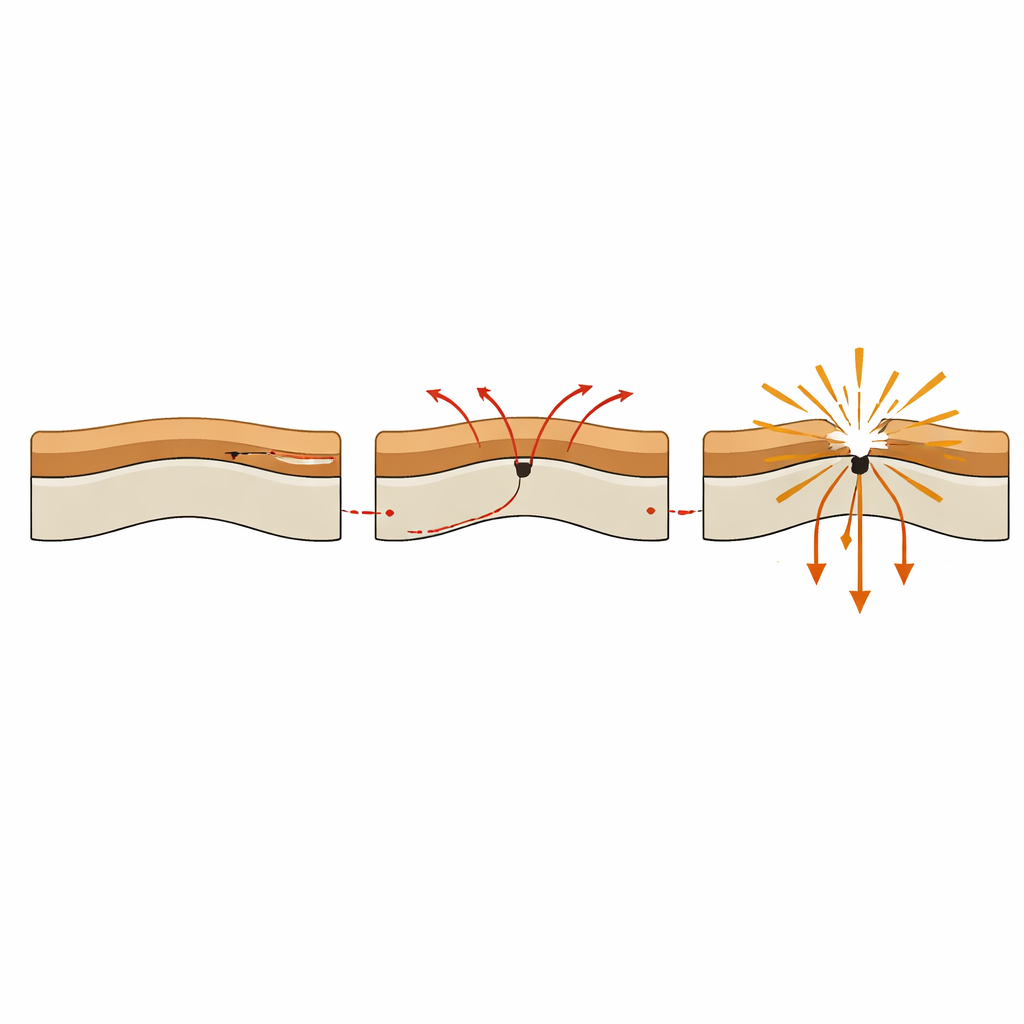
Real‑mine observations that match the lab
To test whether their small‑scale findings applied underground, the researchers investigated a deep coal face in Tangshan Mine. There, the roof is made of alternating soft sandy mudstone and harder sandstones, forming both soft‑over‑hard and hard‑over‑soft combinations similar to the lab beams. Boreholes drilled from a roadway allowed the team to watch how cracks developed as mining advanced. They observed two main failure styles along layer interfaces: delamination, where the rock pulled apart, and dislocation, where layers slid past each other. Which one occurred depended on how the soft and hard rocks were stacked—just as the laboratory beams had suggested. Areas involving thicker, harder layers showed more severe cracking and greater movement, pointing to higher rockburst risk.
What this means for safer mining
For a layperson, the takeaway is that a single thick, strong rock layer in a mine roof can act like a stiff spring: it quietly accumulates bending energy as mining progresses and then releases it in a violent snap. This study shows that such layers not only raise the roof’s peak strength, but also sharply increase the energy stored and suddenly released when failure finally comes. Understanding where these thick hard layers lie, how they are combined with softer rocks, and how they might fracture gives engineers a clearer basis for predicting dangerous events and designing measures—like controlled weakening or improved support—to prevent catastrophic rockbursts.
Citation: Song, Xs., Wang, Zq., Zhang, Pf. et al. Influence mechanism of thick hard layer on fracture and energy release characteristics of composite roof. Sci Rep 16, 10395 (2026). https://doi.org/10.1038/s41598-026-40432-7
Keywords: rockburst, mine roof, hard rock layer, energy release, coal mining safety