Clear Sky Science · en
Depressurization-based reinjection method for low-permeability sandstone geothermal reservoirs
Why Tapping Earth’s Heat Can Be So Hard
Geothermal energy promises steady, low-carbon heat drawn directly from the Earth. Yet in many places the underground rocks that store this hot water act like a tight sponge, making it difficult to push cooled water back down after use. This paper explores a new way to manage underground pressure so that reinjecting water becomes much easier and more energy-efficient, opening the door to more reliable geothermal heating in challenging rock formations.
A Tough Underground Setting
The study focuses on a field in Jilin Province in northeastern China, where heat is stored in deep sandstone roughly two kilometers below the surface. These rocks have very small pores and poor connectivity, so water flows through them only with difficulty. Even after engineers improved the rock with hydraulic fracturing, the wells could only accept reinjected water at pressures high enough to strain surface pumps and raise operating costs. Similar problems in low-permeability sandstone reservoirs worldwide limit how much geothermal energy can be used without damaging wells or the surrounding rock.
A Simple Shift in Strategy
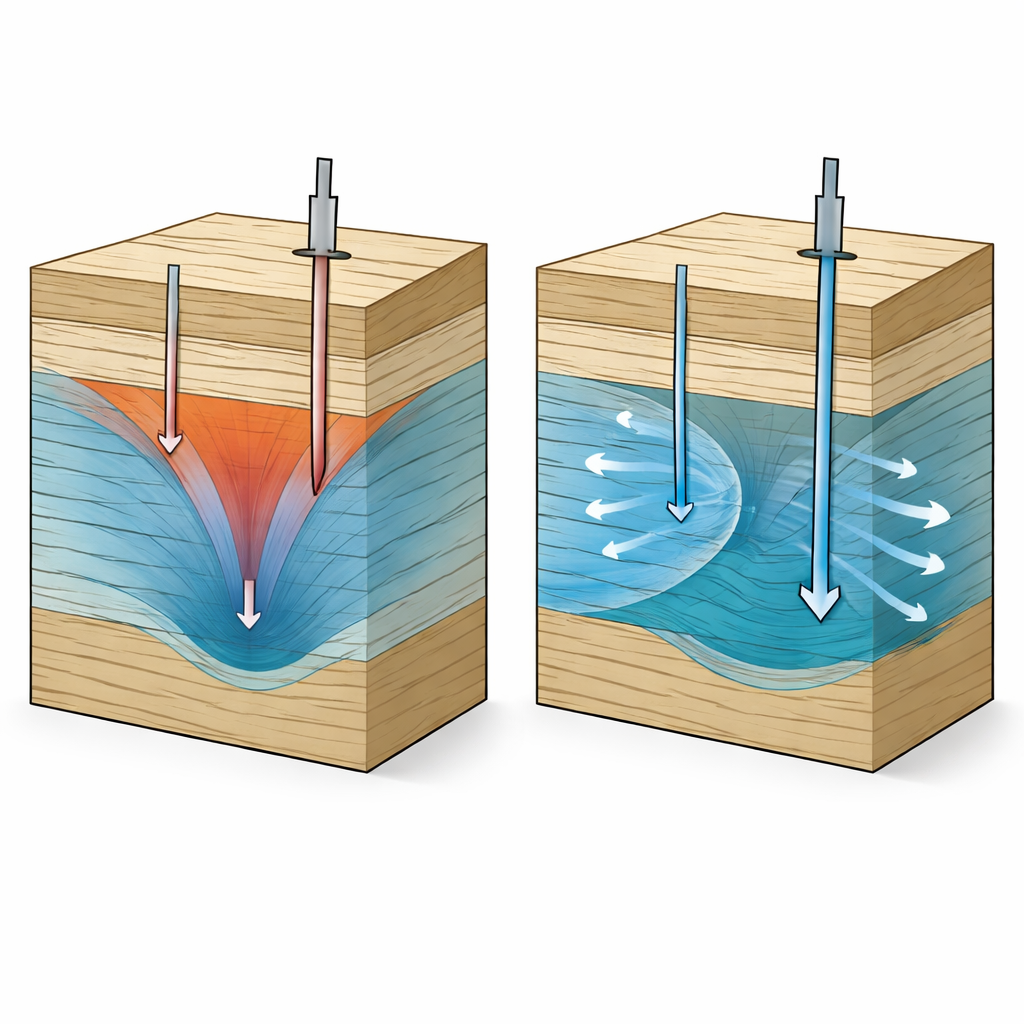
Instead of fighting high pressures at the reinjection well, the authors propose reshaping the pressure field in the reservoir before reinjection begins. Their method has two stages. First, they pump hot water out of a production well at a controlled rate for about a year, gently lowering pressure in an elongated zone around that well—much like creating a broad, shallow bowl underground. Second, they start reinjecting cooler water from a nearby well while continuing production at a steady, lower rate. Because the reinjection well now “sees” a nearby low-pressure zone, water can flow into the rock more easily, slashing the extra pressure needed at the surface.
Building and Testing a Virtual Reservoir
To test this idea, the team built a detailed three-dimensional computer model of the Jilin reservoir using real well tests, fracture measurements, and rock property data. The model tracks both fluid flow and heat transfer, following standard physics for how water moves through porous rock and how it carries heat. They validated the model by comparing simulated water levels and reinjection pressures over two years with actual field measurements from a pair of wells. The close match between simulations and reality gave them confidence to explore longer time spans and alternate operating strategies that would be difficult or expensive to try directly in the field.
Finding the Sweet Spot for Flow and Spacing
With the virtual reservoir in hand, the researchers varied two key design knobs: how hard to pump during the initial depressurization stage, and how far apart to place the production and reinjection wells. Higher early pumping rates created a larger, deeper low-pressure cone that stretched toward the reinjection well, sharply reducing the later pressure needed to push water back underground. At a depressurization rate of about 600 cubic meters per day and a well spacing of 250–300 meters, the required reinjection pressure dropped by more than 80 percent compared with the usual “start injecting immediately” approach. Pumping even harder would lower pressures further but risks squeezing the rock and reducing its ability to transmit water, so the authors highlight this intermediate rate as a practical compromise. Changing well spacing also changes how strongly the two wells interact: too close and the pressure drop becomes excessive; too far and the wells barely influence each other. The simulations point to 250–300 meters as a spacing that maintains strong hydraulic connection without over-stressing the rock.
Keeping the Heat While Moving the Water
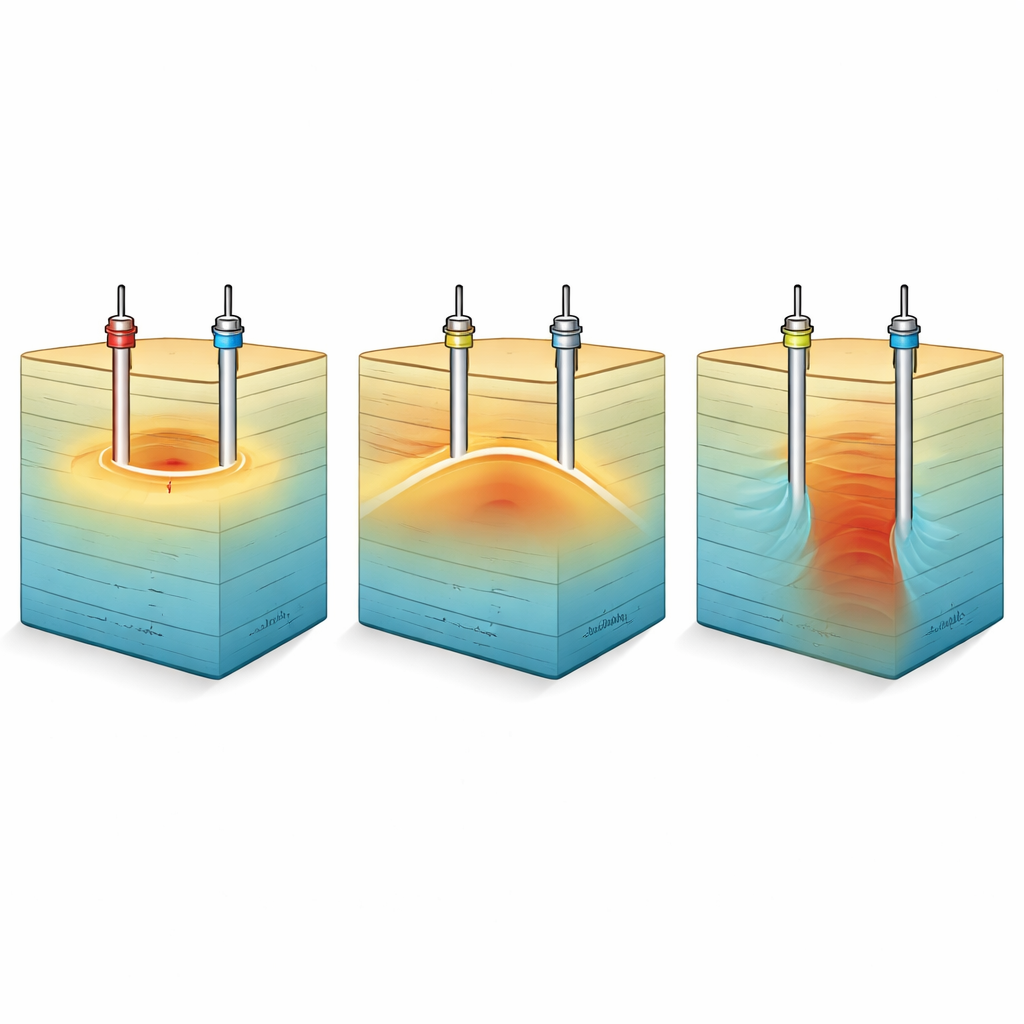
Lowering pressure might raise concerns about cooling the reservoir too quickly. The coupled flow-and-heat model shows that, under the recommended operating plan, the temperature of produced water falls by less than half a degree Celsius over five years—small enough that no rapid thermal “breakthrough” is expected. During the early, higher-rate production stage, the system delivers around 1.5 megawatts of thermal power, then about half that once production and reinjection settle into balance. Because the cooled water is returned underground through a closed loop, the approach supports both pressure management and long-term heat extraction.
A Gentler Way to Use Deep Heat
For non-specialists, the main message is that small changes in how and when we produce hot water from deep rocks can have a big impact on how easily we can put it back. By first creating a controlled low-pressure zone around the production well, this depressurization-based method turns a stubborn, tight sandstone reservoir into one that accepts reinjected water with much less effort. In practical terms, that means lower pumping energy, reduced equipment stress, and more reliable, long-lived geothermal systems. The study also offers a design toolkit—combining field data and simulations—that can be applied to similar low-permeability reservoirs worldwide, helping to make geothermal energy a more accessible part of the clean energy mix.
Citation: Lu, M., Li, Z., Chen, L. et al. Depressurization-based reinjection method for low-permeability sandstone geothermal reservoirs. Sci Rep 16, 10366 (2026). https://doi.org/10.1038/s41598-026-40426-5
Keywords: geothermal energy, sandstone reservoir, reinjection pressure, depressurization method, reservoir modeling