Clear Sky Science · en
Decomposition dynamics and nutrient release of walnut orchard litter in the Taihang Mountains, China
Why fallen walnut leaves matter to your table
When we think about a good walnut harvest, we usually picture pruning, irrigation, or fertilizer bags—not the carpet of leaves, green husks, and dangling catkins that cover the orchard floor. Yet this “litter” quietly feeds the soil, shapes long‑term fertility, and helps determine how many nuts an orchard can produce. This study from China’s Taihang Mountains asks a simple but far‑reaching question: how fast do different kinds of walnut litter break down, and how reliably do they return nutrients to the soil that trees depend on?
What the researchers watched on the orchard floor
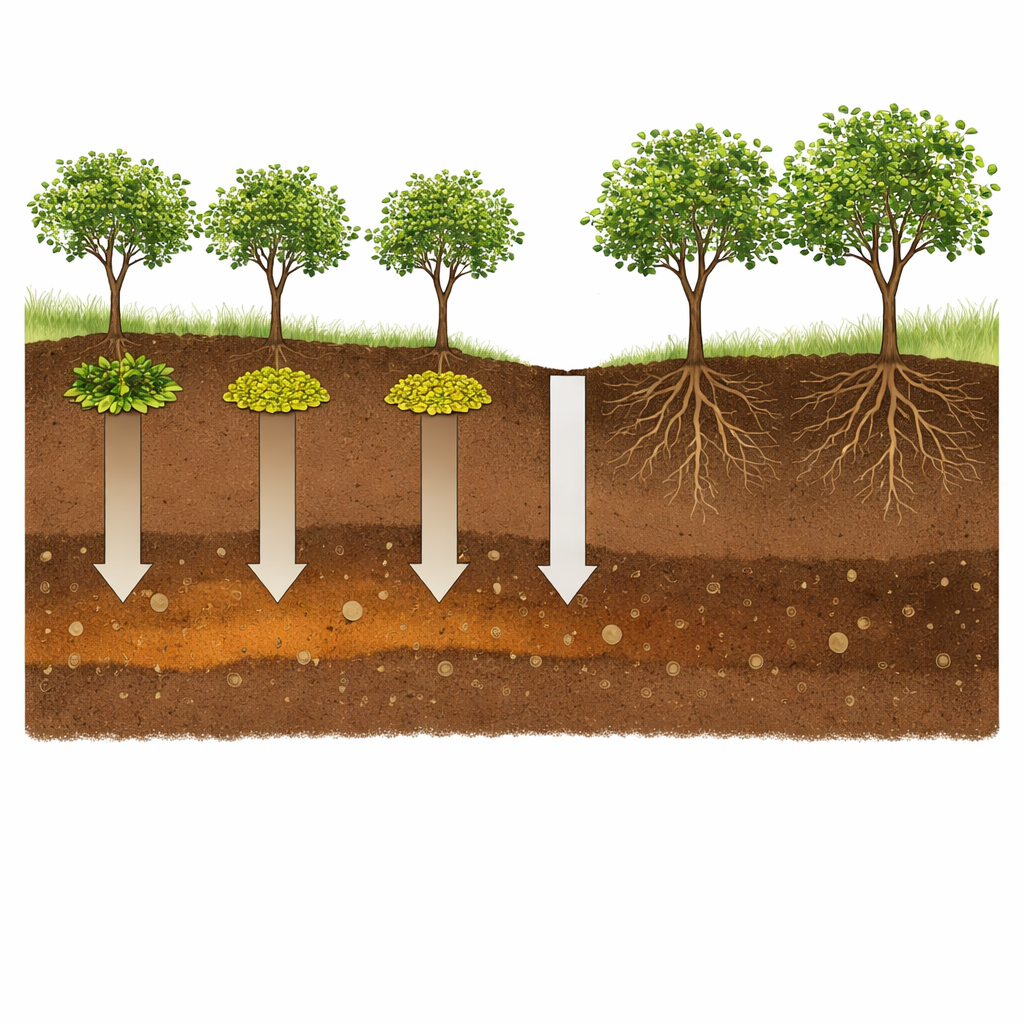
The team focused on three common leftovers from walnut trees: fallen leaves, the thick green husks that surround the nuts, and the male flower clusters (inflorescences) that drop after spring pollination. They filled fine mesh bags with set amounts of each material and laid them on the soil beneath 13‑year‑old walnut trees in a commercial demonstration orchard. Over 300 days—roughly a full growing season plus winter—they collected bags every two months, dried what remained, and measured how much mass and which nutrients were left. They tracked major nutrients important for tree growth (carbon, nitrogen, phosphorus, potassium), several trace metals, and lignin, the tough woody component that usually slows decay.
How quickly each type of litter disappeared
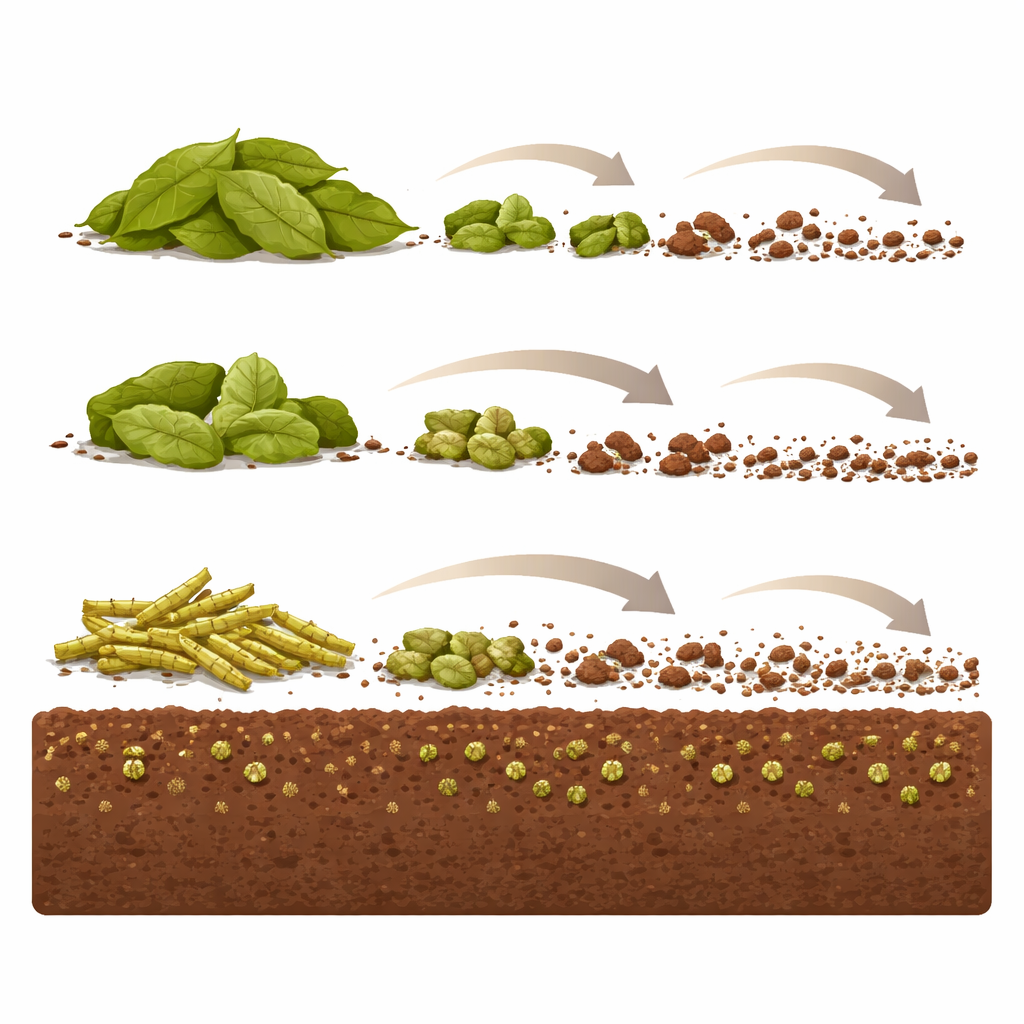
The three litter types did not rot at the same pace. After about 10 months, leaves still retained nearly two‑thirds of their original mass, husks a bit over one‑third, and the delicate male flower clusters only about one‑fifth. Most of the breakdown happened in the first 120 days, spanning late spring to early autumn, when temperatures were mild and microbes in the soil were especially active. After this turning point, the decay curves flattened and the remaining material decomposed much more slowly. Using a standard decay model, the researchers estimated that it would take about 0.4 years for half of the male flower litter to decompose, 0.5 years for the husks, but around 1.3 years for the leaves; reaching 95% breakdown would take several years, especially for leaves.
What happened to the nutrients locked in litter
As the litter decayed, nutrients did not leak out in a simple, straight line. Overall, by the end of the 300‑day period, carbon, nitrogen, phosphorus, potassium, and lignin had all undergone a “net release” from each litter type into the surrounding soil. But along the way, their levels in the remaining litter sometimes rose before falling again. This temporary enrichment can happen when microbes pull nutrients from the soil into the litter as they feed, or when easily washed‑out substances leave behind more resistant material. Trace elements such as iron, copper, zinc, and manganese generally followed a similar pattern of gradual release with occasional spikes in concentration, suggesting that they temporarily bind into stable organic complexes before eventually returning to the soil solution.
Why some pieces rot faster than others
The study shows that the “quality” of the starting material strongly shapes how fast it breaks down. The male flower litter began with relatively high nitrogen and a low carbon‑to‑nitrogen ratio, conditions that favor hungry microbes and speed up decomposition. Husks also had more nitrogen than leaves, even though they contained a good deal of lignin, and so rotted faster than the more carbon‑rich, nitrogen‑poor leaves. Statistical tests confirmed that higher nitrogen and lower carbon‑to‑nitrogen ratios were linked to higher decay rates, while very woody, carbon‑heavy material tended to linger. Local climate also mattered: warm, moderately moist conditions during the first four months aligned with the most rapid loss of mass across all litter types.
What this means for walnut orchards and healthy soils
To a lay observer, walnut litter might look like waste to be swept away. This research shows it is better viewed as a slow‑release fertilizer system built by the trees themselves. Husks and male flower litter quickly return large amounts of nutrients that can support new growth, while the more persistent leaves act as a longer‑term reservoir, gradually feeding the soil and helping maintain organic matter. Together, these different decay speeds and nutrient release patterns help keep orchard soils fertile without relying solely on added fertilizers. Understanding which residues decompose fastest, and when they release key nutrients, can guide orchard managers on how much litter to retain and how to time any supplemental fertilization, supporting both stable yields and healthier soils over the long run.
Citation: Zhang, X., Li, D., Chen, L. et al. Decomposition dynamics and nutrient release of walnut orchard litter in the Taihang Mountains, China. Sci Rep 16, 10397 (2026). https://doi.org/10.1038/s41598-026-40404-x
Keywords: walnut orchards, litter decomposition, soil fertility, nutrient cycling, forest ecosystems