Clear Sky Science · en
Virus-mediated changes in insect vector tolerance to a neonicotinoid insecticide
Why this tiny pest matters to farmers
On farms across the western United States, a microscopic virus and a tiny leafhopper team up to threaten sugar beet crops. Growers lean heavily on insecticides to keep the beet curly top virus in check by killing its insect carrier, the beet leafhopper. This study asks a worrying question with big implications for food production: does the virus actually help its insect carrier survive certain insecticides, making chemical control less reliable over time?
A quiet partnership between virus and insect
Beet curly top virus infects many crops, including sugar beets, beans, peppers, and tomatoes. It cannot move on its own; instead, it hitches a ride inside the beet leafhopper as the insect feeds from plant to plant. Once picked up from an infected plant, the virus circulates through the insect’s body and eventually reaches its mouthparts, where it can be passed on during later feedings. Earlier work showed that virus-carrying leafhoppers can live longer and lay more eggs, hinting that the virus may be subtly reshaping its carrier’s biology in ways that favor its own spread.
Testing survival under common farm chemicals
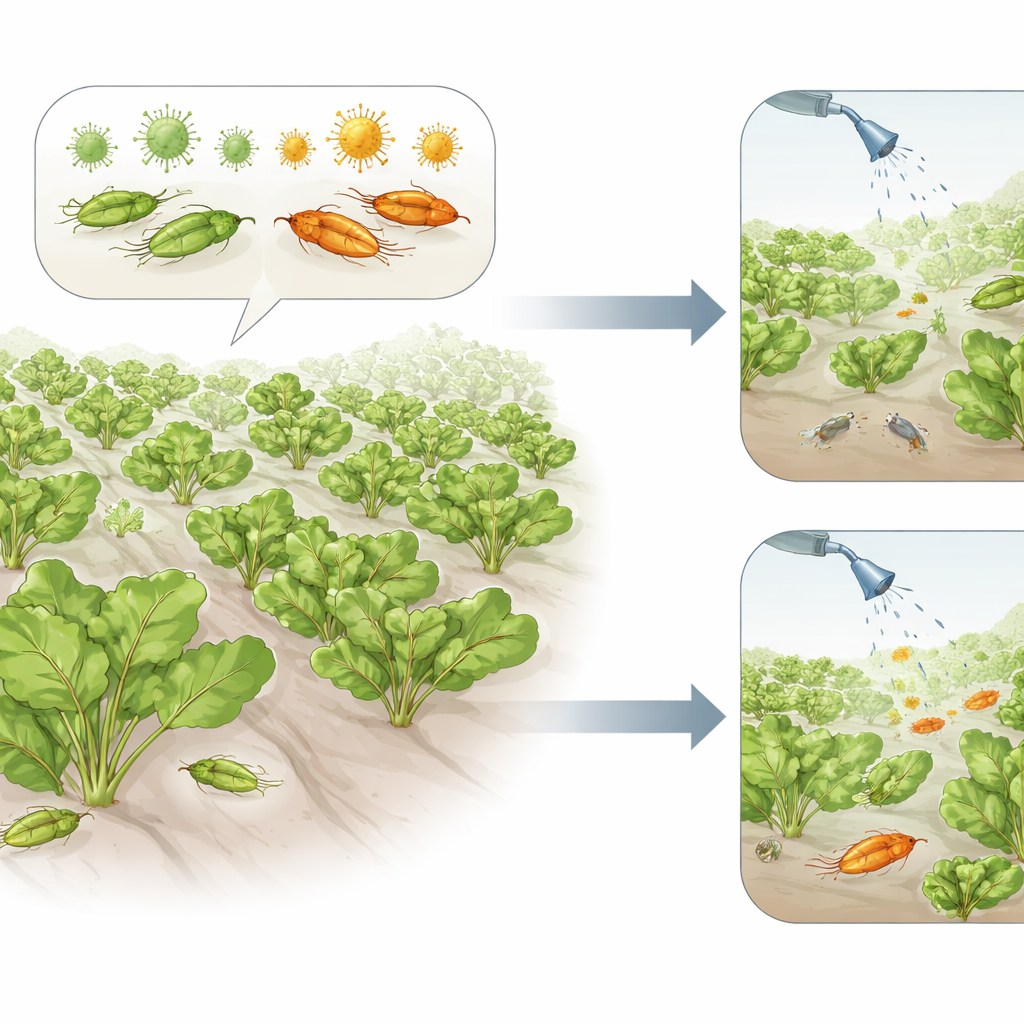
The researchers focused on two major types of insecticides that growers already use: a systemic neonicotinoid, commonly applied as a seed treatment, and a pyrethroid, typically sprayed on plant leaves. They exposed virus-infected and virus-free beet leafhoppers of mixed ages to full-strength (1x), reduced-strength (0.1x), or no insecticide on sugar beet plants. After a week, they counted how many insects were still alive. Virus-carrying insects survived significantly better than virus-free insects when exposed to the reduced-strength neonicotinoid, but not at the full label rate. For the pyrethroid, survival did not differ between infected and uninfected insects at either dose. This shows that the virus can make its carrier more tolerant to a systemic insecticide under mild chemical pressure, while offering no clear advantage under a contact spray.
Looking inside the insect’s molecular toolbox
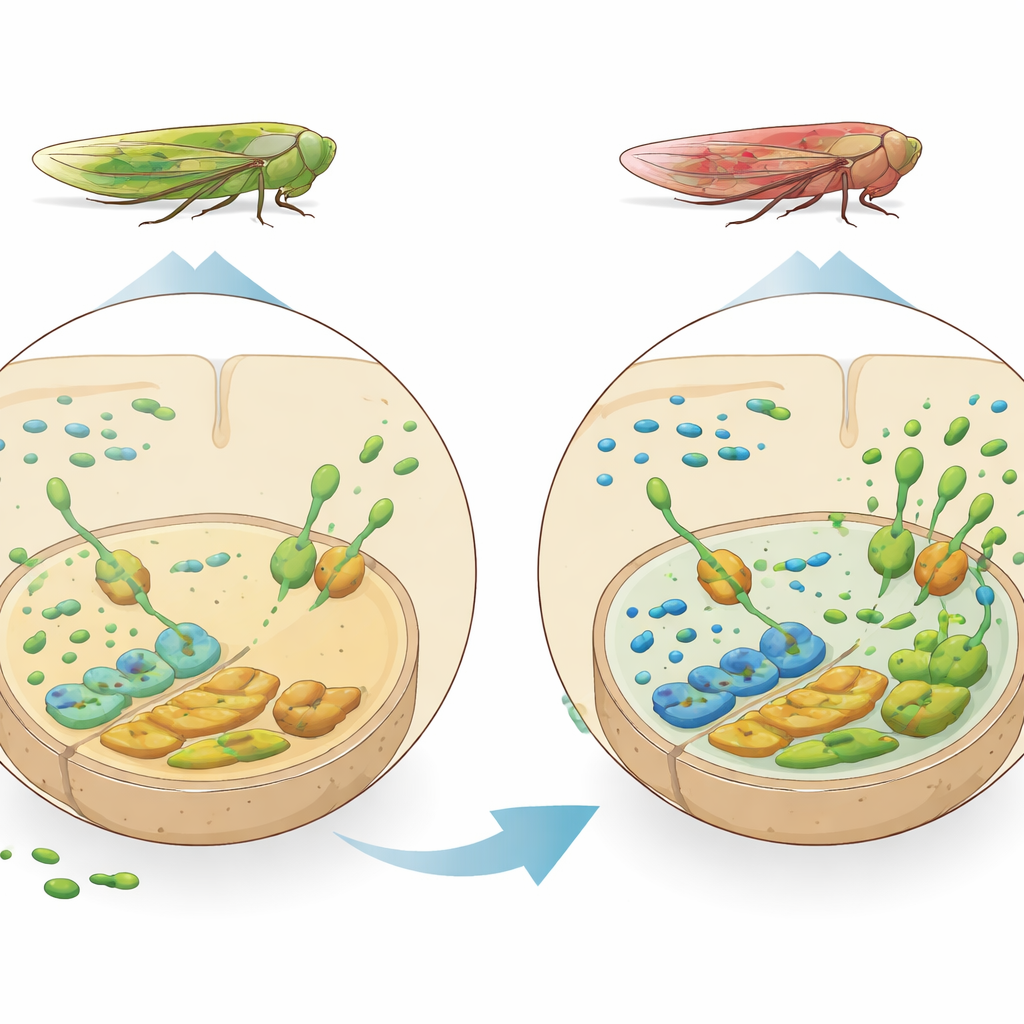
To understand how this extra tolerance arises, the team compared gene activity in virus-infected and virus-free leafhoppers that had all experienced the reduced neonicotinoid dose. Using RNA sequencing, they measured which genes were turned up or down across the insect’s entire genetic “toolbox.” Hundreds of genes changed their activity levels in response to the combination of virus infection and insecticide exposure. Many genes linked to detoxification, waste removal, immune defenses, and stress management were more active in virus-carrying insects. These included families of enzymes known to break down foreign chemicals and proteins involved in tagging damaged molecules for destruction.
Shifting energy from movement to defense
While the leafhoppers’ internal defense machinery was ramped up, many genes tied to muscle function, movement, and the outer body shell were dialed down in virus-infected insects. Genes involved in building the cuticle—the protective outer layer that can slow the entry of contact insecticides—were often less active. Likewise, many genes associated with locomotion and sensory behavior were suppressed. This pattern suggests that the virus does not help its carrier escape insecticides by encouraging it to move away from treated areas or by thickening its outer armor. Instead, it appears to steer the insect toward a strategy that relies on breaking down and expelling chemicals that are taken up through feeding.
What this means for managing crops
Put simply, the study shows that beet curly top virus can make its insect carrier tougher to kill with a commonly used systemic insecticide when doses are low, by priming the insect’s internal detox systems. At the same time, the virus seems to reduce investment in movement and outer-body defenses, pointing to a trade-off shaped by this close partnership. For farmers and pest managers, this means that virus-infected leafhoppers may survive longer under sublethal neonicotinoid exposure, continuing to spread disease and potentially speeding the evolution of insecticide resistance. The findings underscore the need for integrated pest management strategies that do not rely solely on chemicals, but also include resistant crop varieties, crop timing, and habitat management to keep both the insect and the virus in check.
Citation: Schmidtbauer, M., Withycombe, J., Han, J. et al. Virus-mediated changes in insect vector tolerance to a neonicotinoid insecticide. Sci Rep 16, 9988 (2026). https://doi.org/10.1038/s41598-026-40402-z
Keywords: beet leafhopper, beet curly top virus, neonicotinoid tolerance, insecticide resistance, sugar beet pests