Clear Sky Science · en
Absorption, dispersion, and emission characteristics of novel Chitosan blends thin films tuned by UV-Ozone
Light-Tuned Plastics from a Natural Source
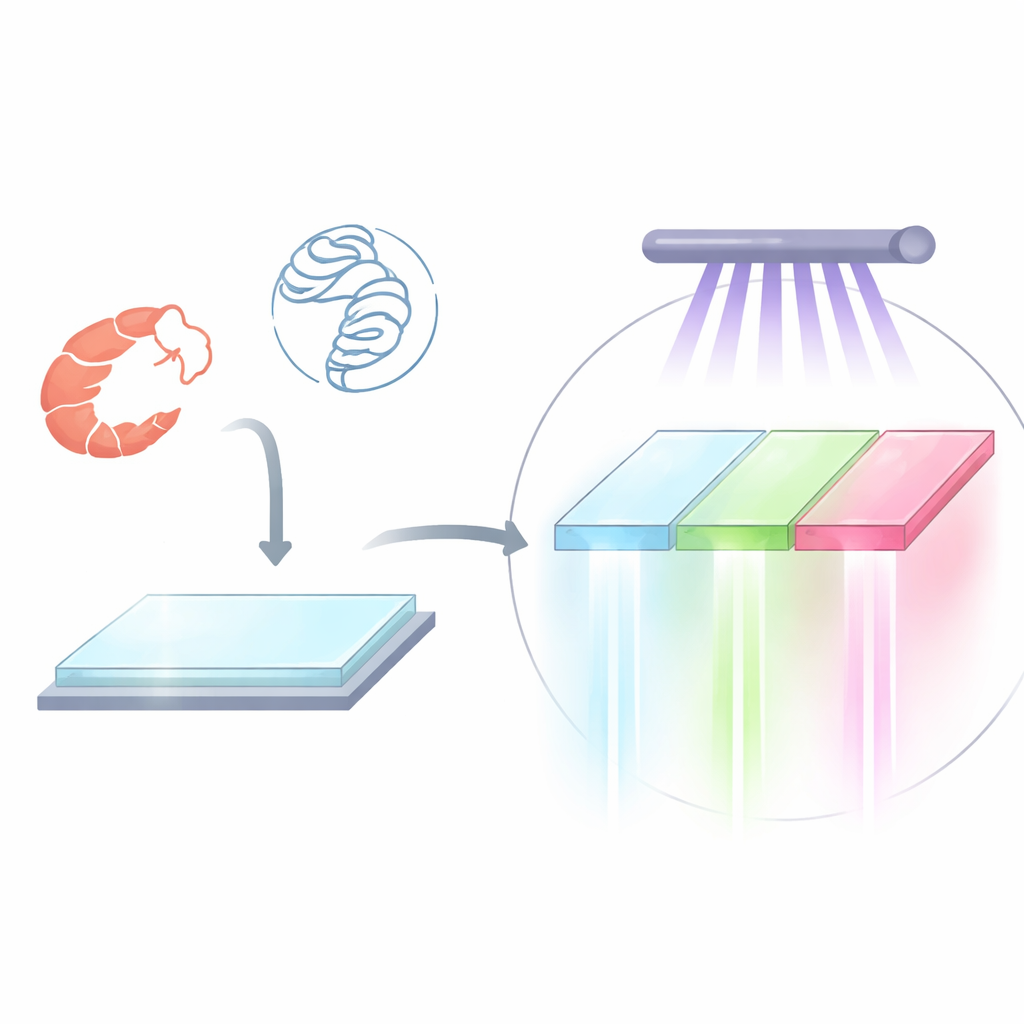
Modern gadgets—from phone screens to smart sensors—depend on materials that can steer light with great precision. In this study, researchers turned to chitosan, a plastic-like substance made from shellfish waste, and showed that its ability to bend, absorb, and emit light can be finely adjusted simply by shining ultraviolet (UV) light on it. This light-controlled tuning could help create safer, more sustainable components for displays, light-emitting devices, and optical switches.
From Shellfish Waste to High-Tech Films
Chitosan is a biopolymer obtained from chitin, the tough material in crab and shrimp shells. It is already valued for being biodegradable and friendly to living tissue, but it also has interesting optical traits. The team synthesized two new chitosan-based polymers and mixed each of them with regular chitosan to form blends. These mixtures were then spun into ultra-thin, glass-like films only about 300 nanometers thick—thousands of times thinner than a human hair—on glass and quartz supports. By comparing pure chitosan films with the two blends, the researchers set out to see how chemical tweaks and UV-ozone exposure reshape the way these films interact with light across a wide range of wavelengths, from deep ultraviolet to the near-infrared.
How UV Light Rebuilds a Thin Film
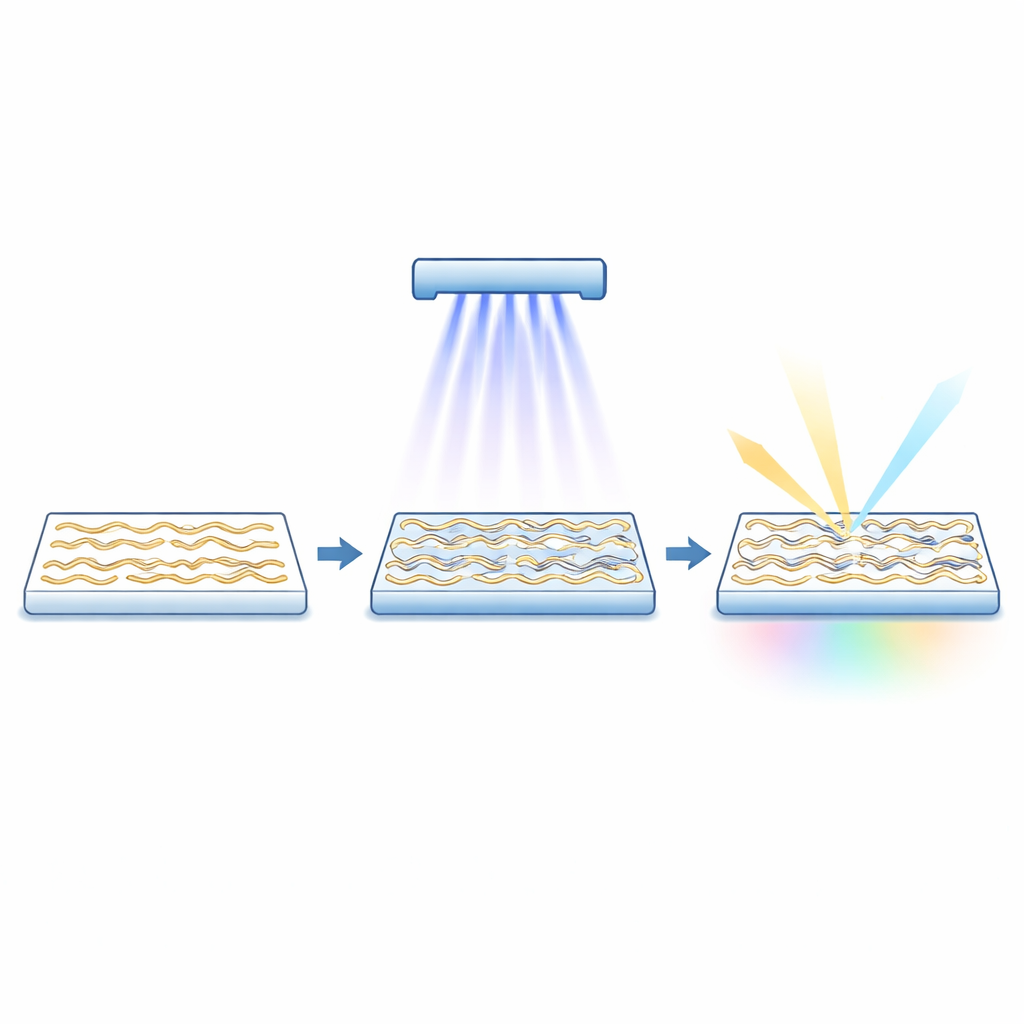
To probe the inner workings of these films, the scientists used tools that reveal both structure and composition. X-ray diffraction showed that all of the materials behave like disordered, glassy solids rather than neat crystals, which is typical for many polymers. Infrared measurements confirmed the presence of new chemical groups in the modified chitosan and revealed that UV-ozone exposure subtly alters bonds, hinting at cross-linking and mild breakdown of some groups. Together, these changes suggest that UV light effectively rearranges the polymer chains: they become more compact and interconnected, which in turn affects how electrons move and respond when light hits the film.
Bending and Absorbing Light on Demand
The key optical tests tracked how much light passes through and reflects from the films, and how strongly they absorb across wavelengths from 200 to 2500 nanometers. After UV treatment, the films generally let more light through, with smoother reflection patterns that point to a more even surface. Crucially, the films’ refractive index—a measure of how much they bend light—rose noticeably in the ultraviolet region, where electronic transitions are active, while changing only slightly at longer wavelengths. At the same time, the energy gap between electron states, which governs how easily a material can absorb light and conduct charge, shrank: for chitosan, it dropped from roughly 5.3 to 4.6 electron volts, and the blends showed even smaller gaps. This narrowing means that less energetic light can trigger electronic activity, a desirable feature for many optoelectronic devices.
Nonlinear Light Effects and White Emission
Beyond ordinary transmission and reflection, the team examined how the films respond to intense light fields, where materials can behave in a "nonlinear" way—changing their refractive index in proportion to light intensity itself. Using established relationships between basic optical constants, they found that UV-irradiated films display enhanced third-order nonlinear responses, especially in the 200–500 nanometer range. Such behavior is important for optical switches and limiters that protect sensors and eyes from sudden light spikes. The films also glowed when excited by ultraviolet light, producing broad emission spanning the visible spectrum. All three materials, both before and after UV treatment, emitted light with color coordinates close to white, making them promising candidates for environmentally friendlier white organic light-emitting diodes (OLEDs).
Why This Matters for Future Devices
By starting from a natural, biodegradable polymer and applying relatively simple UV-ozone exposure, the researchers showed they can tune how thin films bend, absorb, and emit light—without resorting to heavy metals or complex fabrication steps. The ability to lower the energy gap, boost certain nonlinear effects, and maintain white light emission positions these chitosan-based blends as attractive building blocks for optical switches, protective limiters, and next-generation OLED lighting. In practical terms, the work points toward a future where parts of our photonic and display technologies could be made from carefully engineered, light-tuned materials derived from common biological waste.
Citation: Gaml, E.A., Abusnina, H. & El-Ghamaz, N.A. Absorption, dispersion, and emission characteristics of novel Chitosan blends thin films tuned by UV-Ozone. Sci Rep 16, 9680 (2026). https://doi.org/10.1038/s41598-026-40385-x
Keywords: chitosan thin films, UV tuning, optical materials, nonlinear optics, white OLEDs