Clear Sky Science · en
Boulder populations and orientation trends on asteroid Ryugu: implications for rubble-pile surface processes
Rocks on a distant spinning world
Asteroid Ryugu may look like a dull gray dot in a telescope, but up close it is a busy landscape of boulders sliding, cracking, and shifting over time. By carefully cataloging tens of thousands of these rocks, scientists can read Ryugu’s hidden history: how it broke apart, reassembled, spun up, and slowly changed shape. This study turns Ryugu’s jumble of boulders into a record of the forces that sculpt small worlds across the solar system.
A rubble pile held together by gravity
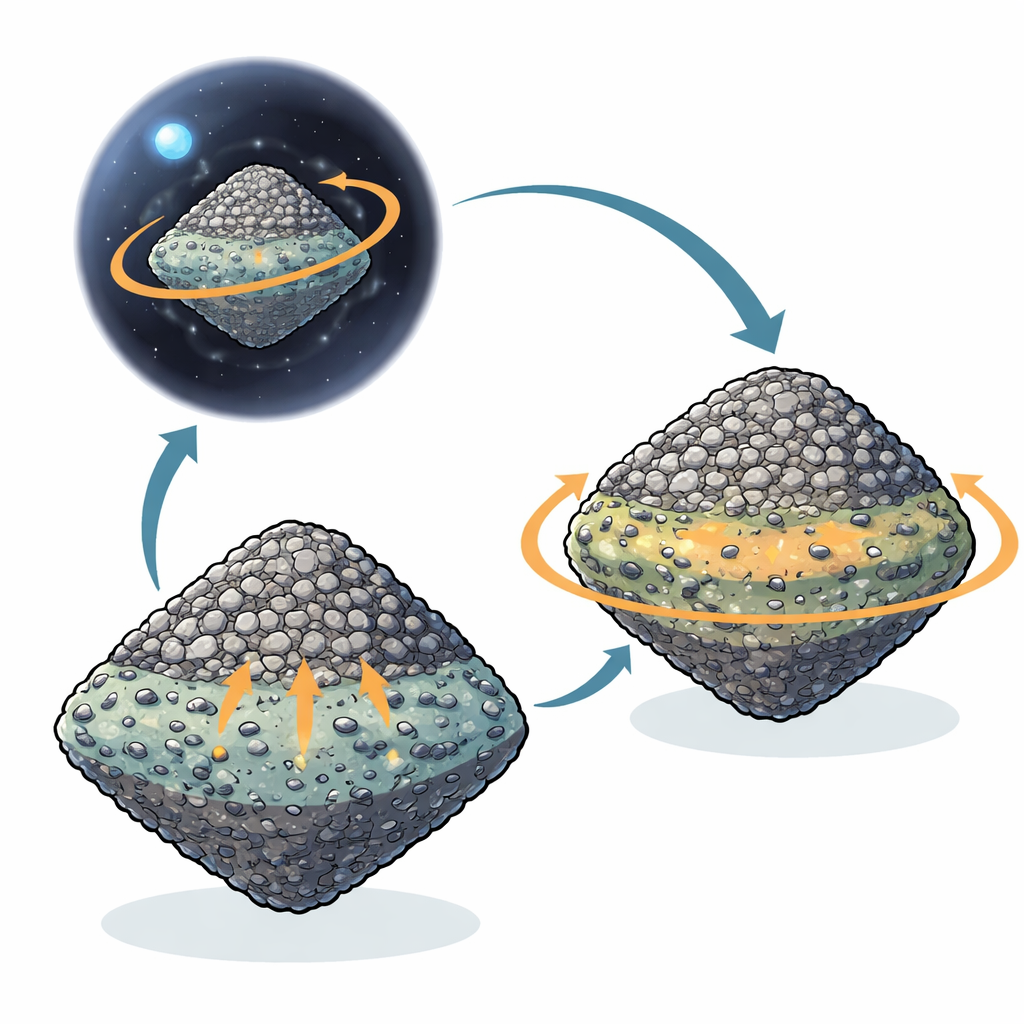
Ryugu is what scientists call a rubble pile: a loose collection of rocks and dust held together mainly by its own weak gravity. The Hayabusa2 spacecraft showed that its surface is dominated by boulders of many sizes, hinting that Ryugu formed when a larger body was shattered and then reassembled. In this work, researchers used high resolution images from the spacecraft to manually map nearly fifty thousand boulders across the entire asteroid, measuring each one’s size, location, and the direction its longest side points. This is the most complete global boulder map of Ryugu so far, and the first to include how the boulders are oriented.
Counting rocks to trace ancient breakups
When a solid body breaks apart, it tends to produce many more small pieces than large ones, and this pattern can be described mathematically. On Ryugu, the team found that boulders larger than about three meters follow a steep size distribution, with small blocks greatly outnumbering big ones. This pattern closely matches earlier studies and resembles that seen on another rubble pile asteroid, Bennu. Together with Ryugu’s low overall density and high porosity, these statistics support the idea that its rocks are leftovers from a catastrophic breakup of a parent body, not just fragments blasted out by later craters. Some enormous boulders, over one hundred meters across, likely preserve deep pieces of that old world.
Where the boulders like to gather
The mapped boulders are not spread evenly over Ryugu. The equatorial ridge, the raised band that gives Ryugu its spinning-top shape, actually has fewer large blocks at the surface than nearby regions. In contrast, so-called slope-breaker zones at mid latitudes, where steep slopes give way to gentler terrain, show both higher boulder counts and distinct size patterns. Young, fresh looking craters also host more visible boulders than older ones. The authors interpret this as a record of constant reshuffling: impacts shake the surface and bring buried rocks upward, while the asteroid’s rotation and low gravity slowly move blocks away from the equator toward mid latitudes, where they tend to pile up and come to rest.
Hidden order in the way rocks point
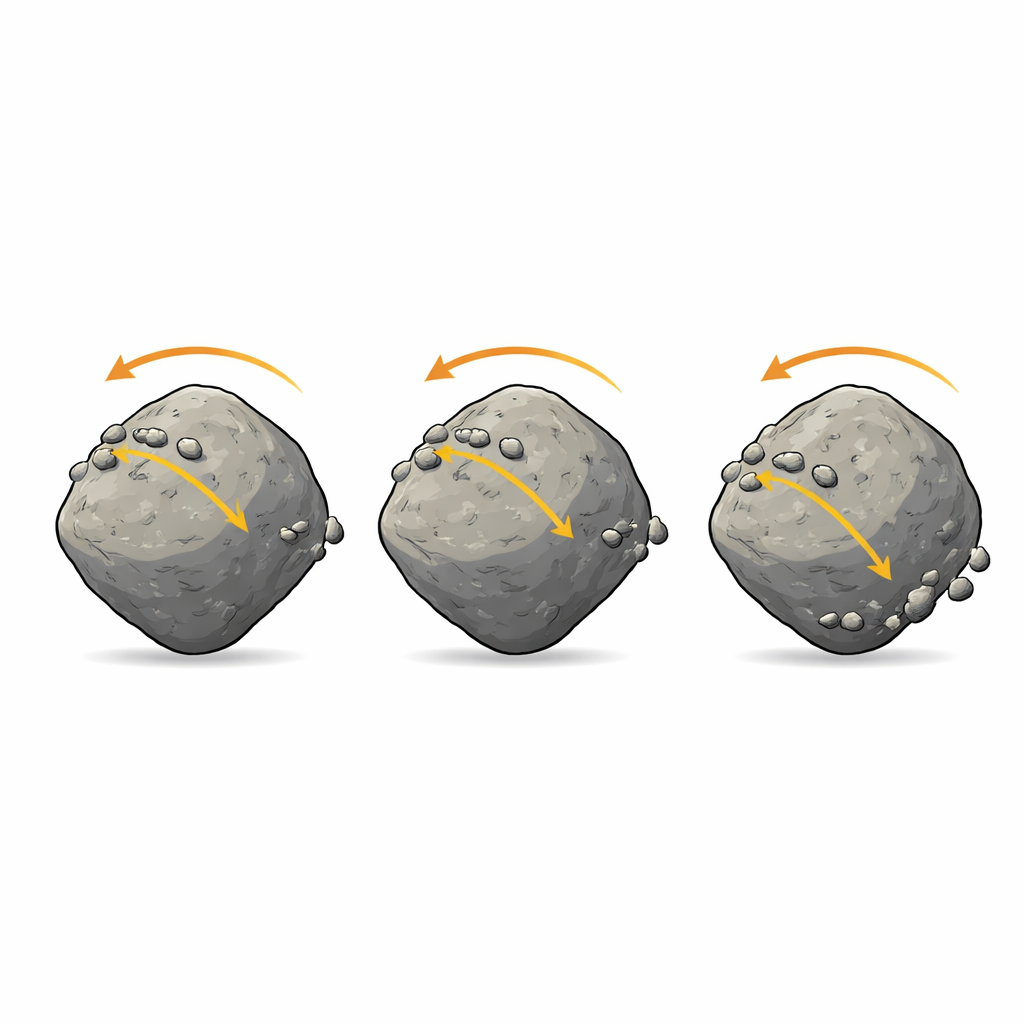
Beyond where the boulders sit, the study reveals how they are aligned. Larger boulders on Ryugu tend to point along preferred directions that differ between the northern and southern hemispheres, especially in the slope-breaker zones. These patterns suggest that as boulders slide downhill, they settle in stable positions that reflect both the downhill pull and subtle sideways nudges from the asteroid’s spin. Smaller boulders show a different, mainly north south trend that the authors link to thermal cracking: repeated day night heating and cooling gradually splits rocks along favored directions set by how sunlight sweeps across Ryugu’s surface.
Reading Ryugu’s story in its rocks
To a casual observer, Ryugu’s boulders might look like a random heap of debris. This study shows that their sizes, locations, and alignments actually encode a detailed story of violent breakup, slow reshaping by changing spin, steady bombardment by impacts, and gentle but persistent cracking from temperature swings. By treating each rock as a data point rather than just a hazard, the researchers build a framework for comparing rubble pile asteroids and for judging how stable their surfaces might be for future landers. In effect, Ryugu’s scattered boulders act as arrows pointing back to the forces that built this small world and continue to remodel it today.
Citation: Ray, A., Ruj, T., Komatsu, G. et al. Boulder populations and orientation trends on asteroid Ryugu: implications for rubble-pile surface processes. Sci Rep 16, 14404 (2026). https://doi.org/10.1038/s41598-026-40370-4
Keywords: asteroid Ryugu, rubble pile asteroids, boulder mapping, rotational dynamics, impact resurfacing