Clear Sky Science · en
Evaluation of bamboo biomass pellets: impact of binder type and age of bamboo on pellet quality and performance
Turning a Fast-Growing Grass into Clean Fuel
Bamboo is often praised for its beauty and speed of growth, but it can also be a powerful ally in the search for cleaner, more affordable energy. This study explores how bamboo dust, usually a low-value by‑product, can be pressed into small, dense fuel pellets using natural binding materials made from agricultural and forest residues. By carefully testing how pellet quality changes with the type of binder and the age of the bamboo, the researchers show a practical way to turn local plant waste into a reliable household and industrial fuel.
Why Bamboo Pellets Matter
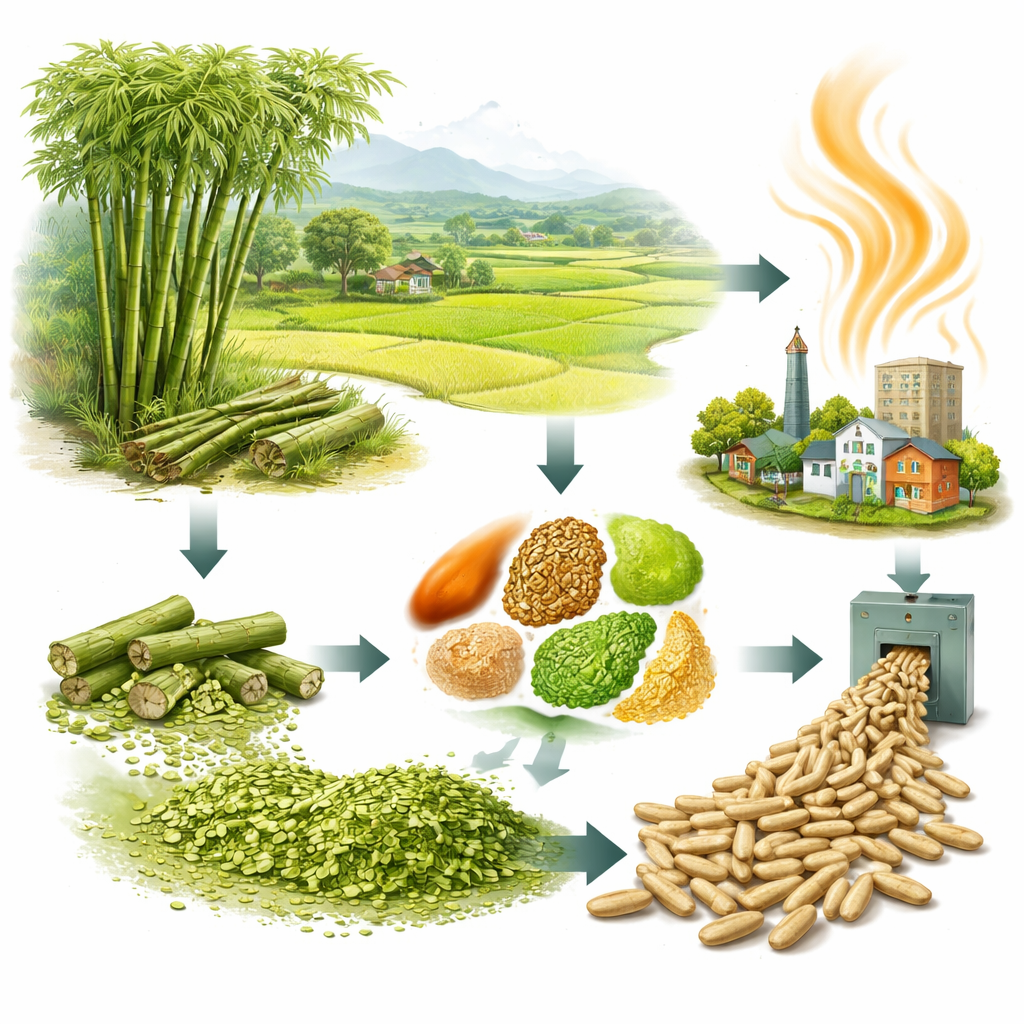
India is one of the world’s bamboo powerhouses, with millions of tonnes of bamboo growing each year, especially in regions like the Western Ghats and Vidarbha. Yet much of the leftover bamboo from farms and processing plants is not used efficiently. Burning loose biomass is smoky, hard to store, and expensive to transport because it is bulky and holds a lot of moisture. Compressing this material into pellets solves many of these problems at once: the fuel becomes denser, drier, easier to move, and burns more evenly. The study focuses on Bambusa balcooa, a widely planted species, and asks how to get the best pellets while keeping costs low and using materials rural communities already have.
From Culm to Pellet
The team harvested bamboo stems that were one, two, and three years old, dried them, and ground them into fine dust. They then blended this dust with different natural binders: deoiled cakes from sal, karanj, and mahua tree seeds, plus rice bran, as well as mixtures of these materials. These cakes are left over after oil extraction and are often treated as waste or restricted to limited uses because some contain natural toxins. In pellet making, however, their proteins, residual oils, and starches help particles stick together and compact under pressure. Using a small pellet mill, the researchers produced cylindrical pellets and measured their size, density, strength, and how they burned.
What Makes a Good Pellet
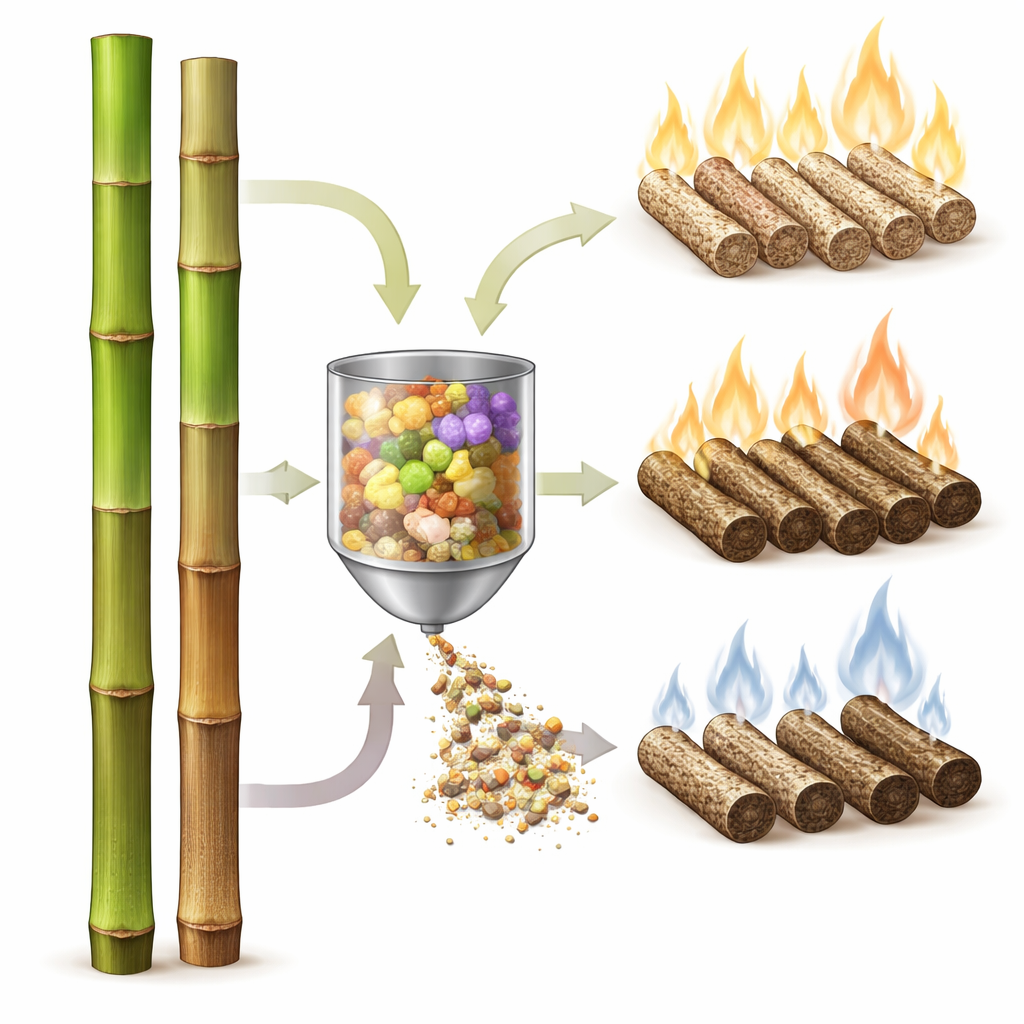
To judge quality, the scientists looked at simple but revealing traits. Heavier, denser pellets that sink in water tend to be strong and resist crumbling during handling and transport. Pellets also need the right balance of moisture, ash (the incombustible residue), volatile gases released during heating, and fixed carbon that glows and provides long-lasting heat. The study found that certain binder mixtures, especially mahua combined with karanj or sal cakes, gave pellets with high density, high fixed carbon, and strong durability. Rice bran alone increased ash content but reduced some energy properties, while sal cake alone produced especially tough pellets that survived shaking tests with minimal breakage.
How Bamboo Age Changes Performance
The age of the bamboo culm also shaped pellet behavior. As bamboo aged from one to three years, its dust naturally became drier, with less ash and slightly higher energy content. Pellets made from two‑year‑old bamboo showed the highest particle density and relatively fast combustion, while three‑year‑old bamboo gave the highest overall heat value and heat release rate. Younger bamboo tended to produce pellets with more volatile matter and higher fixed carbon, leading to lively flames and good burn length, but somewhat lower energy per gram than mature culms. Importantly, all age groups, when combined with suitable binders, produced pellets that passed a basic quality test by sinking in water and withstanding mechanical handling.
Costs, Benefits, and Everyday Impact
Beyond the lab numbers, the study examined whether bamboo pellets could make economic sense for farmers and small entrepreneurs. Factoring in the price of raw bamboo, grinding, binder materials, pelletizing, storage, and labor, the production cost was about 10 to 10.5 Indian rupees per kilogram, while the market selling price was around 14 rupees per kilogram. This leaves a modest but real profit margin, along with environmental gains from using waste materials and easing pressure on forests for firewood. In simple terms, the work shows that with the right binder and bamboo age, rural communities can transform local plant residues into a sturdy, clean‑burning fuel that helps meet energy needs while cutting smoke, waste, and deforestation.
Citation: Ilorkar, V.M., Raut, P.D., Nimbarte, S.R. et al. Evaluation of bamboo biomass pellets: impact of binder type and age of bamboo on pellet quality and performance. Sci Rep 16, 12903 (2026). https://doi.org/10.1038/s41598-026-40368-y
Keywords: bamboo pellets, bioenergy, biomass fuels, renewable energy, agricultural residues