Clear Sky Science · en
Chronicity moderates the impact of severity on central executive-default mode network functional interactions in depression
Why this study matters
Depression is often described in terms of how bad someone feels right now, but for many people the more troubling question is: how long has it been going on? This study looks at both sides of that coin—how severe a person’s symptoms are, and how long their current episode has lasted—to see how each relates to the way major brain networks talk to each other. By comparing people with shorter versus long‑lasting (chronic) depression, the researchers show that duration can actually flip the way brain activity relates to symptom severity, offering clues to why some depressions are harder to treat and slower to lift.
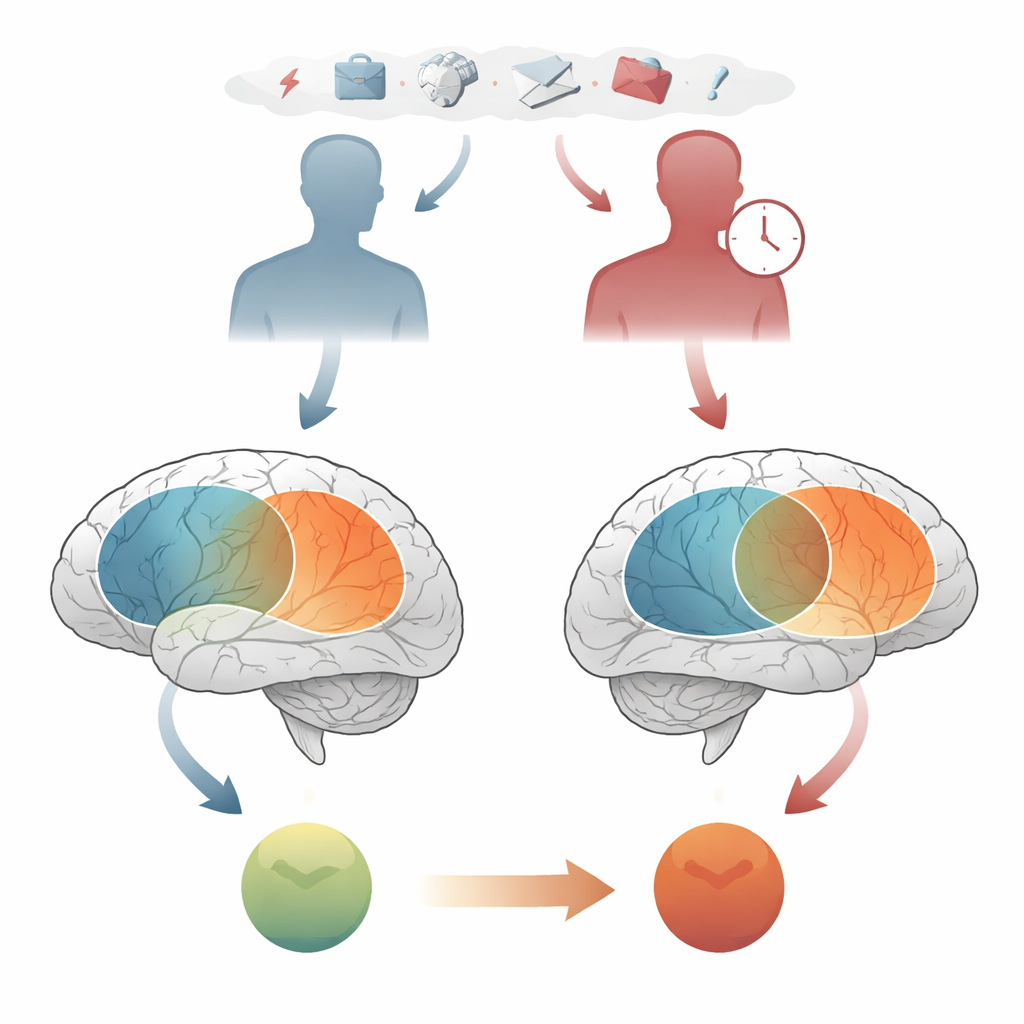
Looking at the brain at rest
The researchers studied 46 adults with moderate to severe major depression who had stopped taking antidepressant medication before having brain scans. They used two MRI methods while people were at rest. One measured functional connectivity—how strongly activity in different brain regions rises and falls together over time. The other measured grey matter volume—the thickness and size of brain tissue in different areas. Rather than focusing only on a few regions, they used whole‑brain network modelling to capture communication between large‑scale systems known to support thinking, emotion, and self‑reflection.
Two key brain networks under the spotlight
The team focused on interactions between the Central Executive Network (CEN) and a core hub of the Default Mode Network called the precuneus. The CEN, which includes the dorsolateral prefrontal cortex, helps with goal‑directed thinking and mental control. The Default Mode Network, and especially the precuneus, is more active during inward‑focused activities such as daydreaming, recalling memories, and thinking about oneself. In healthy brains, these networks usually balance each other: when you concentrate on a task, executive regions ramp up and self‑focused regions quiet down, and vice versa. Many theories of depression suggest that this balance is disturbed, contributing to rumination and difficulty shifting attention away from negative thoughts.
When duration changes the brain’s story
The striking result was that the relationship between depression severity and CEN–precuneus connectivity ran in opposite directions depending on whether patients had chronic depression (episodes lasting more than two years) or not. Among non‑chronic patients, more severe symptoms were linked to weaker functional coupling between the CEN and the precuneus. In chronic patients, however, more severe symptoms were linked to stronger coupling between these same regions. In other words, as depression deepened, the two networks seemed to drift apart in shorter‑lasting illness but lock together more tightly in long‑standing illness. This suggests that the brain’s network response to symptom burden is not fixed, but can reorganize as depression becomes entrenched.
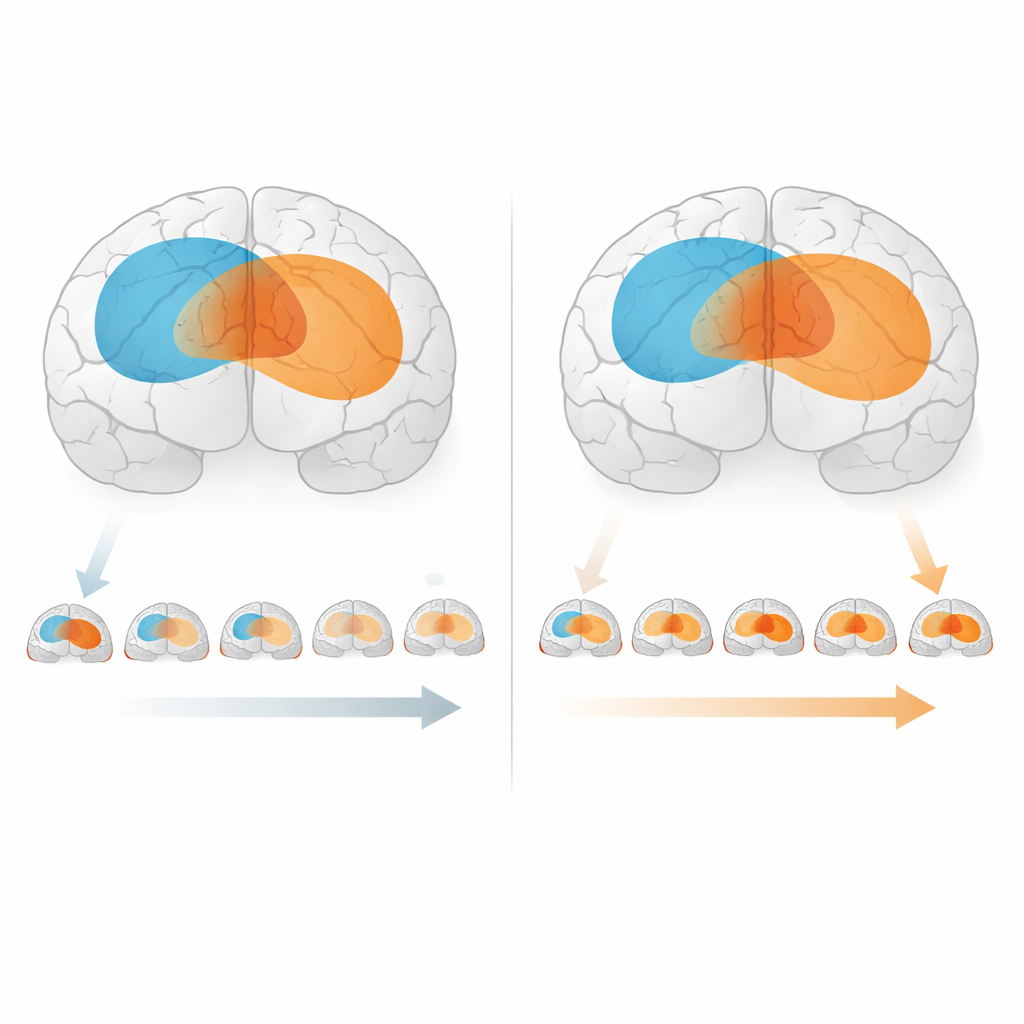
Brain structure and symptom load
On the structural side, the researchers asked whether severity and chronicity were linked to differences in grey matter volume. Here, severity—not duration—stood out. Higher symptom scores were associated with larger grey matter volume in two hubs of the CEN: the dorsal anterior cingulate cortex and the right dorsolateral prefrontal cortex. These regions are heavily involved in regulating emotion and exerting mental control, and they overlapped spatially with the same executive network highlighted in the connectivity findings. Both chronic and non‑chronic patients showed this positive link between volume and severity, suggesting that tissue changes in these control areas may track how burdened a person feels, regardless of how long their current episode has lasted.
What this means for understanding depression
Taken together, the findings suggest that how long someone has been depressed can shape how symptom severity is reflected in their brain networks. In shorter‑lasting depression, worse symptoms may go hand‑in‑hand with a weakening link between control and self‑focused systems, while in chronic depression, worsening symptoms may instead involve excessive coupling between them. At the same time, the size of key control regions increases with symptom severity in both groups. For patients and clinicians, this work underscores that depression is not a single brain state but a moving target over time. Recognizing that severity and chronicity leave different fingerprints on brain organization could eventually help tailor treatments—for example, by guiding brain‑stimulation targets or helping predict who is at risk for depression becoming long‑term and harder to treat.
Citation: Zanao, T., Salvan, P., B. Razza, L. et al. Chronicity moderates the impact of severity on central executive-default mode network functional interactions in depression. Sci Rep 16, 10116 (2026). https://doi.org/10.1038/s41598-026-40364-2
Keywords: major depressive disorder, brain networks, functional connectivity, chronic depression, default mode network