Clear Sky Science · en
Toward a mechanistic characterisation of marine heatwaves
Why ocean heatwaves matter to all of us
Ocean "heatwaves"—periods when parts of the sea become much warmer than usual for days to months—are rapidly becoming more common. They bleach coral reefs, wipe out kelp forests, shift fish stocks, and disrupt coastal economies. Yet most monitoring tools still look at these events point by point on a map, missing how a heatwave actually grows, moves, and fades as a single body of warm water. This paper introduces a new way to follow marine heatwaves as moving objects and link their life stories to the physical forces that drive them.
From hot spots on a map to moving warm bodies
Traditionally, scientists detect marine heatwaves by checking each ocean grid cell against a temperature threshold and flagging days that are unusually warm. This helps count how often extremes occur, but it fragments large events into thousands of isolated pixels and says little about how a heatwave travels or what sustains it. Recent methods improved on this by tracking connected warm patches through space and time, treating a heatwave more like a storm system than a static anomaly. However, these approaches still mostly described the statistics of the events—how big, how long—without tying them clearly to underlying causes such as winds, sunlight, or currents.
Following ocean heatwaves like storms
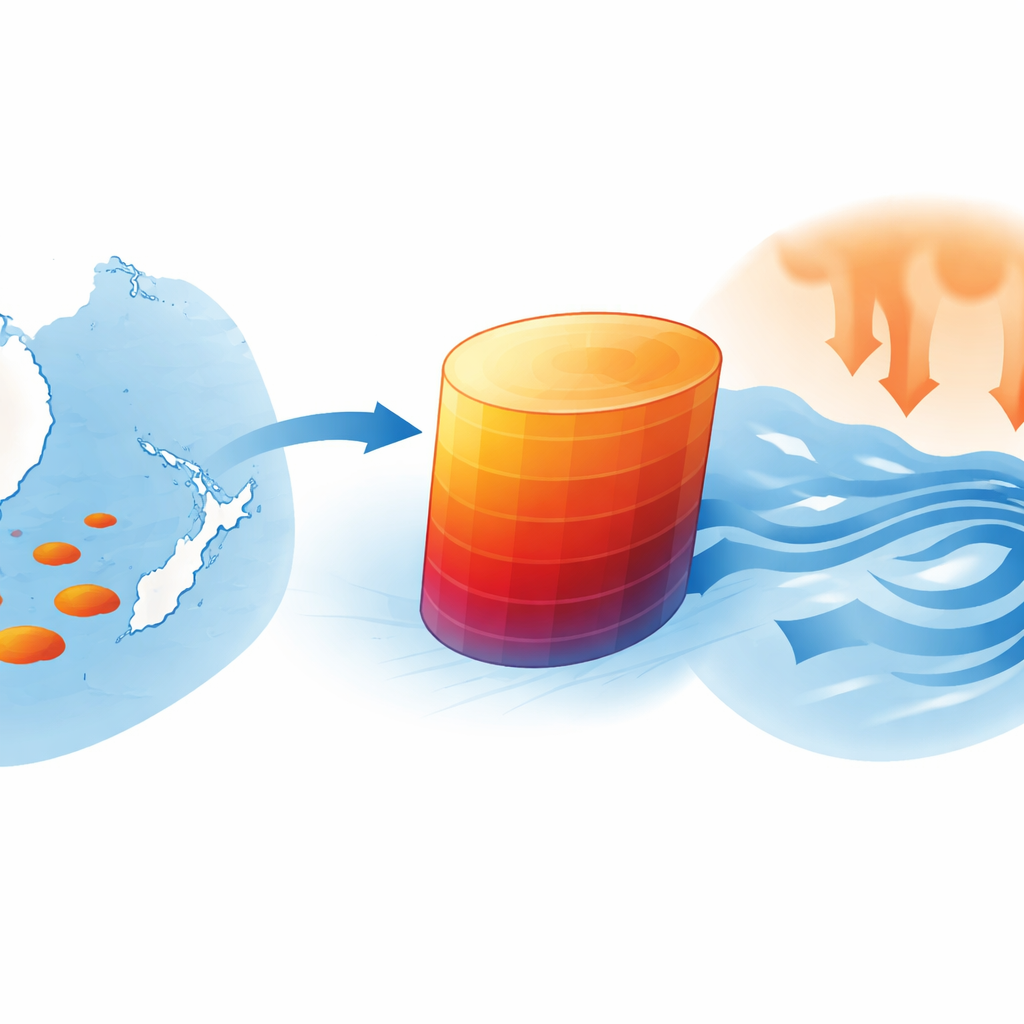
The authors extend these tracking ideas into a more mechanistic framework. They work in the Tasman Sea, between eastern Australia and New Zealand, a region where powerful currents and changing weather both shape marine heatwaves. First, they smooth the raw pixel-level detections so that warm patches become coherent shapes, then follow each shape day by day, building a three-dimensional track (two horizontal dimensions plus time). For every tracked event they measure duration, size, intensity, and how far it travels. They also examine how these properties change when they deliberately ignore the smallest scales, mimicking coarser observing systems. Small, short-lived events tend to disappear as the tracking scale grows, while the remaining heatwaves look larger, persist longer, and propagate farther, revealing the importance of spatial scale for what we see and label as an "event."
Linking drivers to each event’s life story
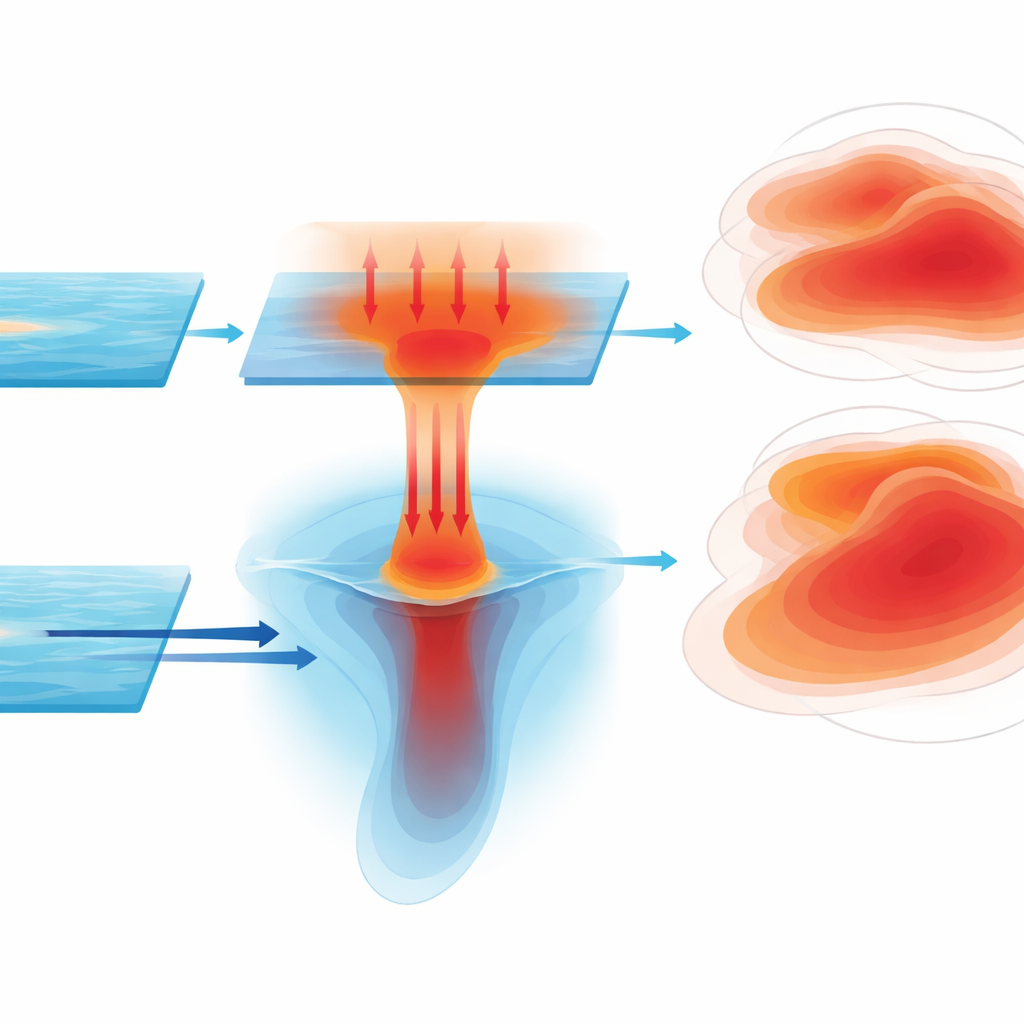
The key advance is to connect each moving heatwave to the processes that warm the upper ocean. The team dissects the mixed-layer heat budget into three main pieces: heating from the air above (net surface heat flux), horizontal transport of warm water by currents (advection), and a residual that gathers other smaller effects and model noise. For every point within a heatwave, they decide which term is locally dominant and then assign each tracked event to the driver that controls most of its area over its lifetime. This reveals two main families. Heat-flux–dominated events tend to be broader and more uniform, often tied to persistent high-pressure systems that reduce winds, clear the skies, and cut the ocean’s heat loss. Advection-dominated events are more common where strong boundary currents and eddies funnel warm water downstream, creating deeper, more mobile warm anomalies that can extend hundreds of meters below the surface.
Putting diverse heatwaves on a common stage
Because each event differs in size, shape, and duration, simple averaging can wash out meaningful structure. To solve this, the authors create a normalised framework: they scale each heatwave so its footprint fits inside a unit circle and stretch its lifetime so that every event runs from 0 (onset) to 1 (termination). This allows them to build composite pictures of how intensity, depth structure, and atmospheric and oceanic conditions evolve through the typical life cycle. In this view, air-driven events warm slowly and reach peak strength late, with heat concentrated in a shallow surface cap aided by weaker winds and a thinner mixed layer. Current-driven events intensify earlier, extend much deeper, and decay more gradually as the underlying warm flow retreats. The method also shows how changes in spatial scale shift apparent dominance from small eddies toward broader atmospheric forcing.
What this means for prediction and impacts
By treating marine heatwaves as moving, coherent entities and tying their evolution directly to heat sources and currents, this study offers a more physical picture of how ocean heat extremes arise and unfold. For managers and communities, the distinction between shallow, atmosphere-driven events and deep, current-driven ones matters: the former may hit quickly but be short-lived, while the latter can persist, affect deeper habitats, and travel long distances. The new framework provides a way to compare very different events on equal footing, opening the door to better forecasts and clearer links between heatwaves, marine ecosystems, and wider climate drivers in a warming world.
Citation: Zhao, Z., Holbrook, N.J., Capotondi, A. et al. Toward a mechanistic characterisation of marine heatwaves. Sci Rep 16, 11092 (2026). https://doi.org/10.1038/s41598-026-40354-4
Keywords: marine heatwaves, Tasman Sea, ocean currents, air–sea interactions, climate extremes