Clear Sky Science · en
Design and development of ultra-broadband THz metamaterial MIMO antenna with efficient diversity parameters optimized with machine learning for TWPAN applications
Why tiny antennas for huge data speeds matter
Video calls that never freeze, augmented reality glasses, and swarms of smart gadgets all depend on moving enormous amounts of data wirelessly. To keep up, engineers are looking to terahertz waves—signals far above today’s Wi‑Fi and 5G—to link devices at blistering speeds over short distances. This paper presents a new type of tiny antenna that can handle an unusually wide slice of the terahertz spectrum while staying compact, efficient, and cheap enough to power future personal networks of wearables, sensors, and handheld devices.

A new building block for personal terahertz networks
The authors focus on connections known as Terahertz Wireless Personal Area Networks, short‑range links between nearby devices such as phones, headsets, and IoT gadgets. These links demand antennas that are not only fast but also miniature, low cost, and able to juggle multiple data streams at once. The team designs a two‑element MIMO antenna—essentially a pair of antennas working together—that operates between 10 and 30 terahertz, spanning an enormous 20‑terahertz bandwidth. Despite its microscopic footprint of 110 by 55 micrometers, the device delivers high signal strength, making it a promising candidate for future high‑speed personal networks.
Shaping metal and materials to bend waves
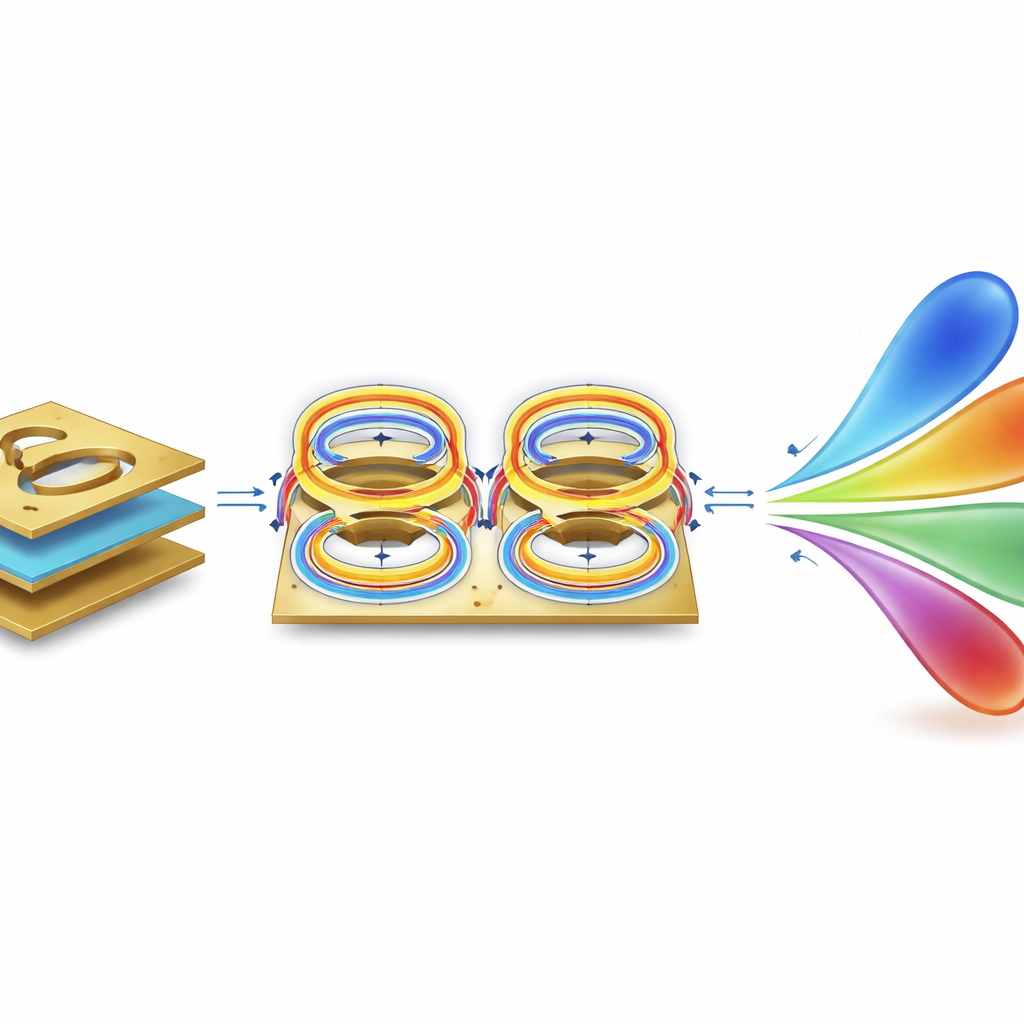
At the heart of the design sits an O‑shaped loop cut into a thin silver patch, stacked above a flexible polyamide layer and an etched silver ground plane. This pattern behaves as a metamaterial: a carefully engineered structure that steers electromagnetic waves in ways ordinary materials cannot. By tailoring the dimensions of the O‑shaped slots and the thickness of each layer, the researchers coax the structure into producing multiple resonances across the terahertz band and a “negative index” response, where waves inside the material bend in the opposite direction to normal. These effects open up extra channels and broaden the usable frequency range without enlarging the antenna.
Keeping signals strong and streams independent
For multi‑antenna systems, it is not enough to radiate strongly; each element must also behave almost independently so that separate data streams do not interfere. The team evaluates several diversity measures derived from simulations, including how similar the signals from each antenna are, how much overall power can be extracted, and how much information is lost as data flows through the system. Across the entire 10–30 terahertz band, the antenna pair shows extremely low correlation between elements, nearly ideal diversity gain, very good matching to the electronics that drive it, and only tiny losses in channel capacity. Together with a peak gain of about 15.7 dBi—unusually high for such a small device—these results suggest that the antenna can support many simultaneous users or data streams in a cramped, reflective environment.
Letting algorithms tune the hardware
Because tiny shifts in layer thickness or device size can dramatically alter performance at terahertz frequencies, the researchers turn to machine learning to guide the fine‑tuning process. They generate simulation data while varying patch height, substrate thickness, ground plane thickness, and the overall length and width of the antenna. A simple regression model then learns how these geometric tweaks affect a key reflection metric. For several parameters, the model predicts the antenna’s behavior with very high accuracy, allowing the team to search the design space quickly and pinpoint combinations that provide deep resonances, wide bandwidth, and strong isolation without endless trial‑and‑error simulations.
What this means for future short‑range links
In everyday terms, the new design shows that a fingernail‑sized chip could host antennas able to pump huge amounts of data over short distances using terahertz waves, while keeping different data streams cleanly separated. By mixing metamaterial patterns with flexible substrates and machine‑learning‑driven optimization, the authors achieve an ultra‑broadband, high‑gain, and well‑behaved dual‑antenna system that meets the demanding needs of next‑generation personal networks. If translated from simulation to mass‑produced hardware, such antennas could become key components in future headsets, wearables, and room‑scale hubs that rely on seamless, cable‑free terahertz connectivity.
Citation: Alsharari, M., Sharma, Y., Aliqab, K. et al. Design and development of ultra-broadband THz metamaterial MIMO antenna with efficient diversity parameters optimized with machine learning for TWPAN applications. Sci Rep 16, 10323 (2026). https://doi.org/10.1038/s41598-026-40351-7
Keywords: terahertz antennas, metamaterials, MIMO communication, wireless personal networks, machine learning design