Clear Sky Science · en
DFT insights into the photovoltaic performance of A–π–A non-fullerene acceptors for organic solar cells
Why Better Solar Materials Matter
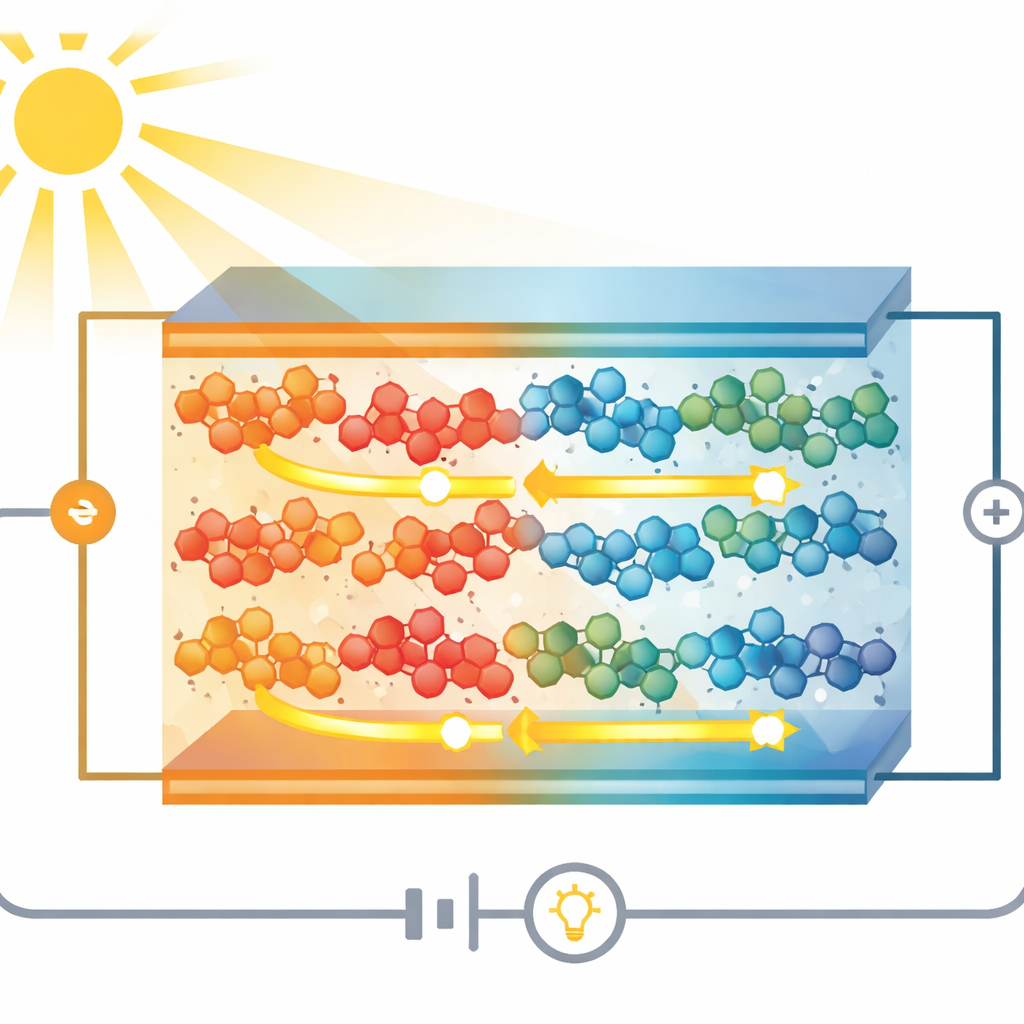
Solar panels are a promising route to cleaner energy, but many of today’s devices rely on rigid, costly materials. A newer class of “plastic” solar cells made from carbon-based molecules could one day be printed on flexible sheets, built into windows, or wrapped around everyday objects. This study explores how carefully redesigning one family of these molecules can make them absorb more sunlight and move electric charge more efficiently, pointing the way toward cheaper, more versatile solar power.
From Soccer-Ball Molecules to Tailor-Made Films
Early organic solar cells depended on special carbon cages known as fullerenes to pull electrons away after light was absorbed. While useful, these fullerenes are expensive, hard to modify, and absorb only a narrow slice of sunlight. Researchers have therefore turned to “non-fullerene acceptors” – flat, dye-like molecules whose shapes and end groups can be tuned almost at will. In this work, the authors took a successful acceptor from the literature and systematically replaced its outer chemical groups with stronger electron-pulling units. They wanted to see which version would best support the journey from captured sunlight to usable electrical current without having to synthesize each one in the lab.
Using Virtual Chemistry to Test New Designs
Instead of mixing chemicals at a bench, the team used high-level quantum calculations to predict how each candidate molecule would behave. These methods simulate how electrons sit in “frontier” zones of a molecule before and after it absorbs light, and how easily they can be promoted into a state where they can move. By examining the shapes and energies of these zones, the researchers could estimate each design’s stability, how strongly it would absorb visible light, and how readily it would move charge from its central backbone toward its ends. They also calculated how tightly bound the electron–hole pair (called an exciton) would be after light absorption, since loosely bound pairs split more easily into free charges in a working solar cell.
Making Sunlight Easier to Harvest
The redesigned molecules share a simple pattern: an electron-rich middle section connected to two electron-hungry end units. Swapping in stronger pulling groups at the ends narrowed the energy gap between the frontier zones and shifted the main light-absorption peak deeper into the red and near‑infrared part of the spectrum—regions rich in solar energy. One particular design, built with nitro groups at its ends, stood out. It had the smallest energy gap, the longest absorption wavelength, and one of the loosest electron–hole pairings, all signs that it can harvest sunlight effectively and then separate charges with minimal loss. Detailed analyses of how charge density moved within these molecules showed that, upon excitation, electrons naturally flowed from the central bridge toward the terminal units, confirming the desired “push–pull” behavior.

Working Together with a Donor Partner
In actual devices, these acceptor molecules are blended with a complementary “donor” material. The authors therefore paired their best design with a well-known donor polymer and computed how electrons would shift between the two. The simulations showed that, when the pair is excited by light, charge tends to leave the donor and settle on the acceptor, creating a strong internal separation between negative and positive regions. The energy difference between the donor’s upper occupied zone and the acceptor’s lower empty zone also suggested that the blended films could deliver healthy open-circuit voltages, a prerequisite for good power output in real solar cells.
What This Means for Future Solar Panels
To a non-specialist, the practical message is that small, carefully chosen tweaks at the edges of an organic molecule can have an outsized impact on how well a flexible solar film works. By using computer models to probe dozens of subtle electronic details, this study identifies a nitro-capped design as a particularly promising candidate for high-performance, non-fullerene solar cells. While actual device fabrication and testing still lie ahead, the work offers a clear recipe: strengthen the electron-pulling ends without twisting the molecule out of shape, and you can build lighter, more efficient solar materials that bring plastic-based photovoltaics a step closer to everyday use.
Citation: Khan, M., Sarwar, F., Gull, K. et al. DFT insights into the photovoltaic performance of A–π–A non-fullerene acceptors for organic solar cells. Sci Rep 16, 9842 (2026). https://doi.org/10.1038/s41598-026-40331-x
Keywords: organic solar cells, non-fullerene acceptors, density functional theory, photovoltaic materials, charge transfer