Clear Sky Science · en
Identifying neuromuscular and mental fatigue in elite youth table tennis players using machine learning
Why Tiredness in Young Athletes Matters
For young table tennis players chasing elite performance, tiredness is more than just feeling a bit worn out. Both body and mind can silently slow reactions, alter technique, and raise the risk of mistakes or even injury. Yet coaches rarely have an objective, real-time way to see when a player is mentally or physically fatigued. This study explores whether a smart, sensor-equipped racket and modern pattern-recognition algorithms can read tiny changes in a player’s strokes to reveal their hidden fatigue state.
A Smart Racket That Feels Every Hit
The research team worked with nine of France’s best teenage table tennis players. They transformed an ordinary racket into a measurement tool by adding a tiny three-dimensional motion sensor in the handle and four pressure sensors where the hand grips the racket and the thumb and index finger rest on the blade. Every time the player hit a ball, the racket recorded how quickly it moved and how firmly the hand pressed at various points. These signals were sampled at very high speed, filtered to remove noise, normalized, and then merged into a single data trace for each stroke. 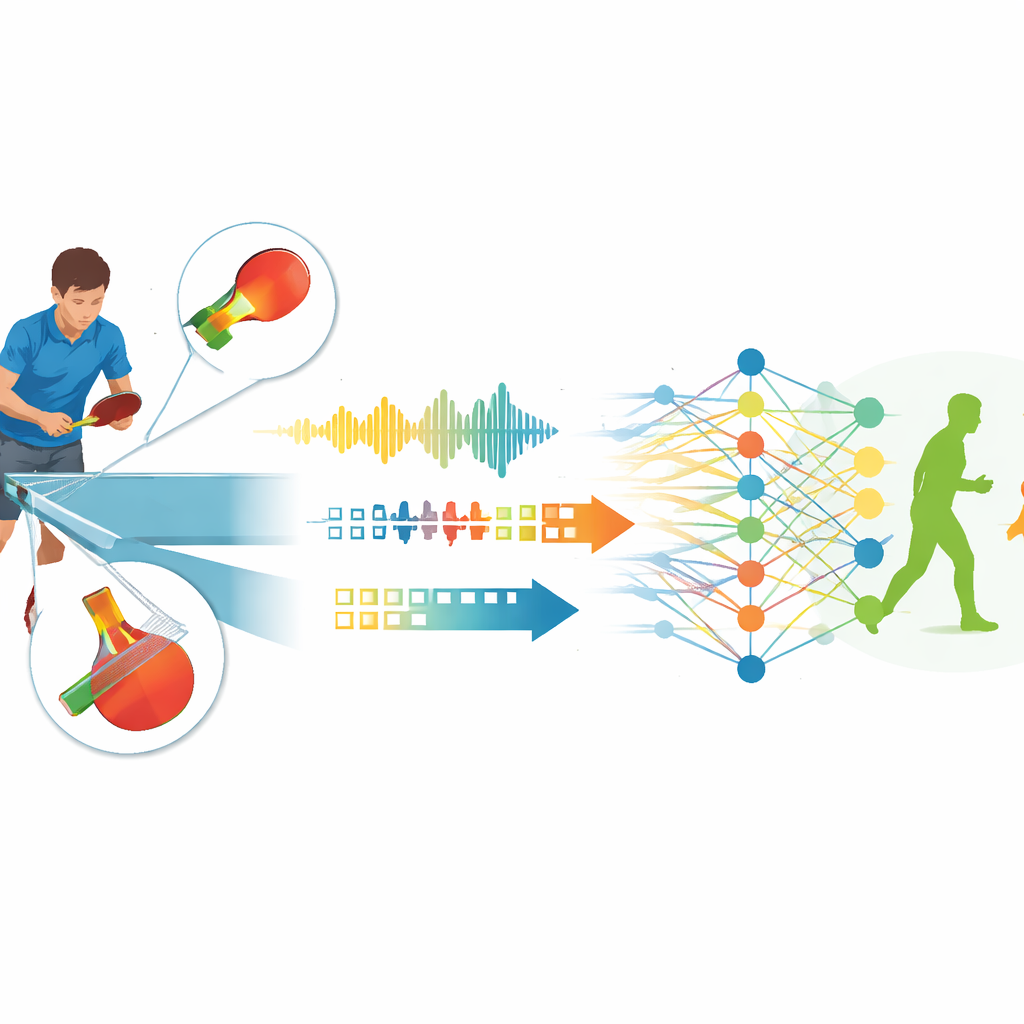
Designing Tired and Fresh Playing Conditions
To link these stroke patterns with different types of fatigue, the scientists carefully created three separate conditions. In one, players performed a demanding computer-based attention task for 90 minutes, known to drain mental energy without directly tiring the muscles. In another, they carried out repeated intense eccentric contractions of the biceps on their playing arm until they lost about 15% of their maximum elbow strength, producing clear muscle fatigue. In the control condition, they simply watched a cognitively neutral film. Before and after each session, the players completed a standardized table tennis test with a ball-launching robot, while their ball speed, accuracy, and number of faults were measured. They also reported how tired they felt and how hard the tasks seemed, and their arm strength was checked with a special force-measuring device.
From Hidden Stroke Changes to Recognized Patterns
The subjective and strength tests confirmed that the mental and physical protocols really did make players feel and perform as fatigued: mental fatigue raised perceived effort and tiredness, and physical fatigue reduced arm strength as planned. Surprisingly, classic performance measures such as ball speed and accuracy barely changed in a clear, statistically robust way across conditions, especially in this small group of highly skilled youngsters. However, when the researchers turned to the rich sensor data from the racket, a different story emerged. They fed thousands of labeled strokes—each tagged as coming from a mentally fatigued, physically fatigued, or control session—into a range of supervised machine learning models, including k‑nearest neighbors and random forests. These algorithms learned to recognize subtle shifts in acceleration curves and grip pressure that the eye could not see. 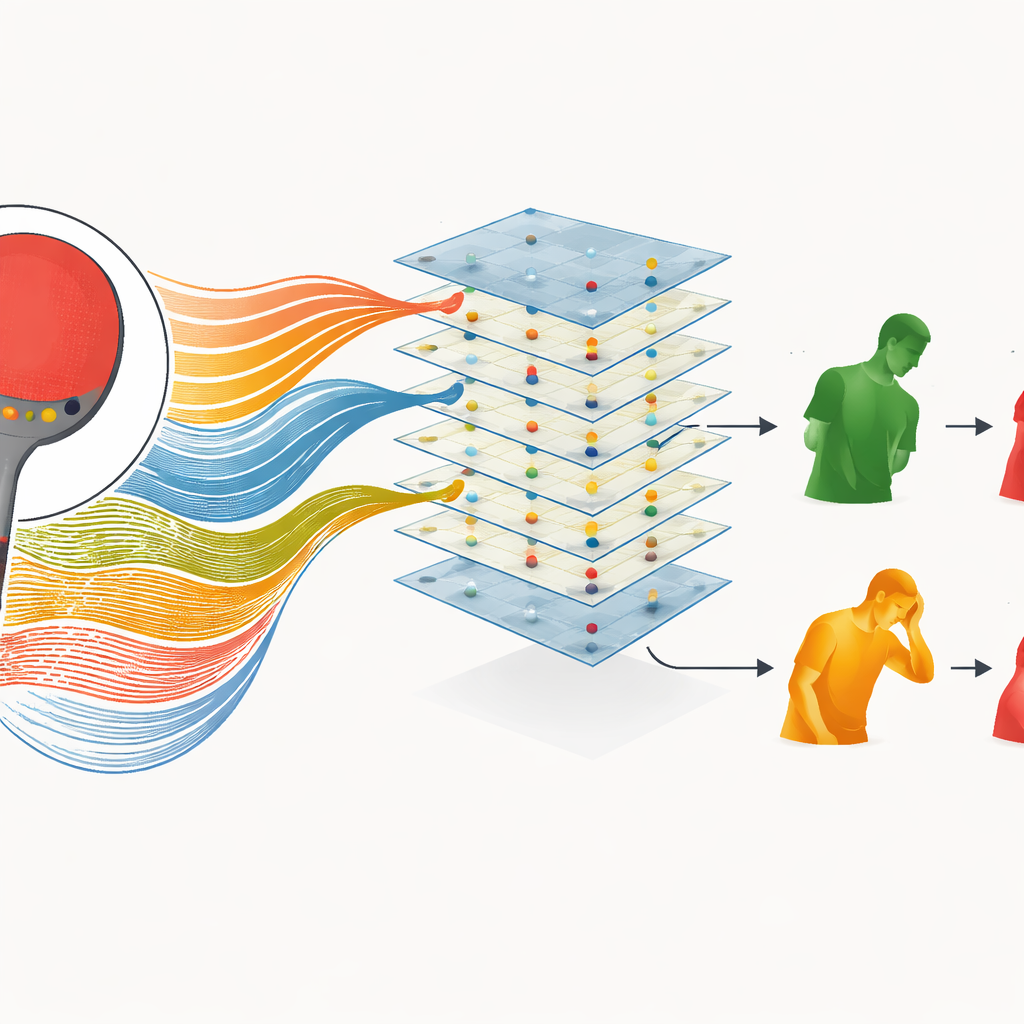
Teaching Computers to Spot Tired Players
When the goal was simply to tell whether a stroke came from a fatigued or non-fatigued state, the best model, k‑nearest neighbors, correctly classified about 84% of cases. When asked to go further and distinguish among three specific states—no fatigue, mental fatigue, and physical fatigue—the random forest model reached around 82% accuracy. This means that, even though the players could still hit the ball with roughly the same speed and precision, their racket “signature” had changed enough for a data-driven system to detect. More demanding tests that tried to generalize across players showed lower success, mainly because the sample was small and each athlete’s style was unique, but they suggest that retraining models within a stable elite training group is feasible.
What This Means for Training and Health
In everyday terms, this study shows that a smart racket and the right algorithms can “listen” to how a young athlete moves and quietly flag when their body or mind is running low, even before obvious errors appear. Coaches could eventually use such tools to manage training loads, prevent overuse, and time tactical or mental breaks more precisely during practice and competition. While more players, more sensors, and real-time systems will be needed before this becomes a standard courtside aid, the core message is clear: subtle changes in how we hold and swing a racket can reveal whether we are fresh, mentally drained, or muscle-fatigued—and machines are already good enough to tell the difference.
Citation: Delumeau, T., Deschamps, T., Plot, C. et al. Identifying neuromuscular and mental fatigue in elite youth table tennis players using machine learning. Sci Rep 16, 11812 (2026). https://doi.org/10.1038/s41598-026-40324-w
Keywords: table tennis, sports fatigue, wearable sensors, machine learning, youth athletes