Clear Sky Science · en
Transient Flow model and heterogeneity effect analysis for fracture networks in shale gas horizontal wells
Why gas from tight rock matters
Much of the world’s future natural gas may come from rocks that hardly seem permeable at all. In China and elsewhere, shale formations thousands of meters underground hold enormous amounts of gas, but it is locked inside dense rock and hairline cracks. Engineers use hydraulic fracturing to create complex fracture networks that let the gas escape, yet predicting how much gas a well will actually produce over years or decades remains difficult. This study tackles that challenge by building a detailed mathematical model of gas flow through these fracture networks and the surrounding rock, then testing it against real production data from two shale gas wells.
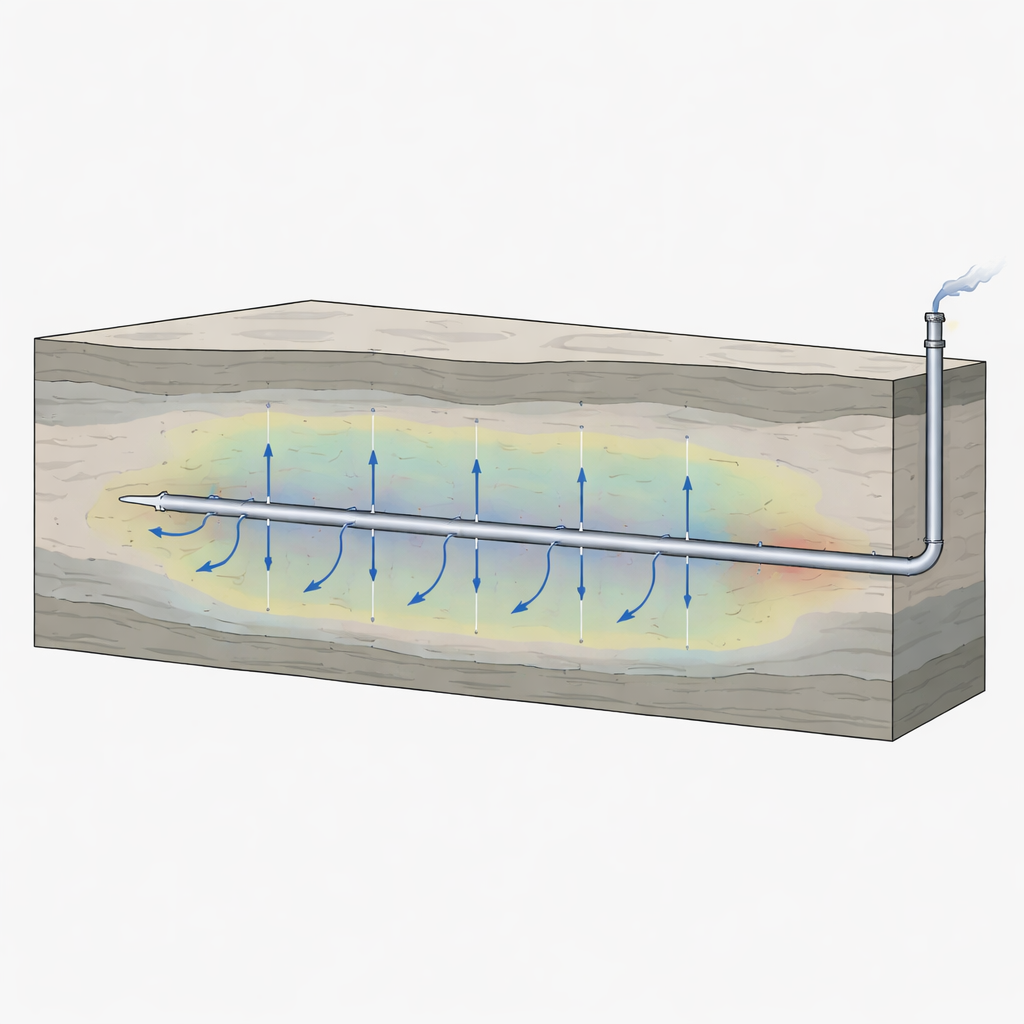
Looking inside a fractured gas reservoir
After a horizontal shale well is hydraulically fractured, it does not behave like a simple pipe in uniform rock. Instead, there is a multistage system: high-conductivity hydraulic fractures directly connected to the wellbore, a stimulated reservoir volume (SRV) made of many smaller fractures and deformed rock around those main fractures, and unstimulated matrix rock farther away. Gas starts out trapped both as free gas in tiny pores and adsorbed onto organic material. As pressure drops, adsorbed gas is released and moves from the tight matrix into the smaller natural fractures, then into the larger hydraulic fractures, and finally to the well. The authors build a flow model that represents these regions separately but couples them together so they can track how pressure and gas flow evolve through time.
Building a model that captures real-world complexity
Earlier models often treated the stimulated region and the fractures as having uniform properties, which glosses over the messy reality seen in field measurements. In practice, fracture pathways vary strongly in their ability to transmit gas: proppant grains are unevenly placed, some fracture segments pinch off, and pressure changes can squeeze fractures closed. To capture this, the researchers allow permeability to change continuously along fractures and within the SRV rather than assigning a single constant value. They draw on advanced mathematical tools – including pseudo-pressure, stress-sensitive permeability terms, and perturbation methods – to obtain analytical solutions that still run efficiently on a computer. The result is a “multi-scale, multi-zone” description that can reproduce fine details of how pressure waves move and how production declines over time.
What controls how far the rock actually drains
With the model in hand, the team explores which rock and fracture properties matter most for long-term production. They find that the permeability of the tight matrix – the background shale away from the main fracture network – is a key control on how far pressure can reach and how much gas can ultimately be drained. Higher matrix permeability lets pressure changes travel farther, increasing the effective drainage distance and sustaining production. Permeability in the SRV also matters: higher values expand the drainage area, while very low SRV permeability delays the onset of matrix flow and shrinks the final drained region. In contrast, simply extending fractures to be much longer brings diminishing returns; beyond a certain length, making fractures longer does little to increase how much of the reservoir can actually contribute gas.
How damage and uneven fractures reshape output
The study also examines how “damage” along hydraulic fractures and uneven properties in the SRV change production curves. If the fracture is blocked near the well (“root damage”), initial gas rates plunge because flow into the well is choked from the start. If damage occurs mainly near the fracture tips, early production looks relatively healthy but declines faster later on as distant rock is poorly connected. Likewise, SRV regions with gently varying permeability act much like a uniform medium, but sharp drops in permeability cause noticeable losses in mid- to late-stage production. These results suggest that protecting fracture conductivity near the wellbore and avoiding strong bottlenecks in the stimulated rock are crucial for both high early rates and stable long-term output.
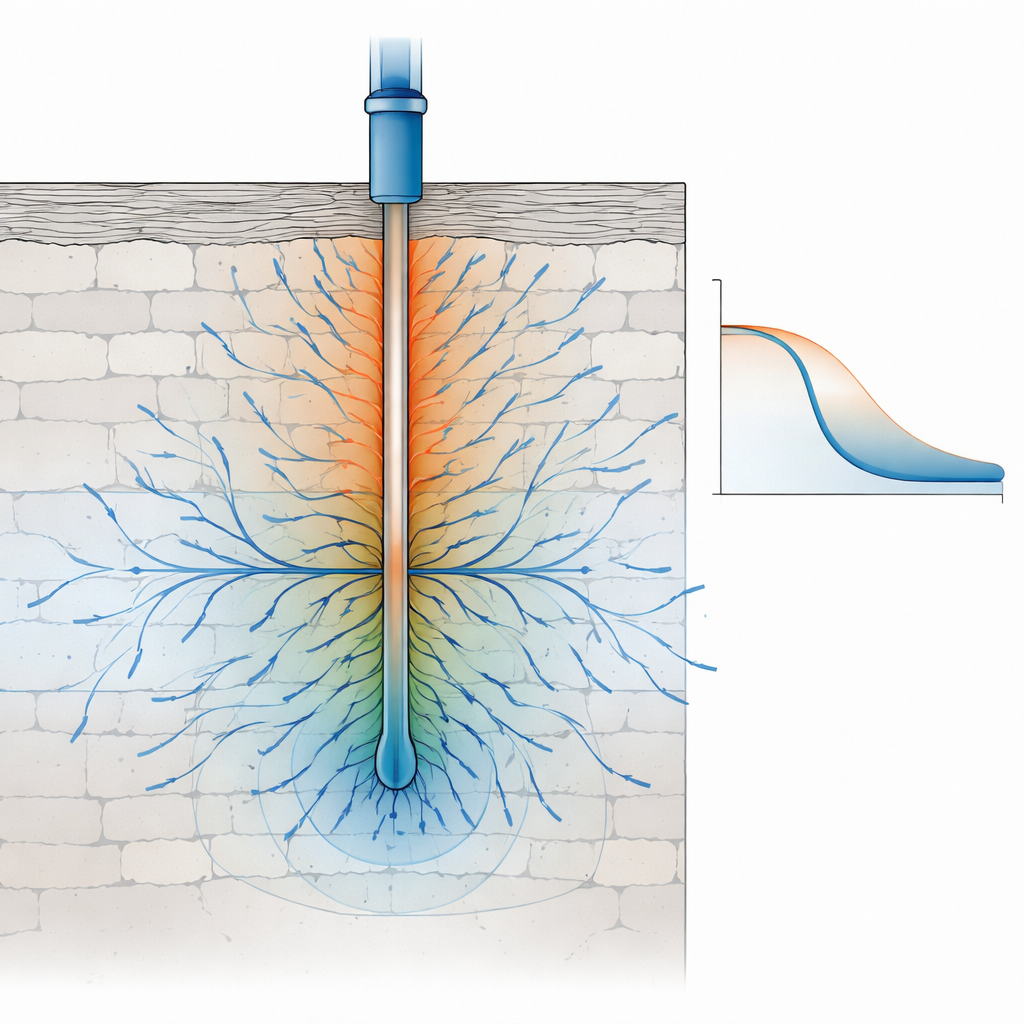
Testing the model on real wells
To see whether their theory holds up in the field, the authors apply their model to two shale gas horizontal wells in China’s Ordos Basin. They combine their analytical solutions with optimization algorithms that automatically adjust uncertain parameters – such as fracture length, SRV permeability, and the degree of fracture damage – until the simulated production curves match the measured data. For both wells, the model reproduces daily and cumulative production with high statistical agreement, and yields realistic estimates of ultimate gas recovery: tens of millions of cubic meters per well. This demonstrates that the model is not just a mathematical exercise but a practical tool for diagnosing how a given well is performing and how its fracture network is likely arranged underground.
What this means for future shale gas wells
For non-specialists, the core message is that in shale gas production, how the fractures connect the rock matters as much as how many fractures are pumped. The study shows that subtle variations in fracture conductivity and stimulated rock quality can strongly influence both early production and long-term recovery, while simply drilling longer fractures may not pay off. By providing a way to infer hidden reservoir properties from routine production data, the new model can help operators design better fracturing jobs, choose well spacing more wisely, and anticipate how fast wells will decline. In short, it offers a more realistic picture of how gas makes its journey from stubbornly tight rock to the surface pipeline.
Citation: Xiong, W., Li, Y., Guo, W. et al. Transient Flow model and heterogeneity effect analysis for fracture networks in shale gas horizontal wells. Sci Rep 16, 11555 (2026). https://doi.org/10.1038/s41598-026-40306-y
Keywords: shale gas, hydraulic fracturing, fracture networks, reservoir simulation, heterogeneous permeability