Clear Sky Science · en
Mechanistic model of phase-transitioning therapeutics injected into poroelastic tissue for improved targeting of superficial tumors
Why this approach to tumor treatment matters
Cancer doctors increasingly want ways to attack tumors right where they sit, instead of flooding the whole body with drugs. One promising tactic is to inject a drug mixed with a special liquid that turns into a soft gel once inside the tumor, helping keep the treatment in place. This paper develops a detailed computer model of how such injections behave inside soft tissue, with the goal of making local cancer therapies safer, more effective, and easier to design without endless animal experiments.
How a simple shot becomes a tiny drug reservoir
When a clinician injects a drug directly into a tumor, the fluid exiting the needle pushes the surrounding tissue aside and creates a small, fluid-filled cavity. In the strategy studied here, the injected fluid carries both the active drug and a helper material that turns from a liquid into a gel when it meets the water-rich environment of the body. Very quickly, a soft gel shell forms at the edge of the cavity, while a more liquid core remains in the center. The drug gradually moves outward: first through this gel shell, then into the neighboring tumor and healthy tissue, forming a spreading cloud of medicine. 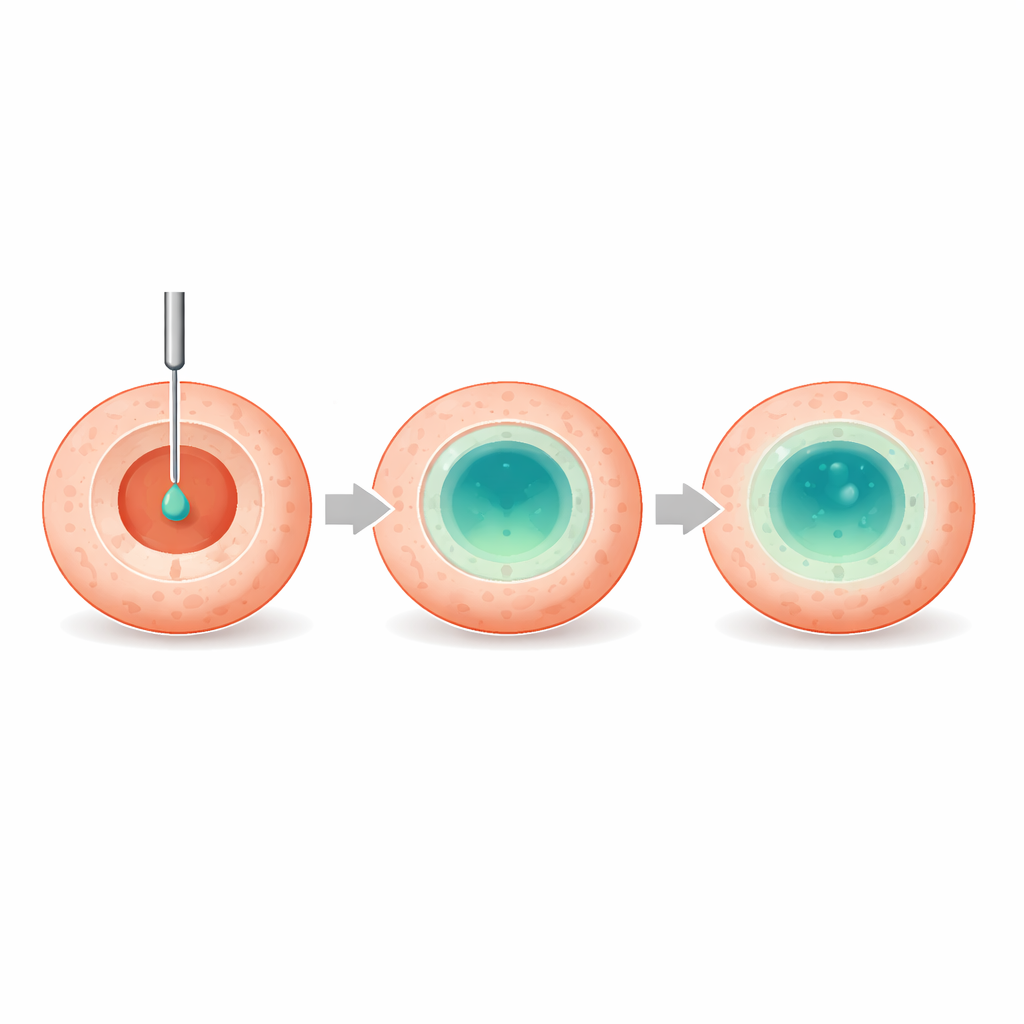
Building a physics-based "digital twin" of an injection
The authors created a mathematical model that treats tissue not as a simple sponge, but as a two-part system: a solid framework soaked with fluid. They coupled three pieces of physics. First, a tissue mechanics module predicts how the tissue deforms and how a cavity grows as fluid is pushed in. Second, a gel-formation module tracks how the special carrier material separates into liquid and dense gel phases over time. Third, a transport module follows how the drug is carried by fluid flow and by slow molecular spreading. Together, these linked equations simulate how pressure, cavity size, gel structure, and drug concentration change from the moment the needle is inserted through the long relaxation period after the injection stops.
What tissue properties mean for keeping drug in place
Using this model, the team explored how features of the host tissue influence where the drug ends up. They found that soft, relatively tight tissues that do not easily let fluid escape tend to hold onto more of the injected drug near the target. In contrast, stiffer tissues form smaller cavities and push more fluid outward, which lowers drug retention in the tumor over time. Likewise, tissues that are more permeable to fluid allow the injectate to leak away more quickly. These results echo what is known about many solid tumors: as they become denser and harder, they are more difficult to treat because drugs struggle to stay concentrated where they are most needed. 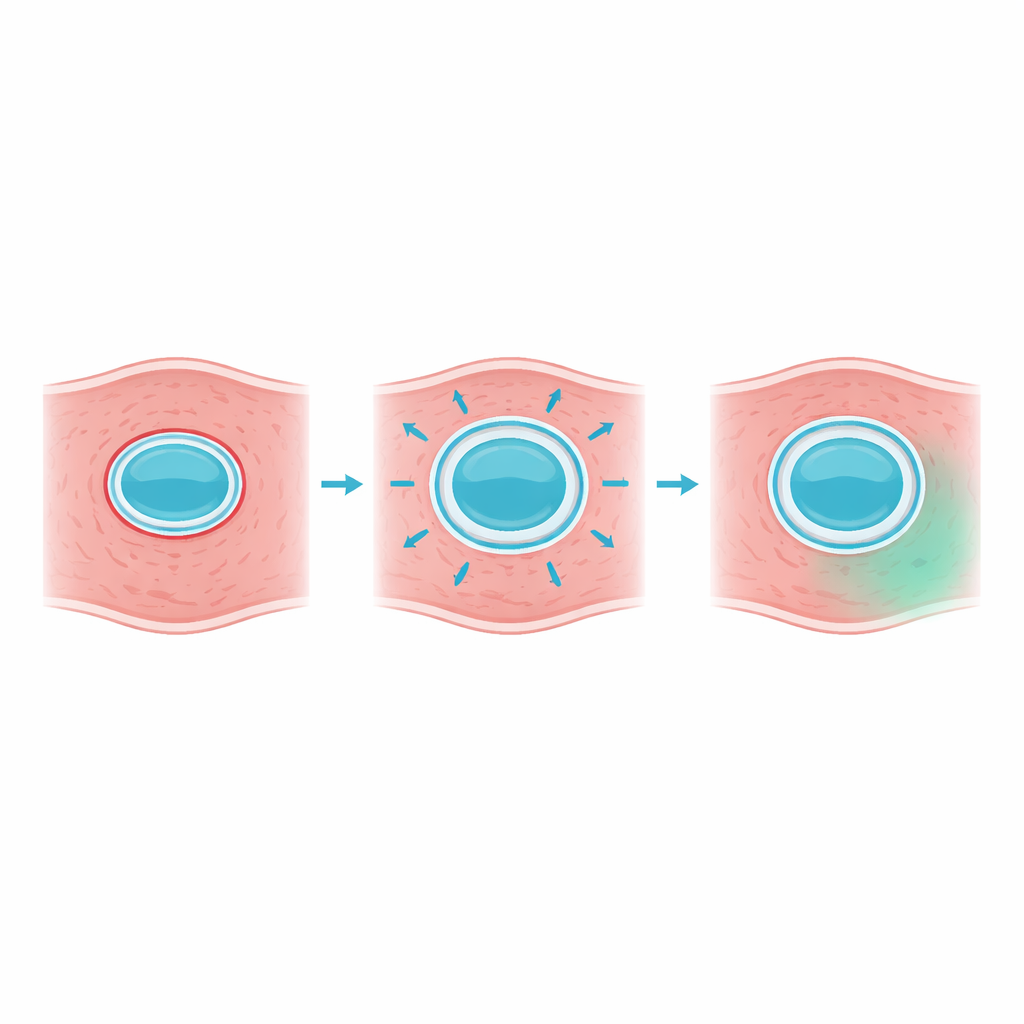
How injection technique shapes drug retention
The model also shows that how you inject matters as much as what you inject. For a fixed amount of drug, smaller injection volumes delivered at higher flow rates tended to keep more drug within the tumor. Rapid injections briefly raise pressure and expand the cavity but end sooner, shortening the window during which fluid flow can carry drug away. Larger volumes extended the injection time without greatly enlarging the cavity, giving convection more time to wash drug out into surrounding tissue. Interestingly, the detailed gelation behavior of the carrier material—how fast it gels and how tightly it holds the drug—played a smaller role than expected under many conditions, because fluid flow during injection dominated the early stages of drug movement.
Limits of the model and paths forward
Like any model, this one makes simplifying assumptions: it treats the tumor as a uniform, spherical body, ignores tissue fracture, and assumes the gel stays inside the cavity rather than seeping into tissue. These choices make the problem manageable but may miss some real-world behaviors, such as cracks that allow fluid to escape or highly uneven tumor structure that redirects flow. Even so, the model qualitatively matches many observations from experiments in animal tissues and tissue-mimicking gels, suggesting that it captures the key physical players and can guide better study designs and device parameters.
What this means for future cancer treatments
In everyday terms, this work offers a way to rehearse complex tumor injections inside a computer before testing them in the lab or clinic. By adjusting tissue softness, needle size, injection rate, volume, and material formulation, the model predicts how much of the drug will stay inside the tumor and for how long. The main takeaways are that soft, less leaky tissues, smaller injection volumes, and faster injection rates all favor keeping medicine where it counts. As the model is refined to include more realistic tumor structures and possible tissue damage, it could become a powerful planning tool for designing localized, gel-forming cancer therapies that are both more effective and less taxing on patients.
Citation: Adrianzen Alvarez, D.R., Orozco, E.S.L., Ramanujam, N. et al. Mechanistic model of phase-transitioning therapeutics injected into poroelastic tissue for improved targeting of superficial tumors. Sci Rep 16, 10403 (2026). https://doi.org/10.1038/s41598-026-40299-8
Keywords: intratumoral injection, hydrogel drug delivery, tumor mechanics, localized cancer therapy, computational modeling