Clear Sky Science · en
Early evidence for the benefits of biochar in organic regenerative agriculture
Why caring for the hidden life in soil matters
Healthy soils quietly help to feed us and to slow climate change by storing carbon underground. But modern farming can wear soils down, and it is hard to know which new practices really rebuild this living bank of carbon. This study tested a promising mix of techniques called regenerative agriculture, with and without an added ingredient—biochar, a charcoal-like material made from plant waste—to see how quickly they can improve soil on a working organic farm in Germany.

Three ways to work the same field
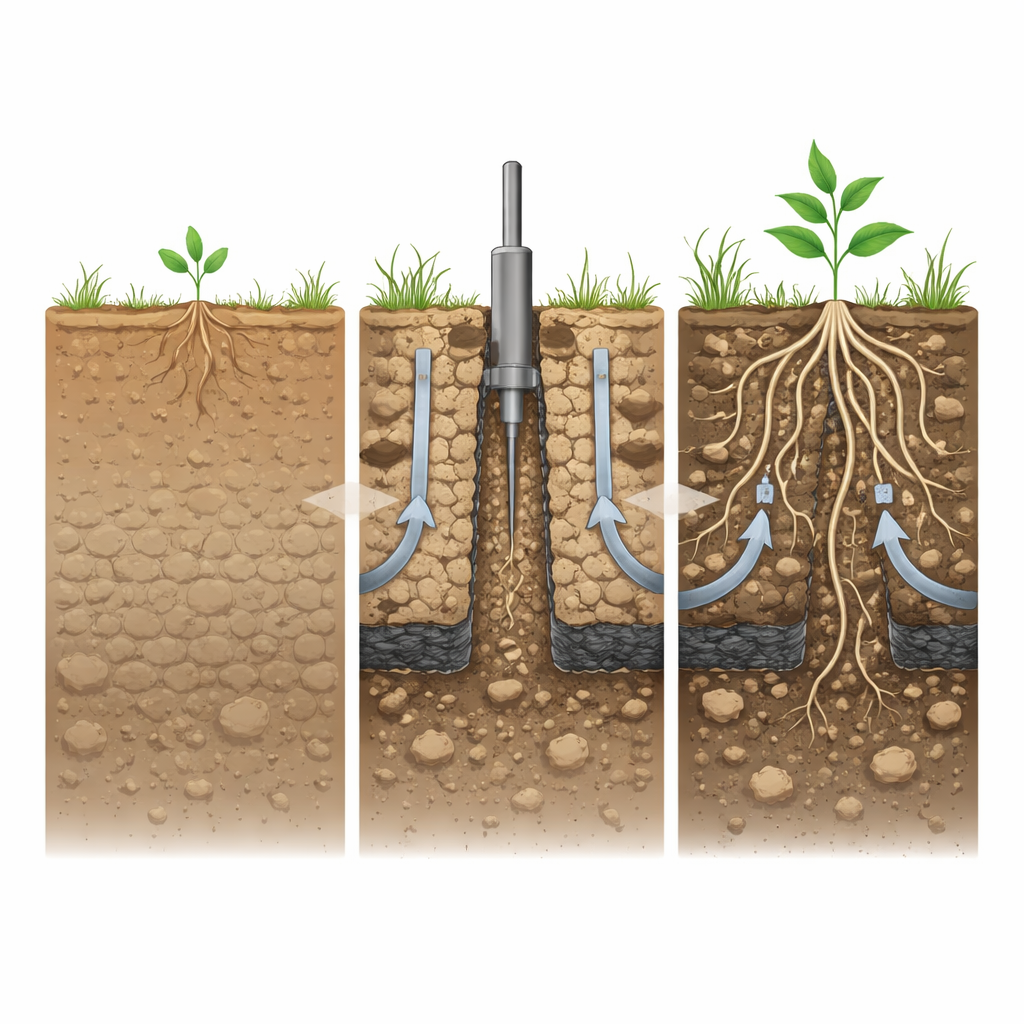
The researchers set up a large field experiment on an organic dairy and arable farm that has been managed without synthetic fertilizers or pesticides for decades. They compared three systems side by side: a regional organic "control" using regular ploughing and modest cover crops; a regenerative system (RA) with reduced tillage, deeper loosening of compacted soil, and very diverse cover crop mixtures; and the same regenerative system plus deep bands of activated biochar placed about 30 centimeters below the surface (RABC). All plots followed the same three-year crop rotation of faba bean, winter wheat, and silage maize so that only the soil practices, not the crops, differed.
Measuring change in a slow-moving system
Because soil carbon changes slowly, the team measured more than just how much carbon was stored. In 2020 and again in 2023 they took deep soil cores down to one meter and split them into five layers. For each layer they recorded carbon content, soil density, and calculated carbon stocks using a method that corrects for changes in soil compaction over time. They also tracked faster-responding signs of soil life in the upper 30 centimeters: how much carbon dioxide the soil breathed out after rewetting, how much easily dissolved carbon and nitrogen it contained, and how much carbon was locked up in living microbes (microbial biomass carbon).
What changed with regenerative practices alone
After three years, the regenerative system without biochar did not store noticeably more carbon than the control when the full one‑meter soil profile was considered. Carbon levels in both systems stayed roughly stable, with small, statistically uncertain shifts up or down in different layers. Yet the biology told a different story. In the top 10 centimeters, microbial biomass was clearly higher under regenerative management, showing that soil life responded quickly to reduced disturbance and more continuous plant cover. At the same time, the total amount of carbon in that layer barely moved once the researchers corrected for the fact that the soil had become looser and less dense—an early sign that structure and biology may be improving before the carbon ledger shows a gain.
Adding biochar tips the balance
The most striking changes appeared when biochar was added to the regenerative system. Here, total native soil carbon stocks across the full meter increased by about 2.24 metric tons of carbon per hectare over three years, on top of the carbon contained in the biochar itself. Soil in these plots became less dense, especially around 30–50 centimeters where a compacted plough layer had been loosened. In the deepest measured layer, carbon concentrations even rose while they declined in the regenerative plots without biochar. Microbial biomass in the topsoil was as high as in the regenerative system, and signs of soil activity—respiration, dissolved nutrients, and an overall soil health score—tended to be stronger, although most of these trends were not yet statistically firm.
Limits, trade-offs, and real-world hurdles
The study highlights why short trials can miss the full picture of soil recovery. Models and previous long-term experiments suggest that building soil carbon often takes a decade or more, especially in already well‑managed organic soils and under increasingly frequent droughts like those during the trial years. The authors argue that early boosts in microbial biomass and better soil structure are promising hints that regenerative practices are steering the system in the right direction, even before clear carbon gains appear. However, they also note that biochar—the component that delivered measurable carbon increases—remains expensive, and the experiment did not find yield gains that would offset the cost under current market conditions.
What this means for climate‑friendly farming
For non‑specialists, the takeaway is that simply switching to gentler tillage and more cover crops can quickly enliven the soil, but turning that biological buzz into measurable, long‑lasting carbon storage is slower and uncertain. Combining regenerative methods with targeted biochar in the subsoil appears to speed up carbon buildup and improve soil structure, at least in the early years. Yet confirming how much climate benefit this really delivers—and whether it is economically viable for farmers—will require longer‑term measurements, full carbon accounting that includes other greenhouse gases, and supportive policies or carbon credit schemes. In short, regenerative farming is a promising tool to care for soils and buffer them against climate stress, and biochar may be a powerful helper, but both need time, careful monitoring, and financial support to reach their full potential.
Citation: Kohl, L., Minarsch, EM.L., Niether, W. et al. Early evidence for the benefits of biochar in organic regenerative agriculture. Sci Rep 16, 7833 (2026). https://doi.org/10.1038/s41598-026-40280-5
Keywords: regenerative agriculture, biochar, soil carbon, cover crops, organic farming