Clear Sky Science · en
Stentor stipatus is a new unicellular species that demonstrates habituation and unique phototaxis
A surprising mind in a single cell
Most of us picture single-celled organisms as simple blobs, but some of them behave in ways that look uncannily like memory, decision-making, and even a daily sleep–wake rhythm. This paper introduces Stentor stipatus, a newly discovered freshwater microbe that is large enough to see with the naked eye and packed with green algae under its skin. Found in the rust-colored waters of a Cape Cod swamp, this lone cell can learn to ignore repeated pokes and can swim toward or away from light depending on the time of day, offering a rare window into how complex behavior can arise without a brain.
A new giant cell from a rusty swamp
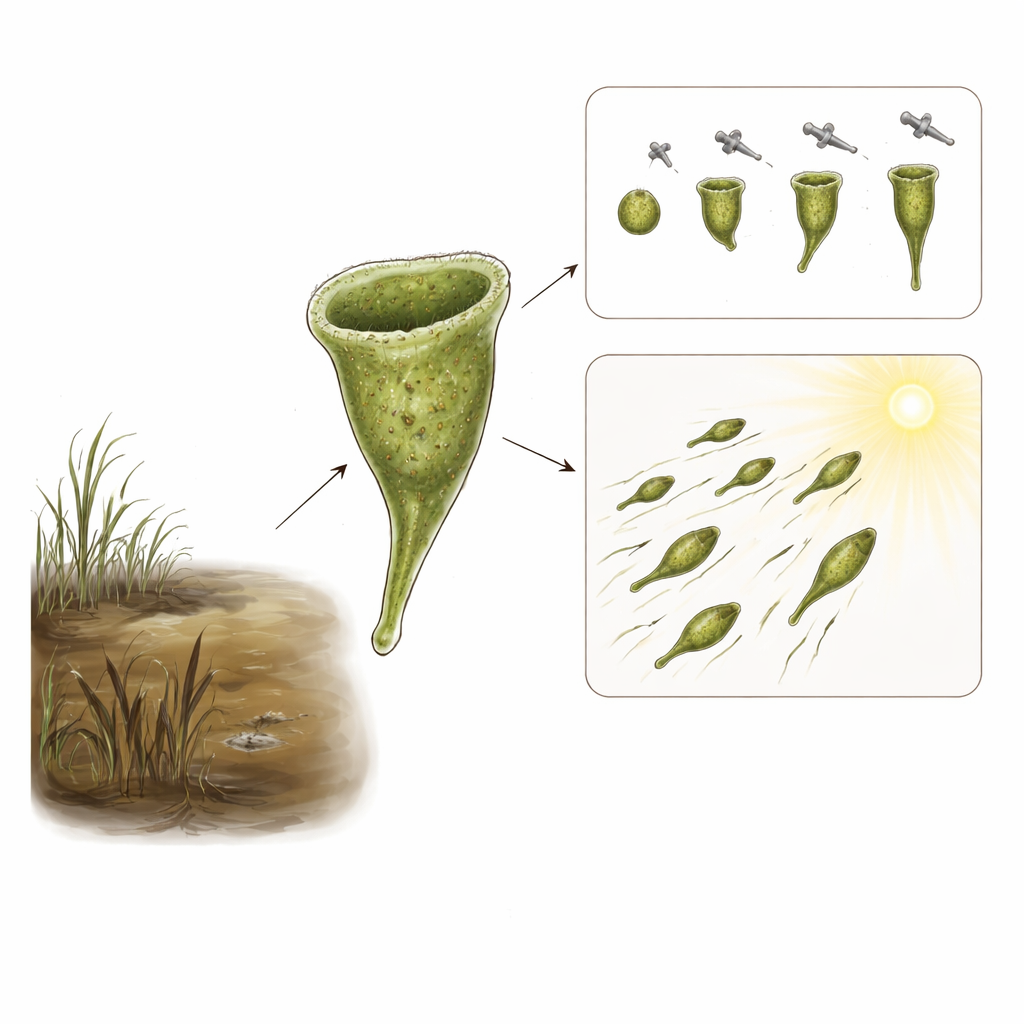
The story begins in an iron-rich white cedar swamp linking two ponds on Cape Cod, Massachusetts. There, researchers noticed dark, fast-swimming, trumpet-shaped cells gathering in sunlit patches of the murky water. Under the microscope, these organisms looked similar to known members of the genus Stentor, famous for their large size and dramatic contractions. The team found that the new cells are small by Stentor standards—about two-tenths of a millimeter long—and shaped like a flattened teardrop or watermelon seed. They live among decaying plant matter and often attach by one end to leaves or debris, but can quickly detach and dart away when disturbed. Their preferred home, unusually high in dissolved iron, seems harsh for closely related species, hinting that S. stipatus may be specially adapted to this challenging niche.
Green coats and hidden colors
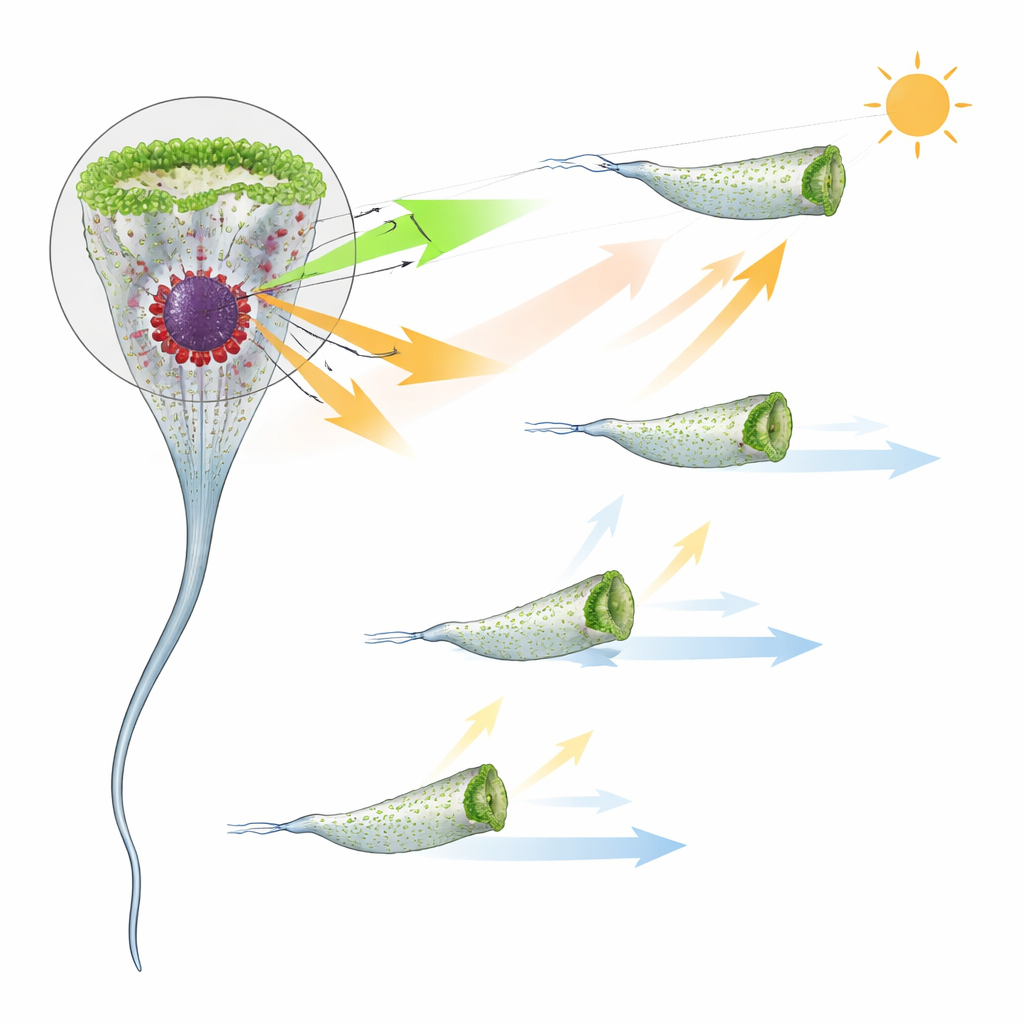
Closer inspection revealed striking body architecture. The outer layer of S. stipatus is densely lined with rows of tiny green algae, which give the cell its overall green color. Just inside this shell of algae sit scattered reddish-brown granules, especially concentrated around a single round nucleus deep in the center. Fluorescence imaging confirmed that the algae form a tight band under the surface while the darker granules cluster near the genetic control center, as if the cell were wearing a protective cloak that still lets its partners see the light. Because the algae are highly fluorescent and remain tightly packed against the cortex, the system offers a natural model for studying how a host cell positions its symbiotic partners and pigments in three dimensions.
Proving it is truly new
At first glance, S. stipatus could be mistaken for Stentor amethystinus, a known species with rich red coloring and similar size. To test whether this swamp inhabitant is genuinely distinct, the researchers sequenced a standard piece of ribosomal DNA from multiple individual cells and compared it to existing Stentor sequences. Using evolutionary tree-building methods, they found that S. stipatus forms its own well-supported branch, sitting near but clearly separated from S. amethystinus and another green species, S. pyriformis. The genetic distance between S. stipatus and S. amethystinus is comparable to that separating other accepted Stentor species, confirming that this is not just a local variant but likely a true newcomer to the catalog of life.
Learning from repeated pokes and following the light
Behavior is where this single cell truly shines. Like its relatives, S. stipatus performs a rapid full-body contraction when mechanically jarred, a likely escape maneuver from predators. Using an automated tapping device, the team delivered regular mechanical jolts and recorded how many cells responded over time. At first, most S. stipatus cells contracted, but within about an hour their responses dropped sharply—even though the taps continued. This pattern, known as habituation, is a simple form of learning in which an organism stops reacting to repeated, harmless stimulation. Compared with the well-studied species Stentor coeruleus, S. stipatus is less sensitive to the same force and becomes habituated more quickly, providing a new comparative model for probing how a single cell can “tune out” background noise.
A living compass that runs on an internal clock
S. stipatus is also strongly drawn to light. In a custom-built chamber with a light source at one end, most cells swam briskly toward the brighter side, producing a high phototaxis index and sharply directed motion paths. When the researchers tested different colors of light, they found that the cells responded to a broad range, with strong attraction to orange–yellow wavelengths and secondary peaks in the green and possibly blue-green. Yet this light-seeking is not constant. In cultures kept on a 12-hour light, 12-hour dark schedule, the cells showed almost no attraction to light before dawn, ramped up to very strong attraction around midday, and then lost and even reversed their preference near evening, becoming slightly light-avoiding at night. This rise and fall preceded the external changes in lighting, suggesting that the cells might be using an internal clock rather than just reacting passively to current conditions.
Clues from spinning cells and shifting pigments
To probe how the internal layout of algae and pigments matters, the team subjected S. stipatus to high-speed centrifugation. Spun cells did not lose their algae, but their internal contents shifted so that one half of the cell became packed with green and dark material while the other half turned transparent. Under uniform dim light these cells swam normally, but under a bright directional beam they traced tight circles instead of heading straight toward the light. Over about ten minutes, the pigments and algae gradually spread back over the whole cell, and the usual straight, corkscrew swimming toward light returned. Fixed images confirmed that the algae had been redistributed to one side and then reclaimed even coverage, supporting the idea that the relative positions of algae and pigments help determine how the cell senses light and steers.
Why this single cell matters
Together, these findings establish Stentor stipatus as a new species with a distinctive look, habitat, and behavior. It carries a living coat of algae, may be unusually tolerant of iron-rich waters, can learn to ignore repeated pokes, and changes its light-guided swimming over the course of the day in a way that hints at an internal timing system. For a single cell with no nervous system, this range of abilities is remarkable. By comparing S. stipatus to its Stentor cousins, researchers hope to uncover basic rules for how cells build complex bodies, manage symbiotic partners, cope with polluted environments, and generate behaviors that, in animals, would be assigned to brains and clocks. In short, this humble swamp-dweller offers a powerful new model for exploring how much “intelligence” can fit inside one cell.
Citation: Rajan, D.H., Lee, B., Albright, A. et al. Stentor stipatus is a new unicellular species that demonstrates habituation and unique phototaxis. Sci Rep 16, 9984 (2026). https://doi.org/10.1038/s41598-026-40277-0
Keywords: Stentor stipatus, single-celled behavior, phototaxis, habituation, protist ecology