Clear Sky Science · en
Integrative taxonomic study reveals a new species of Maculolachnus (Hemiptera: Aphididae) from South Korea
A New Hidden Guest on Our Garden Roses
For most of us, rose bushes are symbols of beauty in gardens and city parks. But tucked along their woody stems live tiny sap-feeding insects whose stories are largely unknown. This study uncovers a previously overlooked aphid species living on roses in South Korea, shows how scientists combined careful field work, body measurements, DNA analysis, and electron microscopy to recognize it, and explains why finding such hidden diversity matters for understanding ecosystems, plant health, and the many creatures—from ants to fungi—that interact with these insects. 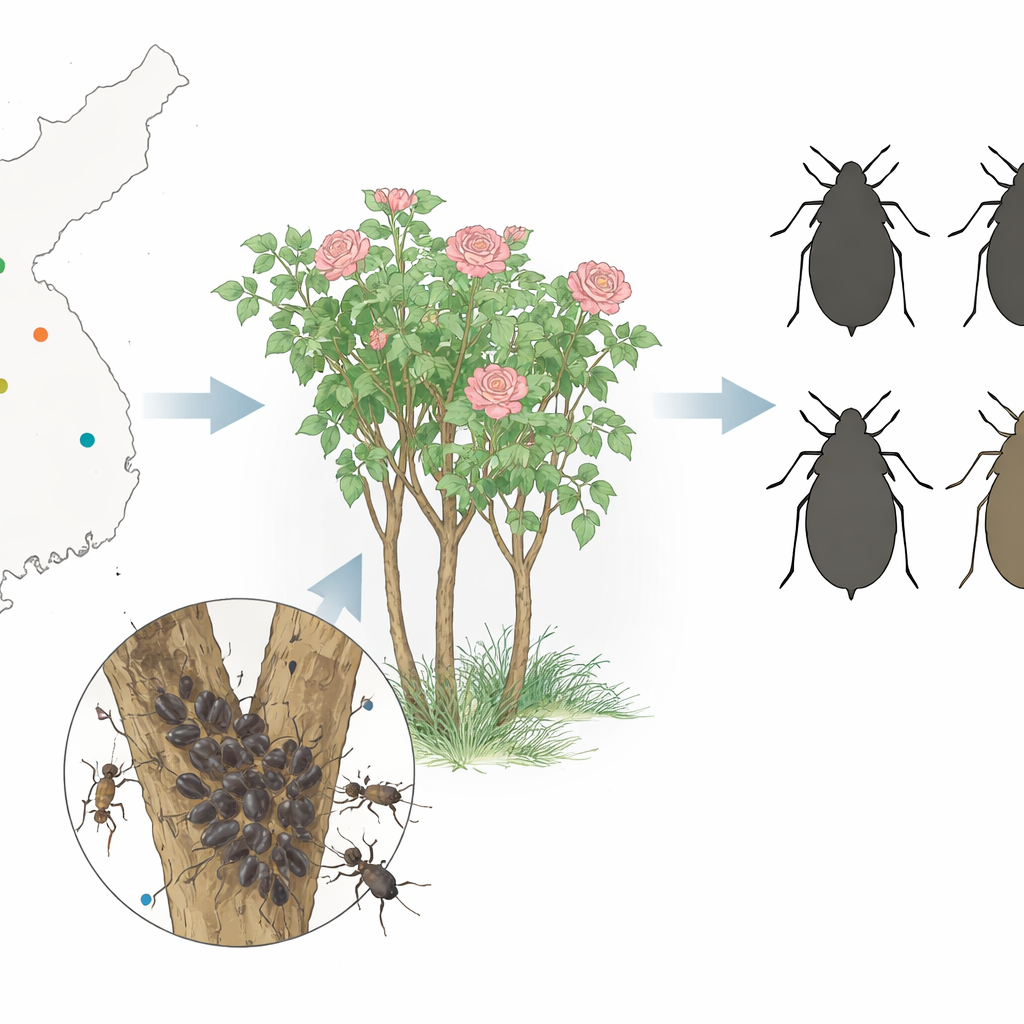
Unmasking a Look-Alike on Rose Stems
The focus of the work is a genus of large bark-dwelling aphids called Maculolachnus, which feed only on woody rose relatives. Around Eurasia they have long been treated as a few widespread species, especially one named M. submacula. Korean specimens had been assigned to that species simply because they looked broadly similar. The authors revisited this assumption by collecting aphids from cultivated and wild roses across South Korea and studying all life stages on their natural hosts. They noticed subtle, but consistent, differences in body shape, color patterns, and fine structures compared with European material. These clues suggested that the Korean populations might not be the same species after all.
Measuring Bodies and Reading DNA
To test this, the team carried out an “integrative” taxonomic study, meaning they combined several independent lines of evidence. Under the microscope, they compared features such as the proportions of the antenna segments, patterns on the wings, the shape of the mouthparts, and the texture of the abdomen. Korean aphids had a distinct pattern of polygon-like sculpturing on the body surface and a differently shaped genital plate compared with European M. submacula. At the same time, the researchers sequenced a standard stretch of mitochondrial DNA known as COI, widely used as a genetic barcode. When they built evolutionary trees and ran species-delimitation programs, the Korean aphids consistently formed their own branch, clearly separated from three other known relatives: M. submacula, M. sijpkensi, and M. paiki. 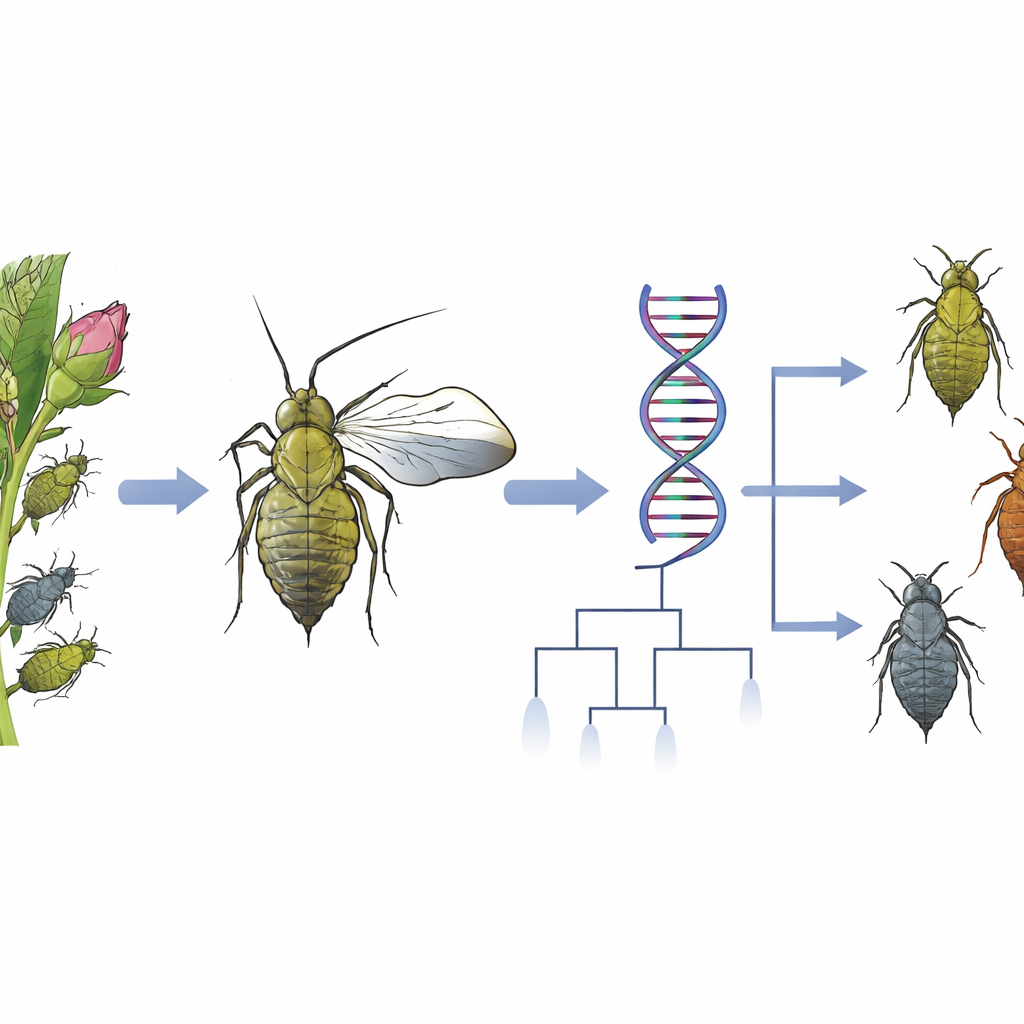
Life Among Roses, Ants, and Sooty Mold
Field observations revealed that the newly recognized species, which the authors name Maculolachnus koreanus, lives on several rose species planted by people in both mountain villages and urban green spaces. Colonies form mainly on stems close to the ground, often inside or near tunnels built by ants of the genus Lasius. The ants tend the aphids, feeding on the sugary honeydew they excrete. In early summer, wingless and winged females build up large colonies; in autumn, special egg-laying females and males appear, and eggs are placed on branches and thorns to survive the winter. Heavy infestations can leave branches, leaves, and flower buds coated in black sooty mold that grows on accumulated honeydew, affecting the appearance and possibly the vigor of ornamental roses.
Seeing the Invisible with Electron Beams
To go beyond what standard microscopes can show, the team used scanning electron microscopy to image the aphids at extremely high magnification. This revealed forests of hair-like sensilla on the antennae, head, legs, wings, and abdomen—tiny sensory organs that help the insects sense their surroundings, hosts, and ant partners. The exact shapes, surfaces, and arrangements of these structures turned out to be distinctive and provided a new set of characters for telling species apart within this otherwise uniform group. Such images also document how the aphids’ rear-end structures are adapted for life with ants, supporting earlier ideas that some bark-dwelling aphids have evolved bodies specially shaped for this close partnership.
Why One Small Species Matters
In the end, the evidence from body measurements, DNA, and fine-scale anatomy all point to the same conclusion: the Korean aphids once lumped into a widespread species are actually a distinct evolutionary lineage, formally described here as Maculolachnus koreanus. Recognizing this species brings the known total in the genus to four and corrects a long-standing misidentification on the Korean Peninsula. More broadly, the study shows how much hidden diversity can remain even in well-traveled environments like gardens, and how combining classical taxonomy with modern genetic tools and advanced imaging can uncover it. Such work refines our picture of biodiversity, helps track pest species more accurately, and lays the groundwork for future studies of how insects, plants, and mutualistic ants coevolve in a changing world.
Citation: Lee, M., Kanturski, M. & Lee, S. Integrative taxonomic study reveals a new species of Maculolachnus (Hemiptera: Aphididae) from South Korea. Sci Rep 16, 12278 (2026). https://doi.org/10.1038/s41598-026-40274-3
Keywords: aphids, rose pests, integrative taxonomy, DNA barcoding, insect biodiversity