Clear Sky Science · en
Experimental study on permeability of dry and wet high rank coal specimens related to stress and mechanical properties
Why this matters for cleaner energy
Coalbed methane—natural gas trapped in coal seams—can help cut carbon emissions if it can be produced efficiently. A major obstacle is that gas has trouble flowing through deep, tight coal, especially when the rock is stressed by the weight of overlying strata and filled with water. This study looks closely at how squeezing and soaking coal change its ability to let gas through, and how the coal’s own strength and stiffness either protect or damage that flow. The findings offer practical clues for getting more gas out of deep coal seams while managing water and pressure underground.
How coal holds and moves gas
Coal is not a uniform block: on a microscopic level it is shot through with pores and natural fractures that act as tiny pipelines for methane. The ease with which gas moves, called permeability, depends on how open those pathways are. As coal seams are drained during production, the balance of forces underground shifts. Water and gas pressures drop, while the weight of surrounding rock is increasingly carried directly by the coal framework. This "effective" stress tends to squeeze fractures shut, and the rock’s mechanical properties—how strong, stiff, or deformable it is—control how quickly that happens. The authors set out to link these mechanical traits directly to changes in permeability in both dry and water-bearing high-rank (very mature) coals from China’s Qinshui Basin.
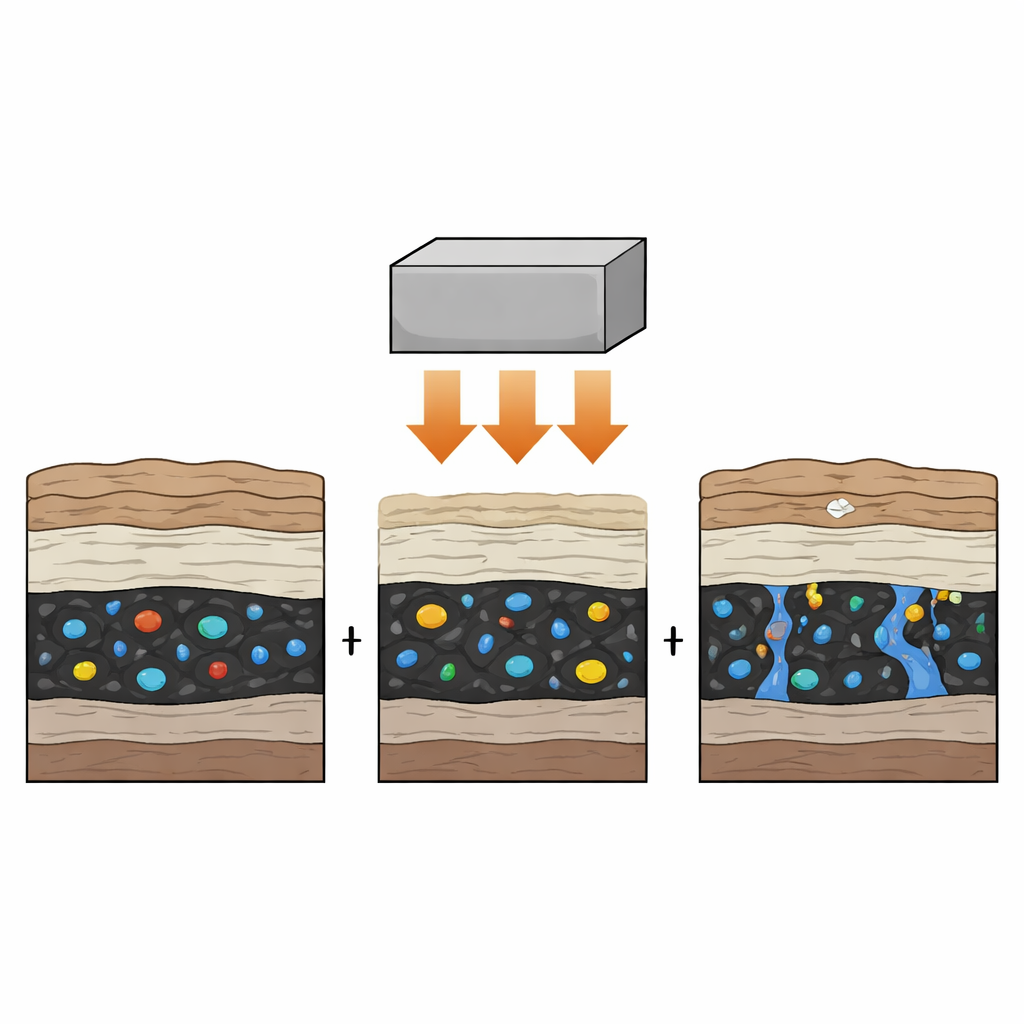
Putting coal under pressure in the lab
The team cored small cylinders of coal from several mines and tested them in a controlled laboratory setting. First, they measured how easily helium gas flowed through the dry coal as they gradually raised the surrounding pressure to simulate increasing in-situ stress. Then, they repeated these tests on specimens that had been saturated to different water levels, from completely dry to fully water-filled. In parallel, they used compression and splitting tests to find each sample’s compressive and tensile strength, elastic modulus (stiffness), Poisson’s ratio (how much it bulges sideways when squeezed), and how much it softened when soaked. This combination of seepage and strength tests let them quantify how stress, water, and rock mechanics interact.
What stress and water do to gas flow
The experiments show that gas permeability in both dry and wet high-rank coals falls off exponentially as effective stress rises: the first few megapascals of extra stress cause a rapid drop in flow, which then tapers off as fractures become mostly closed. Water makes this problem much worse. As water saturation increases, permeability declines faster and the coal becomes more "stress sensitive"—small extra loads or pressure changes cause large additional losses in flow. By the time the samples are fully saturated, most of the original permeability is damaged once moderate stress levels are reached. This means that in real coalbed methane wells, dewatering and drawdown can quickly squeeze wet coal, closing its natural cracks earlier and more severely than in drier seams.
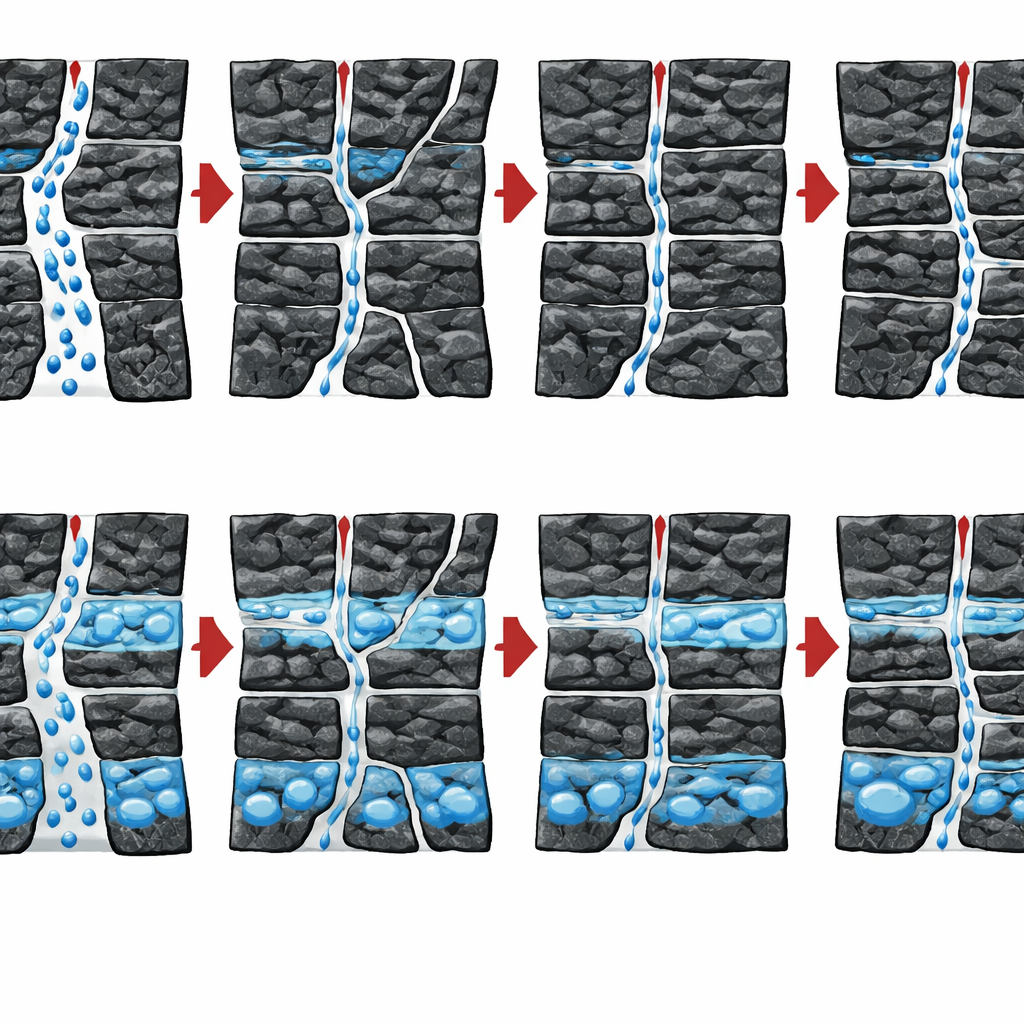
How coal strength and structure control sensitivity
The authors also found that high-rank coal tends to be relatively weak and compliant compared with surrounding rocks, with low compressive and tensile strength, low stiffness, and a relatively high Poisson’s ratio. As the coal becomes more thermally mature (higher vitrinite reflectance), its strength and stiffness increase and Poisson’s ratio drops, reflecting a tighter, more rigid structure. Stronger, stiffer samples generally started with lower permeability—because their fractures were already tighter—but their flow pathways were less damaged by added stress. In contrast, coals with a higher Poisson’s ratio, which deform more sideways, had higher initial permeability but suffered larger and faster permeability loss under load. Water exposure further reduced strength (strong softening), especially in coals rich in certain clay minerals, making their fractures easier to close.
What this means for producing methane
Overall, the study shows that permeability in deep coal seams is not a fixed property but a moving target controlled by stress, water, and rock mechanics. High water saturation and mechanically weak, compliant coal lead to high initial gas flow that collapses quickly as wells are drawn down. Stronger, stiffer, drier coal may start tighter but maintains its flow channels better as stress increases. For engineers, these results underscore the importance of carefully managing pressure and water removal, and designing stimulation treatments that keep fractures propped open, especially in water-rich seams. In practical terms, understanding a coal reservoir’s strength, stiffness, and tendency to soften in water can help predict how its permeability will evolve and how to sustain methane production over the long term.
Citation: Zhao, K., Meng, Y. & Wang, X. Experimental study on permeability of dry and wet high rank coal specimens related to stress and mechanical properties. Sci Rep 16, 9892 (2026). https://doi.org/10.1038/s41598-026-40273-4
Keywords: coalbed methane, coal permeability, stress sensitivity, water saturation, rock mechanics