Clear Sky Science · en
A robust direction of arrival estimation method based on the chaotic MUSIC algorithm
Finding where signals come from
Modern wireless and radar systems constantly listen for faint signals arriving from many directions. Accurately telling where a signal comes from is vital for tasks like locating phones in an emergency, tracking aircraft, or steering a self driving car. This paper explores a new way to pinpoint a signal’s direction more reliably when the airwaves are cluttered and unpredictable, a situation that often confuses standard methods.
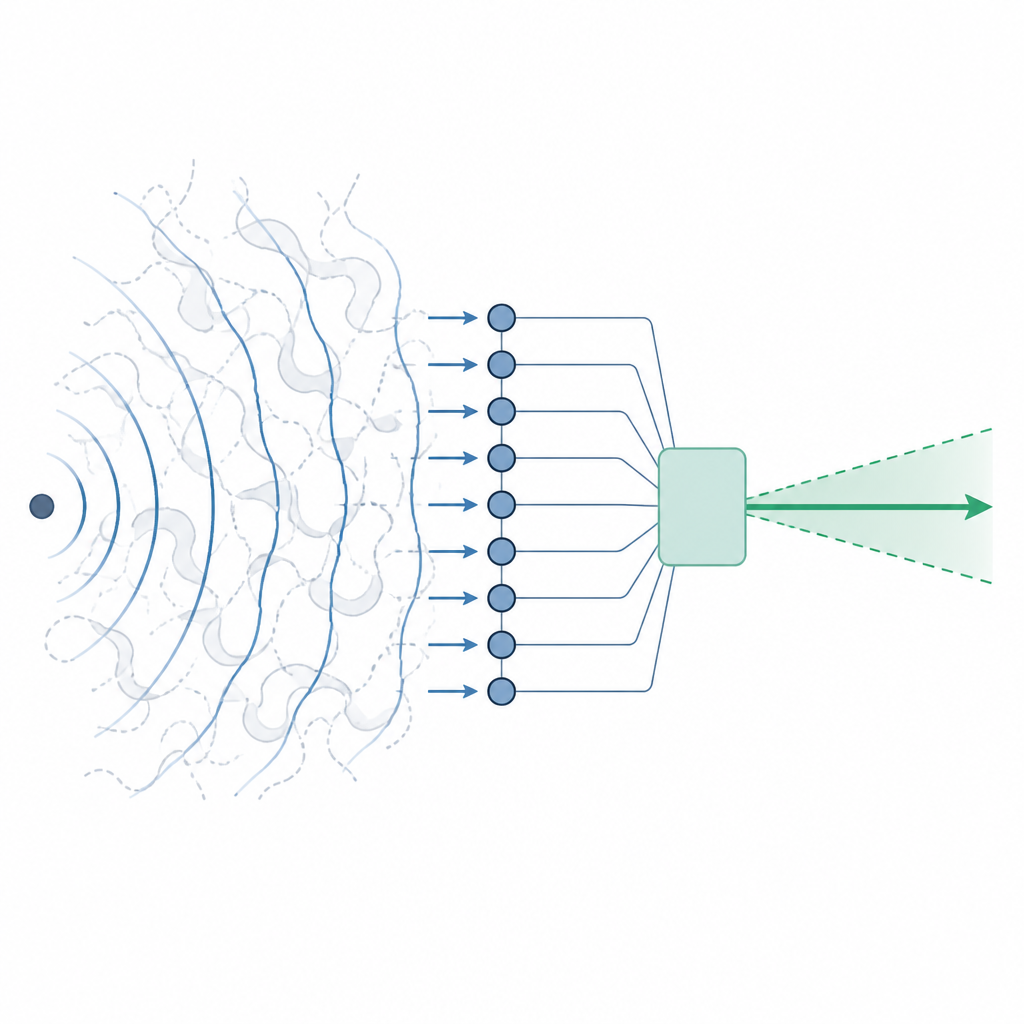
Why listening in space is hard
Engineers often use a row or grid of sensors to work out the direction of arrival of a signal. Each sensor hears the same transmission at a slightly different time and strength, and clever math turns these differences into an angle on the sky. A popular method called MUSIC has long been a workhorse for this task because it can separate several signals that arrive from nearby directions. However, MUSIC assumes that background noise behaves in a neat, bell curve fashion and that signals are not too strongly related to each other. Real environments rarely cooperate, so its accuracy can drop sharply when noise is impulsive, signals echo and blend, or the signal strength is low.
Adding chaos to match the real world
The authors argue that real signals behave more like controlled chaos than like tidy textbook waves. To capture this, they model incoming data with a mathematical chaotic number generator based on Chebyshev functions and logistic maps. These tools produce sequences that are fully determined by equations yet look random and highly sensitive to initial conditions. By feeding such chaotic snapshots into the direction finding process, the model better mirrors messy, real signal paths with reflections, interference, and nonlinear effects. This chaos aware view makes it easier for the algorithm to tell the underlying structure of the signal apart from the clutter that surrounds it.
Teaching the method to ignore outliers
Even with a better signal model, occasional extreme disturbances can still distort the estimate of how noisy the environment is. To tackle this, the team borrows a tool from robust statistics called the Tukey biweight cost function. Instead of treating every data sample as equally trustworthy, this approach automatically downplays samples that stray too far from the typical pattern. In practical terms, this means that sudden spikes or bursts in the data do not overly sway the calculation of the covariance matrix, the key ingredient that MUSIC uses to separate signal from noise. The result is a “robust” version of the algorithm that is much less sensitive to outliers and more stable in rough conditions.
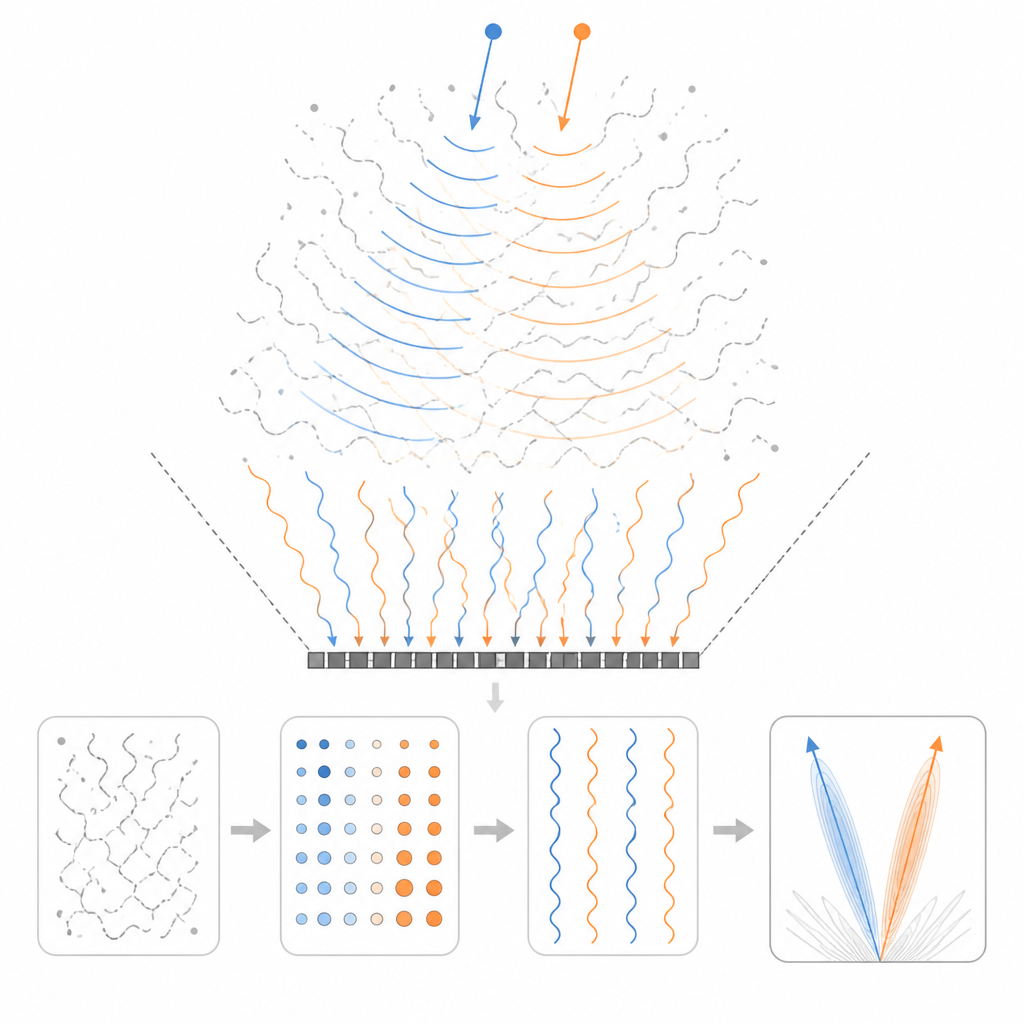
Putting the new idea to the test
To check the benefits of these changes, the researchers run large numbers of computer simulations that mimic a sensor array listening to two closely spaced sources. They compare four setups: standard MUSIC, MUSIC with Tukey biweight, a chaotic version of MUSIC, and the full combination of chaotic MUSIC with Tukey biweight. Performance is judged mainly in two ways. First, root mean square error measures how far the estimated directions stray from the true ones. Second, probability of resolution counts how often the algorithm can tell that there are in fact two separate sources rather than one blurred blob. These trials cover a wide range of signal to noise ratios and degrees of correlation between the sources.
What the results mean for real systems
The simulations show that bringing chaos modeling together with the Tukey biweight function markedly improves performance when conditions are toughest, such as at low signal strength or when signals are highly correlated. The chaotic MUSIC with Tukey biweight method delivers lower average errors, less variation from run to run, and a higher chance of correctly separating nearby sources than the other approaches. While traditional MUSIC can still look better in some average statistics under mild conditions, the new method is more dependable in the demanding scenarios that matter most in practice. For designers of wireless communication links, radar, and sensor networks, this work suggests a practical path toward direction finding systems that remain accurate and stable even when the real world behaves chaotically.
Citation: Muni, B.K., Delwar, T.S., Panigrahi, T. et al. A robust direction of arrival estimation method based on the chaotic MUSIC algorithm. Sci Rep 16, 15877 (2026). https://doi.org/10.1038/s41598-026-40266-3
Keywords: direction of arrival, sensor arrays, signal processing, chaotic signals, robust algorithms