Clear Sky Science · en
The impact of AI on Japanese language education: a hybrid model for student behavior detection
Why Smarter Classrooms Matter
In many language classes, especially for Japanese, teachers struggle to see how every student is really doing. Are they listening, confused, bored, or eager to join in? In large or technology-rich classrooms, it is almost impossible for one teacher to track every face and gesture. This study introduces an artificial intelligence system that watches classroom video and automatically recognizes key student behaviors, with the aim of helping teachers respond faster and improve learning.
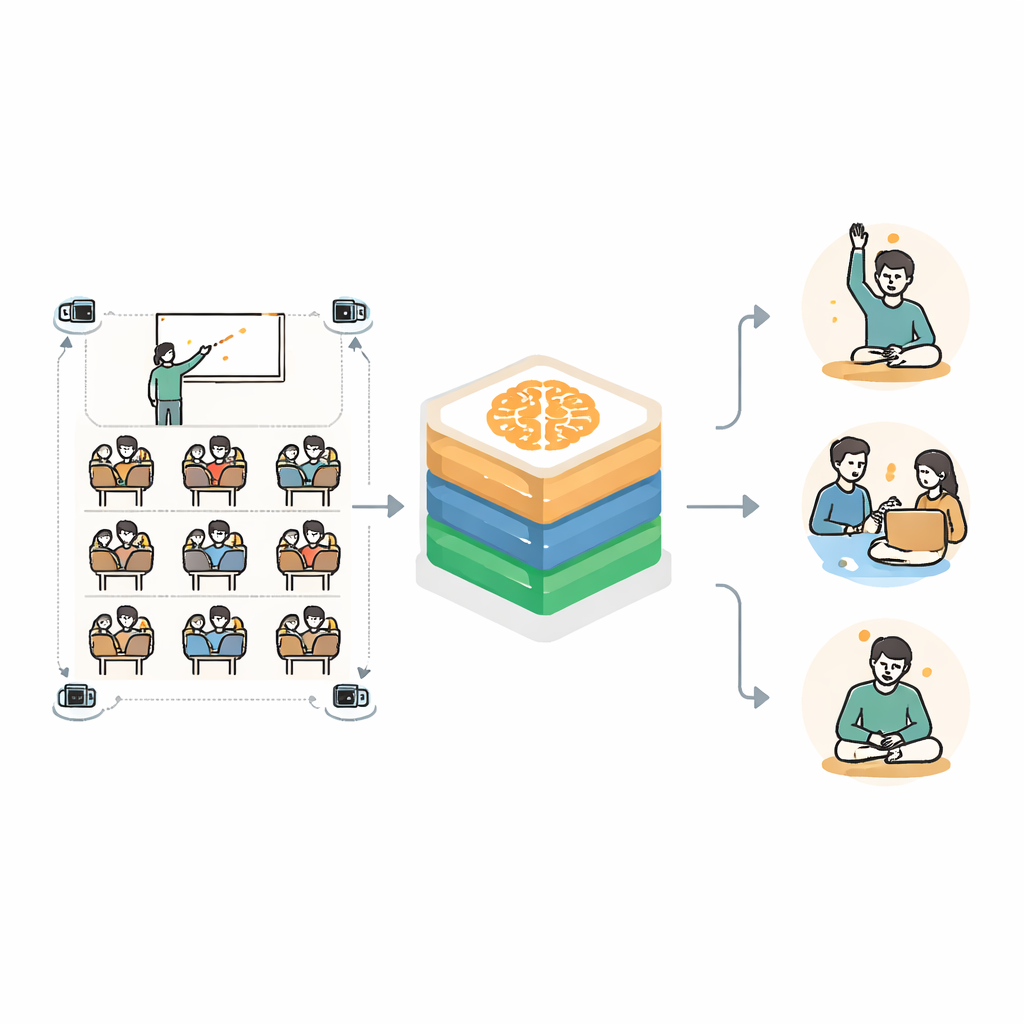
From Camera View to Learning Clues
The researchers built an automated “observer” that analyzes images and videos captured by cameras placed at the sides of the classroom. Instead of relying on a teacher’s moment-to-moment judgment, the system continuously scans the room to pick out patterns such as students writing, listening, raising their hands, sleeping, or answering questions. By turning these everyday actions into data, the system can provide an objective picture of how engaged the class is at any given time, which is especially valuable in wireless or online-connected environments where many classes run in parallel and human attention is stretched thin.
Teaching a Computer to Read the Room
To make sense of complex classroom scenes, the team combined several advanced AI techniques. First, they used a deep learning model called AlexNet to process each image. AlexNet excels at recognizing visual patterns; here, it learns to extract important details from crowded, low-resolution classroom views, such as posture, arm position, and where students are looking. These visual features are then passed to another model called an Extreme Learning Machine, which acts as a fast decision-maker, assigning each student snapshot to one of several behavior categories. This setup helps tackle practical challenges like students appearing at different distances, being partly blocked by others, or seen under varying lighting conditions.
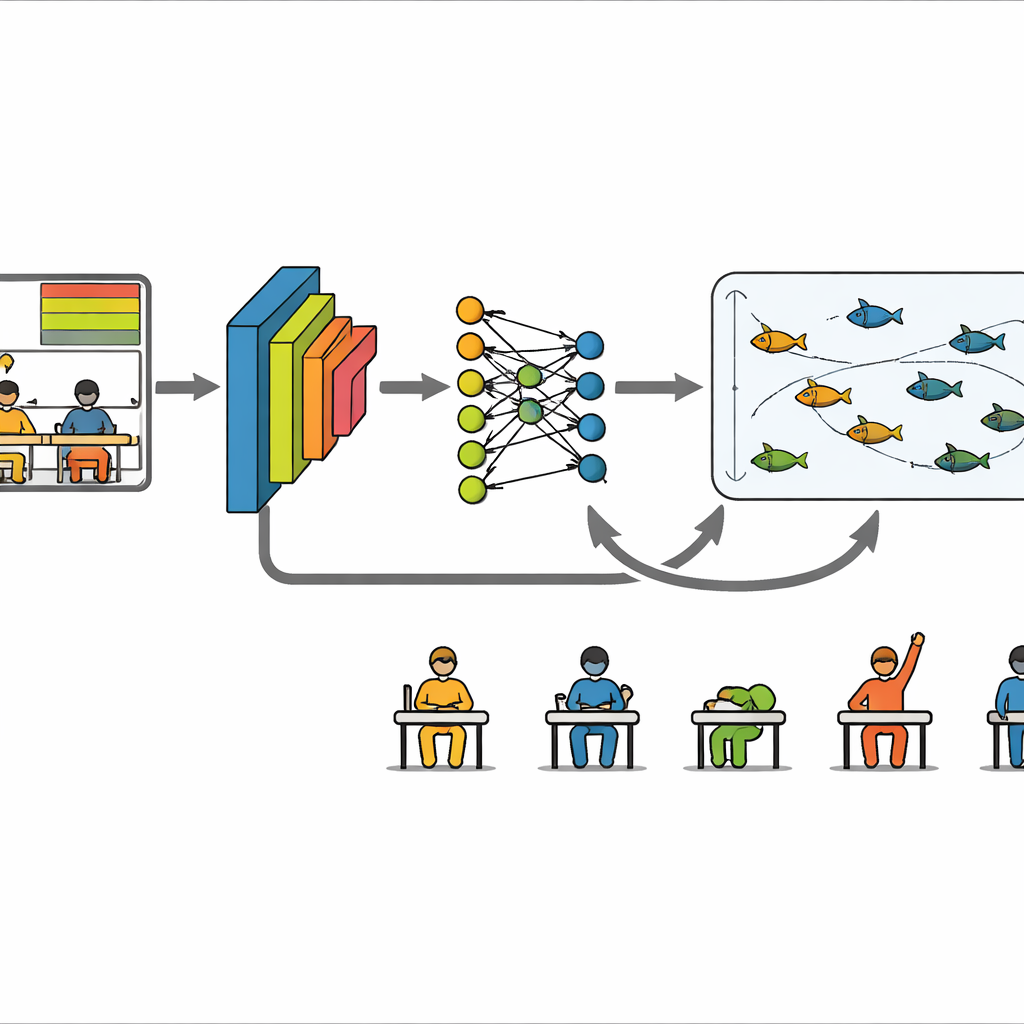
Borrowing Tricks from Electric Fish
A key difficulty in building accurate AI systems is tuning the many internal settings, or parameters, so the model does not overfit a small dataset or miss subtle cues. To handle this, the authors designed a new optimization method inspired by how electric fish search for food in murky water. In nature, these fish emit electrical signals and sense the echoes to navigate and hunt. The algorithm mimics this by treating each possible parameter setting as a “fish” exploring a landscape of solutions. It adaptively balances local fine-tuning and broad exploration, and even splits the population into subgroups that search different promising regions. This advanced electric fish optimization scheme systematically adjusts the inner workings of the behavior classifier to find highly accurate settings without getting stuck on poor solutions.
Putting the System to the Test
The team evaluated their framework using a real classroom dataset containing 282 source images and videos and 1,456 test samples. They compared their combined AlexNet–Extreme Learning Machine–electric fish optimization model with more conventional neural networks and with earlier optimization methods. Across the board, the new system performed best, achieving about 96.5% accuracy, 94.8% precision, and 98.2% recall when separating behaviors such as writing, listening, hand-raising, sleeping, and answering questions. Detailed confusion matrices and ROC curves showed that errors were rare for both highly engaged actions, like raising a hand, and disengaged states, like sleeping, indicating strong reliability in realistic classroom conditions.
What This Could Mean for Future Lessons
For non-specialists, the main takeaway is that it is becoming technically feasible for AI to “read the room” during language lessons, not by analyzing what students say, but by quietly watching how they act. While the current study is based on a modest-sized dataset and still focuses on static images rather than full video streams, it demonstrates that carefully designed AI can offer teachers a real-time dashboard of classroom engagement. In the future, such systems could support more personalized teaching: highlighting students who are lost or disengaged, measuring the impact of new activities, and freeing instructors to focus less on watching every seat and more on guiding learning.
Citation: Li, Y., Zou, H., Xu, J. et al. The impact of AI on Japanese language education: a hybrid model for student behavior detection. Sci Rep 16, 11140 (2026). https://doi.org/10.1038/s41598-026-40262-7
Keywords: classroom behavior detection, Japanese language education, deep learning in education, student engagement analytics, intelligent tutoring systems