Clear Sky Science · en
Non-destructive testing and micro-structural analysis of self-compacting concrete using different mineral powder additions in ternary blends
Why stronger, greener concrete matters
From bridges and skyscrapers to the house you live in, concrete quietly holds up much of modern life. But making traditional cement is energy-intensive and emits large amounts of carbon dioxide, while huge volumes of industrial by-products end up as waste. This study explores a new recipe for a special kind of concrete that flows into place on its own, needs no vibration, and makes better use of industrial leftovers—aiming to build structures that are both stronger and kinder to the environment.
A new kind of easy-flowing concrete
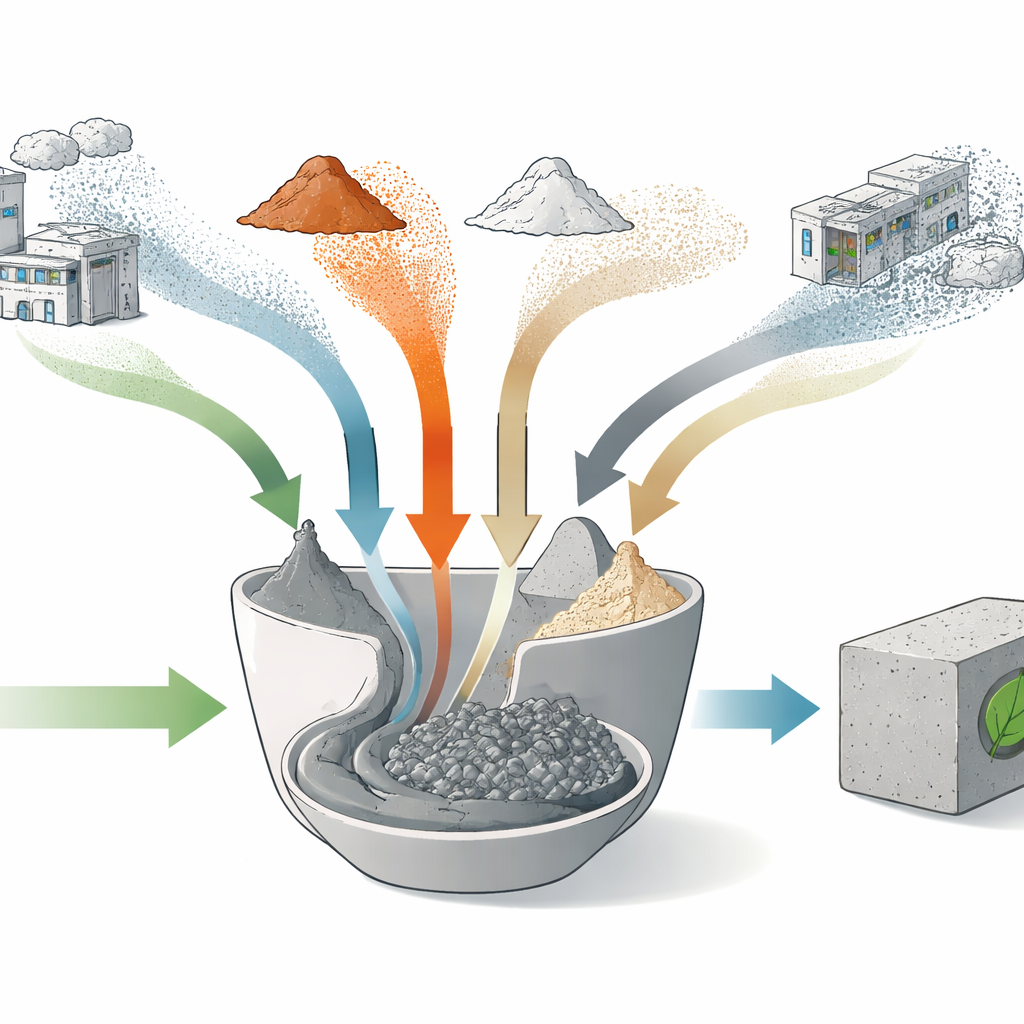
The work focuses on self-compacting concrete, a mix designed to flow like thick honey so it can slip through tight clusters of steel bars without the usual shaking and tamping. That property saves time, reduces noise on site, and cuts down on labour, while often giving a smoother, more uniform finish. However, such mixes normally rely on high cement and chemical admixture contents, which raise both cost and environmental impact. The researchers set out to see whether part of the cement and sand could be replaced with three finely ground powders—metakaolin, high-calcium fly ash, and waste marble powder—without sacrificing, and ideally improving, performance.
Turning wastes into useful ingredients
Fly ash comes from coal-fired power plants; metakaolin is made by heating certain clays; and marble powder is a leftover from cutting and polishing stone. All three are rich in minerals that can react or pack tightly with cement, filling gaps between particles. In this study, the team produced nine different concrete mixes. One was a conventional reference mix, one used only fly ash to replace some cement, and the rest combined a fixed amount of fly ash and marble powder with varying levels of metakaolin. Every mix was designed to have the same water content so that any differences in behaviour would mainly come from the powders themselves.
Listening to concrete without breaking it
Instead of relying only on crushing tests, the authors used non-destructive methods that can be applied to real buildings. One method sends sound waves through concrete and measures how fast they travel: higher speeds usually mean a denser, less cracked interior. Another method uses a spring-loaded hammer that bounces off the surface; the rebound gives a quick indication of hardness and strength. They also measured how stiff the concrete was by loading cylinders and recording how much they shortened—a key property for predicting how beams and columns will bend under weight. These tests were carried out after 28 days and again after 90 days to see how the concrete matured over time.
A closer look at the inner skeleton
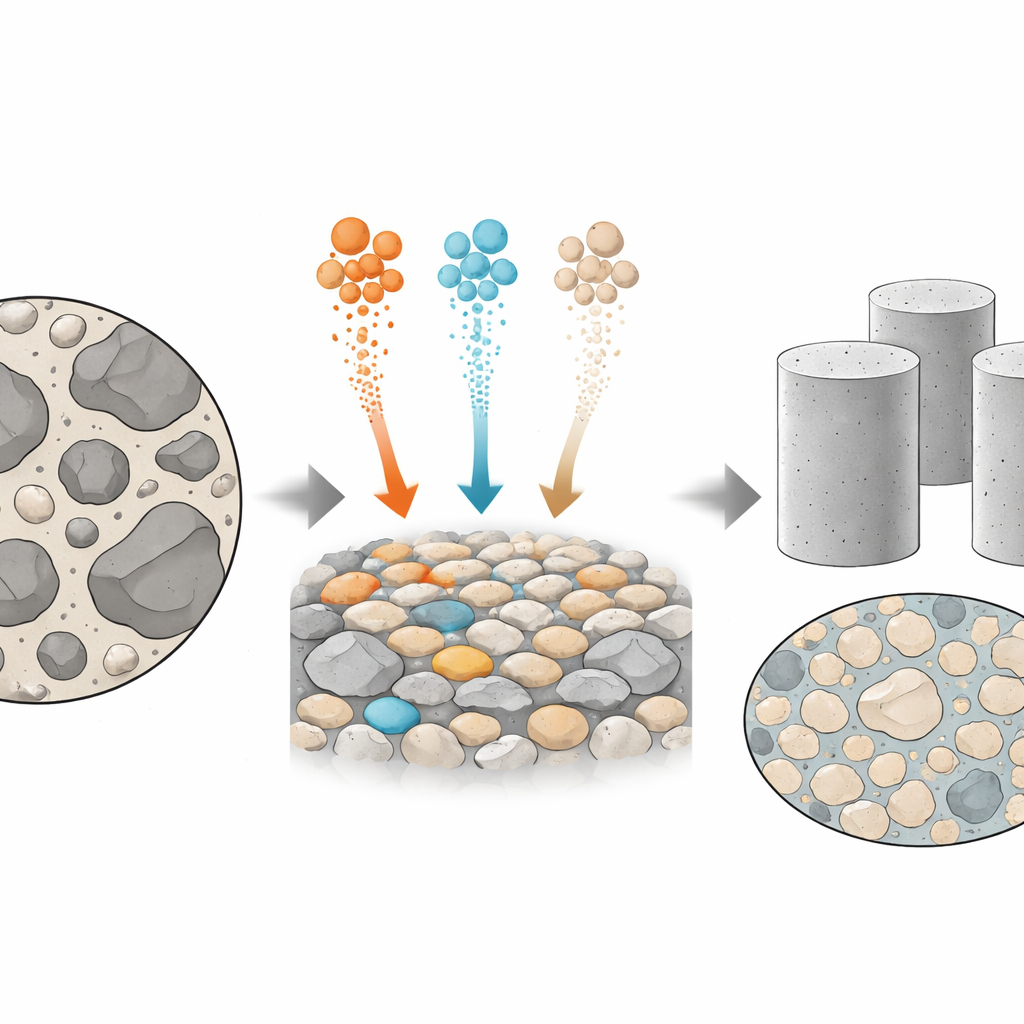
To link these overall properties to what happens inside the material, the team used electron microscopes to image the cement paste at very high magnification and to measure its chemical makeup. In the more successful mixes, the inner structure looked much denser, with fewer tiny voids and micro-cracks and a more continuous binding phase around the sand and stone. Chemical scans showed that part of the calcium-rich material formed during cement hydration had been converted into additional binding gel, thanks to reactions with metakaolin and fly ash. Marble powder, while not strongly reactive, helped by filling space and improving particle packing.
Finding the sweet spot in the recipe
Across all the tests, a clear pattern emerged. Adding a moderate amount of metakaolin—about 12.5% of the cement, together with 15% fly ash and 20% marble powder in the fine fraction—produced the best overall mix. This concrete was stiffer, carried higher loads, and showed faster ultrasonic pulse speeds than the ordinary version, pointing to a stronger and more uniform internal structure. Very high metakaolin levels, by contrast, began to reduce performance, underscoring that there is an optimum range rather than a simple "more is better" rule. Statistical checks confirmed that the improvements were not due to chance.
What this means for future buildings
For a non-specialist, the main takeaway is that carefully tuned blends of industrial by-products and waste powders can make self-compacting concrete both better and greener. The right combination of metakaolin, fly ash, and marble dust allows engineers to use less conventional cement and natural sand while achieving concrete that is denser, more durable, and easier to place in complex structures. In practical terms, this could translate into longer-lasting bridges, high-rise frames, and water structures that require less maintenance and carry a smaller environmental footprint over their lifetime.
Citation: Danish, P., Ganesh, G.M. & Santhi, A.S. Non-destructive testing and micro-structural analysis of self-compacting concrete using different mineral powder additions in ternary blends. Sci Rep 16, 14116 (2026). https://doi.org/10.1038/s41598-026-40257-4
Keywords: self-compacting concrete, fly ash, metakaolin, waste marble powder, non-destructive testing