Clear Sky Science · en
Thermal insulation performance and environmental assessment of vermiculite and agricultural residue based composites for the Kahramanmaras climate
Turning Farm Waste into Cozy Homes
Keeping buildings warm in winter and cool in summer uses a huge amount of energy, much of it supplied by fossil fuels. At the same time, farmers around the world burn leftover stalks and shells in their fields, adding more carbon dioxide to the air. This study explores a way to tackle both problems at once: turning common agricultural leftovers from the Kahramanmaras region of Turkey into high‑performing wall insulation that can rival familiar plastic foams while being kinder to the environment.
From Field Leftovers to Building Blocks
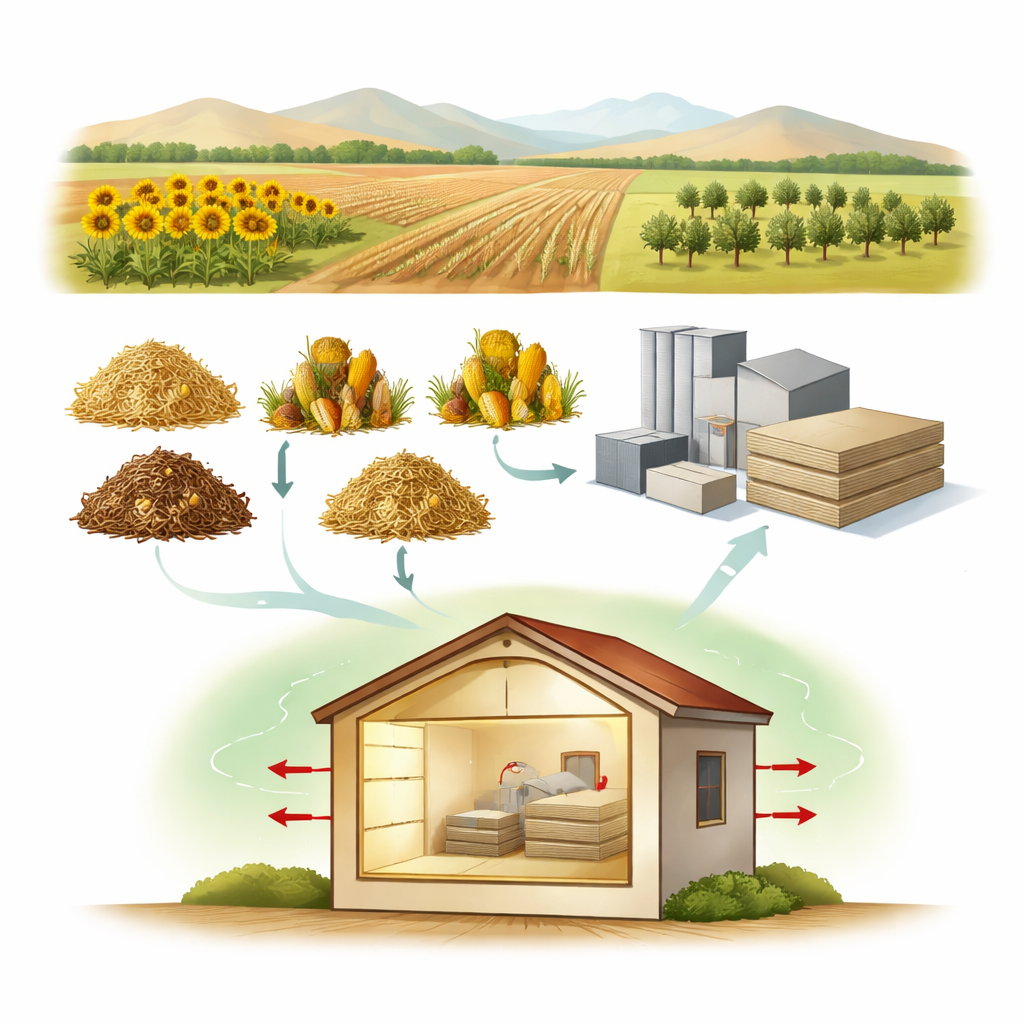
The researchers focused on wastes that are normally seen as a disposal problem: cereal stubble left after harvest, sunflower stalks, corn cobs, corn stalks, and olive pits. All of these are abundant around the Kahramanmaras–Elbistan Plain. Instead of burning or dumping them, the team mixed them into a lightweight base made of vermiculite, a naturally expanded mineral, held together with an epoxy binder. By carefully choosing how much of each waste type to add, they produced flat composite panels that could be tested like commercial insulation boards. This locally anchored approach ties building materials directly to regional agriculture and supports a circular economy in which today’s waste becomes tomorrow’s resource.
Lightweight Panels with Hidden Air Pockets
Good insulation works by trapping air so that heat moves slowly. The team first measured how heavy their panels were and how much water they soaked up. Panels made with straw‑like materials, especially stubble and corn stalks, turned out to be very light and full of tiny pores, which improved their insulating ability but also made them more prone to taking up moisture. In contrast, panels with ground olive pits and corn cobs were denser and absorbed less water. Using sound‑wave tests and strength measurements, the researchers showed that even the lighter, more porous panels still had enough internal strength for use as wall insulation, while the denser olive‑pit panels were mechanically very robust.
Warm in Winter, Safe in a Fire
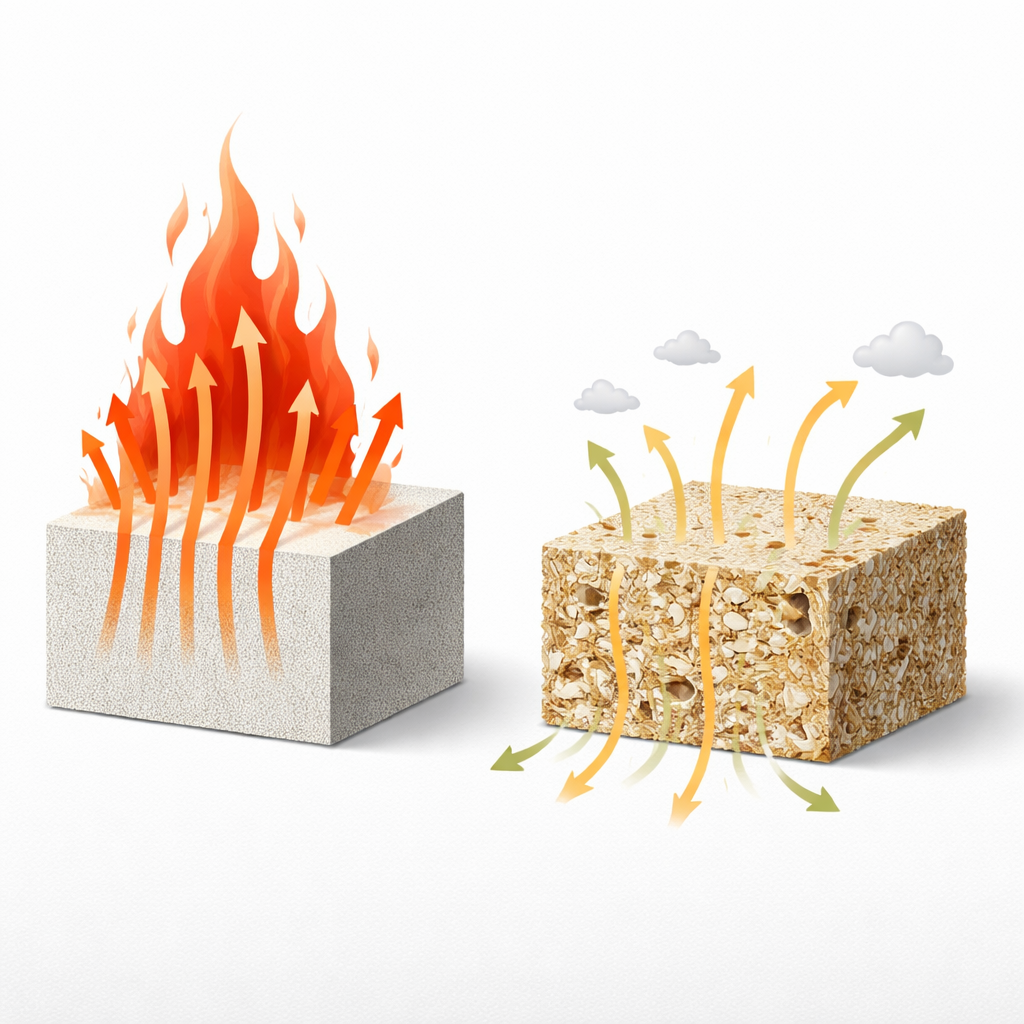
The heart of the study was how well these panels slowed the flow of heat. Several mixtures, particularly those rich in stubble, reached thermal conductivity values close to 0.041–0.042 W/mK—very similar to common expanded polystyrene foam used in many buildings. At the same time, the vermiculite mineral dramatically improved how the panels behaved in a flame test. While plastic foam burns quickly, loses a noticeable fraction of its mass, and allows flames to run along its surface, the new composites charred slowly, lost only a few percent of their weight, and limited flame spread. In other words, they delivered near‑foam insulation performance while acting more like a mineral board in a fire.
Cutting Energy Bills and Carbon Emissions
To understand the real‑world impact, the authors modeled a typical home in the Kahramanmaras climate and “filled” its walls with the new panels. Using measured heat‑flow data, they calculated how much heating and cooling energy would be saved compared with ordinary foam, and then converted those savings into annual carbon‑dioxide reductions. Because the plant‑based ingredients are considered nearly carbon neutral and would otherwise be burned in open fields, the composites not only reduced operating emissions but also lowered the emissions tied to making the material itself. Straw‑rich panels such as the S1, S2, and SS2 mixtures delivered the best combination of low density, strong insulation, and sizable CO₂ savings over the full life of the building, especially as insulation thickness increased.
What This Means for Future Buildings
Put simply, the study shows that chopped stalks, cobs, and pits from local farms can be turned into wall panels that keep homes comfortable, stand up well in strength tests, resist fire better than many plastic foams, and shrink both energy bills and carbon footprints. For regions with climates similar to Kahramanmaras and with abundant agricultural residues, these bio‑based vermiculite composites offer a practical, scalable alternative to petrochemical insulation. Instead of being burned in the field, farm leftovers could line our walls, helping buildings waste less energy while easing pressure on the planet.
Citation: Eken, M., Gürgen, A. & Dinçer, A. Thermal insulation performance and environmental assessment of vermiculite and agricultural residue based composites for the Kahramanmaras climate. Sci Rep 16, 11464 (2026). https://doi.org/10.1038/s41598-026-40255-6
Keywords: bio-based insulation, agricultural waste, building energy efficiency, low-carbon materials, vermiculite composites