Clear Sky Science · en
Performance analysis of a three-dimensional micromixer with baffles using a flexible physics-informed neural network
Why tiny fluid mixers matter
Inside many lab-on-a-chip and medical testing devices, two or more liquids must be blended quickly and evenly while flowing through hair‑thin channels. Because the flows are extremely smooth at this scale, different fluids often slide past each other instead of mixing. Engineers typically add small obstacles, called baffles, to stir things up, but testing every possible 3D layout with conventional simulation tools is slow and labor‑intensive. This study introduces a new physics‑aware artificial intelligence method that can accurately predict how such tiny mixers behave, opening the door to faster design of more efficient microfluidic devices.
Tiny channels and hidden stirrers
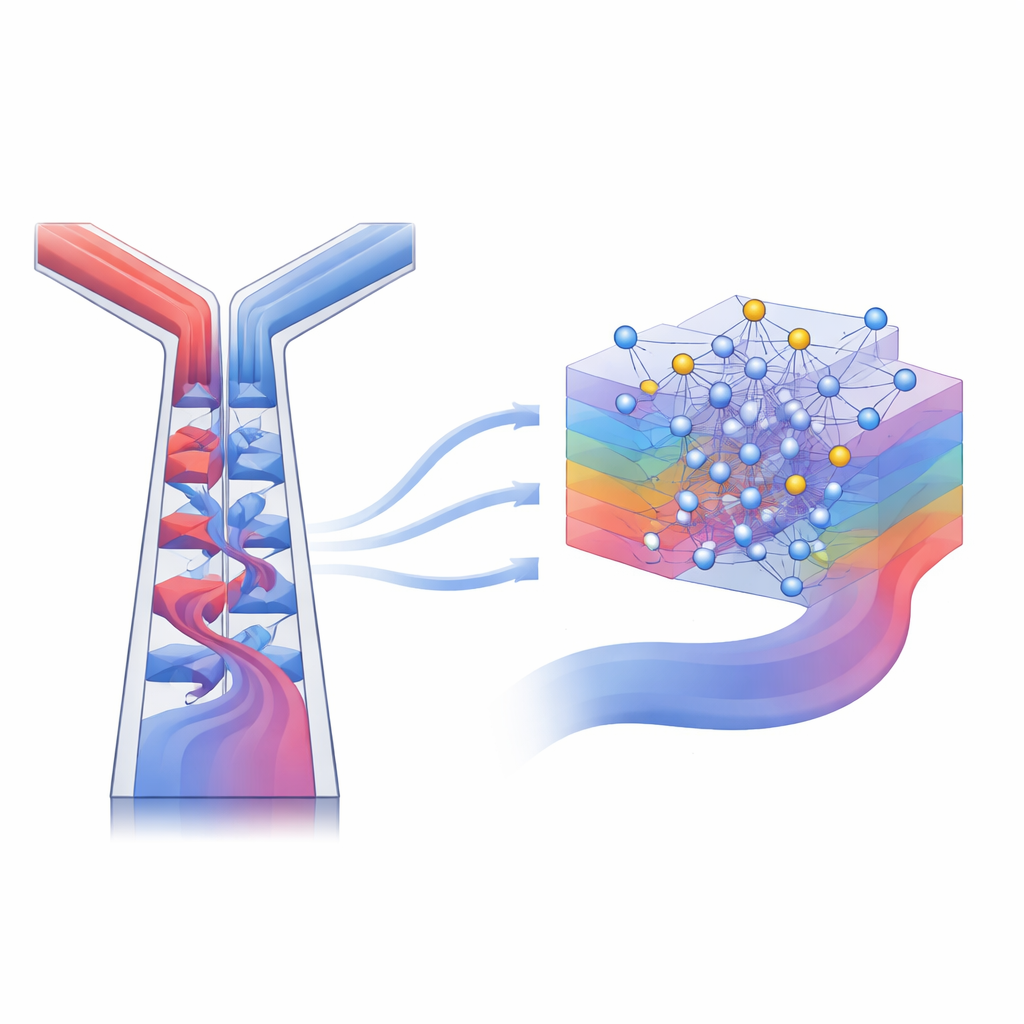
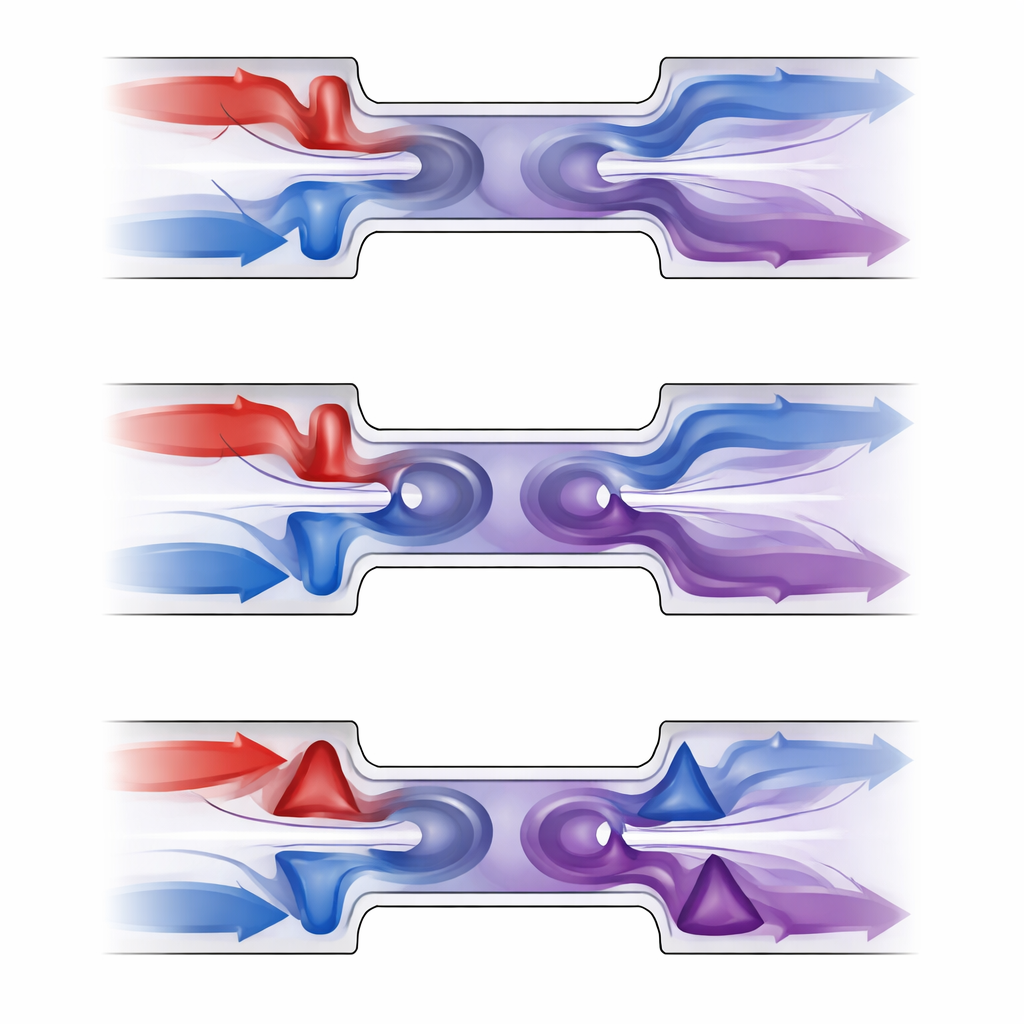
The work focuses on a common T‑shaped micromixer: two inlet channels bring in different liquids that meet and flow into a straight main channel. Along this main channel, the researchers place small, block‑like structures—baffles—at the corners of the cross‑section. These baffles come in three simple shapes (rectangular, elliptical, and triangular) and can be arranged in several patterns. As the fluid flows around them, the streamlines twist, fold, and swirl in three dimensions, helping the two liquids interpenetrate and mix. The challenge is to predict, for many possible shapes and arrangements, how well the mixer blends the fluids and how much extra pumping power is needed to push fluid through the device.
Using physics to teach a neural network
Instead of building a traditional computer mesh and solving the equations of fluid flow in each tiny cell, the authors use a physics‑informed neural network. In this approach, the inputs are simply points in space inside the channel. The neural network learns to output the fluid velocity, pressure, and concentration of one fluid by being penalized whenever it violates the underlying physical laws, such as conservation of mass and momentum. The team develops an enhanced version they call FlexPINN, which splits the problem into parallel subnetworks, rewrites the equations in a numerically gentle, dimensionless form, and adds special penalty terms that enforce overall conservation of flow and concentration along the channel. These steps keep the network from drifting to unphysical solutions and allow it to handle fully three‑dimensional, baffle‑filled geometries that standard physics‑informed networks struggle with.
Checking accuracy and speeding up learning
To make sure FlexPINN is reliable, the researchers compare its predictions with high‑quality computational fluid dynamics (CFD) simulations for a simple T‑mixer without baffles and for baffled mixers under various conditions. They focus on two key measures: how uniform the mixture is at the outlet (the mixing index) and how much the pressure rises across the mixer (the pressure drop coefficient). Across all tests, FlexPINN stays within about three percent of the CFD results, both for mixing and for pressure. The team also uses transfer learning: once the network has learned to handle one baffle shape, its internal parameters are reused as a starting point for another shape. This strategy cuts the training time for new designs by roughly one‑third, demonstrating that FlexPINN can be an efficient exploration tool rather than a one‑off solver.
What makes a good tiny mixer
Armed with this tool, the authors scan through different flow speeds (summarized by the Reynolds number), baffle shapes, and baffle configurations. They find that how baffles are sequenced around the channel corners strongly affects performance, even when their total number and size are fixed. Among the tested layouts, a staggered pattern known as Configuration C produces the most vigorous three‑dimensional stirring. When rectangular baffles are arranged in this configuration in a double‑length channel and operated at a moderate flow speed, the resulting device achieves a high mixing index while keeping the added pressure within a reasonable range. To capture this trade‑off, the authors define a mixing efficiency that rewards better mixing but penalizes higher pressure drops; the best design more than 60 percent improves this efficiency over a similar channel without baffles.
Take‑home message for non‑experts
For readers outside fluid mechanics and machine learning, the key insight is that carefully placed, simple shapes inside a tiny channel can transform two smooth, side‑by‑side streams into a well‑blended mixture—if we know where to put them. FlexPINN provides a new way to answer that design question without the heavy setup cost of conventional simulations. By baking the laws of physics directly into a neural network, the authors obtain accurate predictions of mixing and energy use for many 3D baffle arrangements. Their results show that a staggered row of rectangular baffles in a straight channel is particularly effective, offering strong mixing at manageable pumping effort. More broadly, the method points toward faster, more flexible design of future microfluidic components for chemical analysis, drug discovery, and biomedical testing on a chip.
Citation: Hassanzadeh, M., Ghaderi, E. & Bijarchi, M.A. Performance analysis of a three-dimensional micromixer with baffles using a flexible physics-informed neural network. Sci Rep 16, 10151 (2026). https://doi.org/10.1038/s41598-026-40254-7
Keywords: microfluidics, micromixer, physics-informed neural networks, passive mixing, computational fluid dynamics