Clear Sky Science · en
Ultraviolet light illuminates species-specific biofluorescent casque patterns in cassowaries (Casuarius)
Hidden Colors in a Rainforest Giant
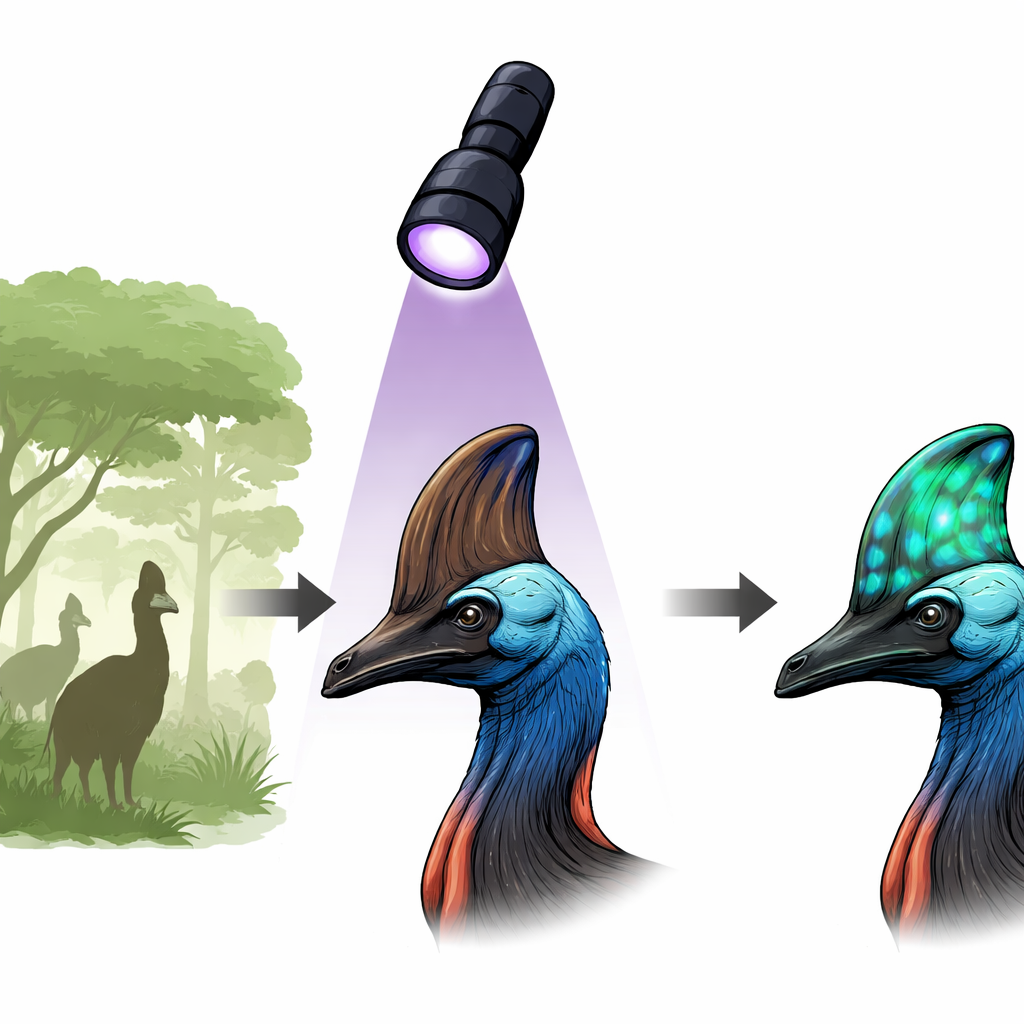
Cassowaries, the towering, helmeted birds of Australian and New Guinean rainforests, already look otherworldly to human eyes. Yet this study shows that they may be even more visually striking in wavelengths we cannot see. By shining ultraviolet (UV) light on cassowary heads, researchers uncovered glowing patterns on their hard head "helmets," called casques, revealing a secret layer of color that could reshape how we think about bird displays, communication, and even how we identify these elusive animals in the wild.
The Strange Helmet on a Giant Bird
Cassowaries are famous for their tall casques—solid structures made of bone covered by a shell of keratin, the same material as our fingernails. Scientists have long suspected that these helmets might help birds recognize one another, attract mates, or signal status. Yet in ordinary daylight the casques look relatively dull compared with the bright blues, reds, and yellows of the birds’ bare head and neck skin. At the same time, many birds, including cassowaries, can see UV light, extending their vision beyond the human range. This raised a provocative possibility: perhaps cassowary casques are not bland at all, but carry messages written in ultraviolet.
Making the Invisible Glow
To probe this hidden world, the authors examined 95 adult cassowaries, including living birds and museum specimens of all three species: the dwarf, southern, and northern cassowary. They illuminated the heads with two bands of UV light (365 and 385–395 nanometers) and photographed the responses. Under these conditions, parts of the keratin casing on the casque and beak emitted a soft blue‑green glow—an effect known as biofluorescence, where incoming UV light is absorbed and re‑emitted at longer, visible wavelengths. The team then used image‑analysis software to measure what fraction of each casque surface lit up and mapped where the glowing patches occurred.
Species Signatures in the Glow
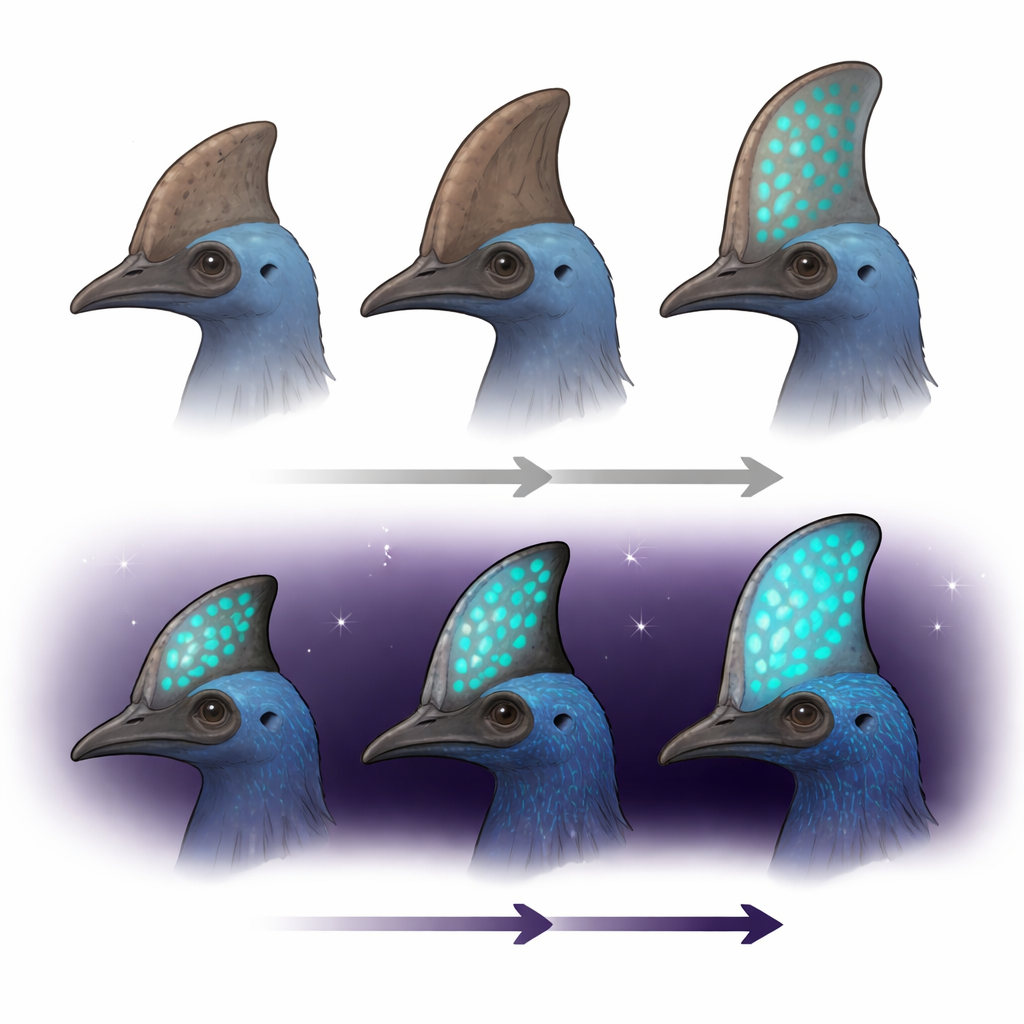
The glowing patterns were surprisingly specific. In the dwarf cassowary, most casques showed no fluorescence at all, with only a rare individual displaying a tiny glowing patch. By contrast, in the southern and northern cassowaries, large portions of the casque lit up under UV, sometimes covering more than two‑thirds of the visible surface. Not only did the overall coverage differ among species, but the locations of the glowing areas did too: southern cassowaries tended to glow toward the rear of the casque, whereas northern cassowaries showed either patchy glow on the front and top or almost complete coverage. Even the color seen in normal light gave clues—regions that appeared brown, green, or yellow were most likely to glow under UV, while black or dark gray areas generally did not. Remarkably, museum skins and frozen heads preserved these patterns, matching what was seen in living birds.
Reflective Helmets and Unanswered Questions
Glowing under strong UV lamps in a dark room is one thing; being useful to a bird in a shaded rainforest is another. To test what cassowaries might actually see, the researchers also asked whether the casque reflects UV light, not just fluoresces. Using a special UV‑sensitive camera and controlled lighting, they found that much of the casque surface can indeed reflect 365‑nanometer light, meaning it could stand out against a leafy background that tends to absorb UV. However, the fine‑grained glowing patterns they measured with fluorescence did not reappear as distinct reflective patterns. This leaves open a key question: can cassowaries really perceive the subtle, species‑specific glow, or do they mainly see a more generally bright, UV‑reflective casque that emphasizes size and shape rather than detailed markings?
New Tools for Conservation and Deep Time
Even if cassowaries cannot fully appreciate the intricate fluorescent patterns, humans can use them. Because the glow survives in long‑preserved specimens, curators can shine UV lamps on old skins and skulls to distinguish cassowary species, even when telltale soft tissues or colors have faded or bones are incomplete. In the field, portable UV lights or modified trail cameras could help researchers recognize individual birds by their unique casque "fingerprints," aiding surveys of these rare, shy, and sometimes dangerous birds. More broadly, the work offers a modern reference point for thinking about the head ornaments of extinct dinosaurs and their relatives, whose bony crests were likely sheathed in keratin as well. By revealing that cassowary casques hide complex UV‑linked properties, this study opens a new window on how visual signals might operate in dense forests—and how much of nature’s color remains invisible to us.
Citation: Green, T.L., Watanabe, A., Berman, J.M. et al. Ultraviolet light illuminates species-specific biofluorescent casque patterns in cassowaries (Casuarius). Sci Rep 16, 10302 (2026). https://doi.org/10.1038/s41598-026-40230-1
Keywords: cassowary, ultraviolet, biofluorescence, cranial ornaments, bird vision