Clear Sky Science · en
Effects of sodium chloride on circadian period and temperature compensation of KaiC phosphorylation
Why salt and body clocks matter
Every cell in our bodies keeps time, following a roughly 24‑hour schedule that helps regulate sleep, hormone release, metabolism, and more. At the same time, common table salt—sodium chloride—is constantly flowing in and out of our cells and can vary widely across different organisms and environments. This study asks a simple but important question: can changes in salt levels tweak the internal clock itself, and if so, how? To answer it, the authors turned to a stripped‑down “test tube clock” from cyanobacteria, tiny photosynthetic microbes with one of the simplest known circadian systems.
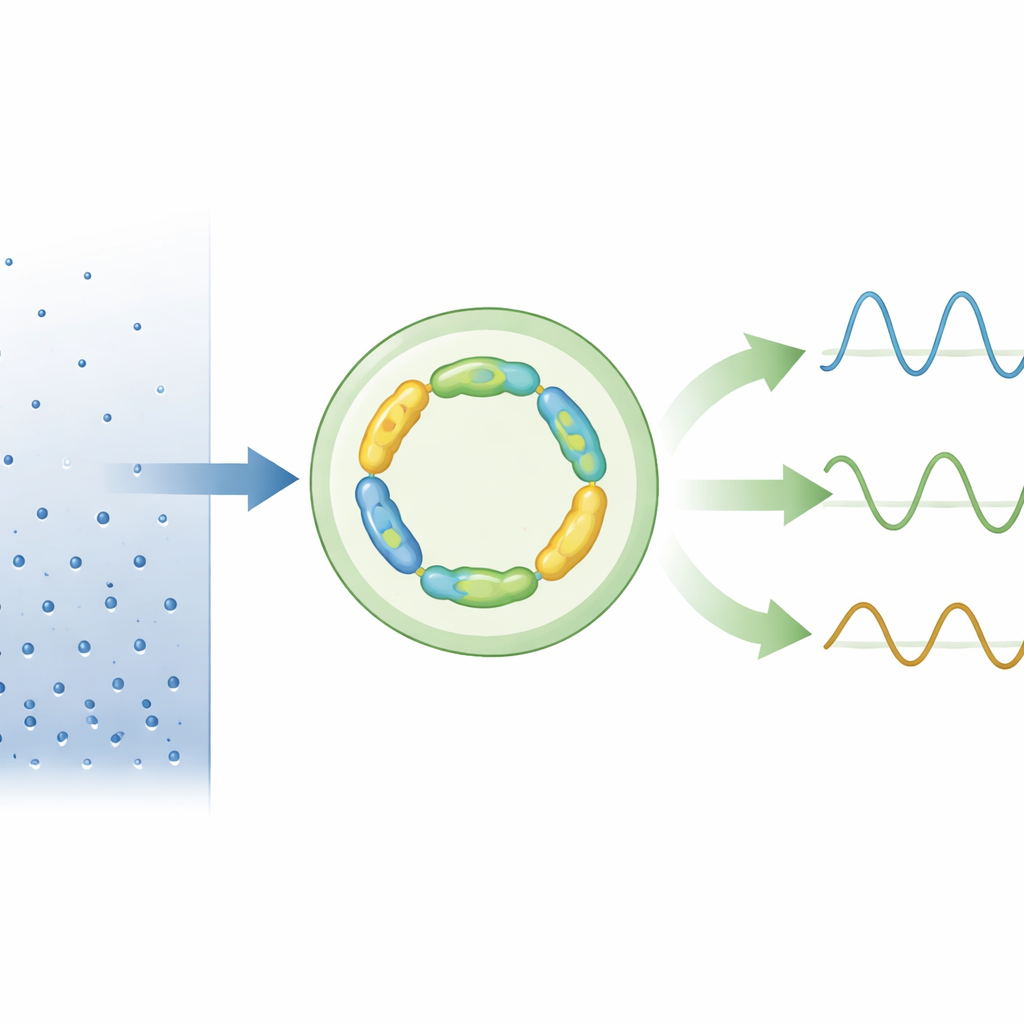
A simple clock built from three parts
Cyanobacteria tell time using just three proteins, called KaiA, KaiB, and KaiC. When these purified proteins are mixed with energy‑rich molecules and magnesium ions in a test tube, they generate self‑sustaining 24‑hour rhythms in the chemical modification (phosphorylation) of KaiC. This makes the system an ideal model to study what controls the speed and stability of a biological clock without the complexity of a whole cell. The researchers focused on sodium chloride, a major component of the cellular environment, and asked whether changing its concentration would alter the clock’s ticking.
Salt makes the clock run faster
The team reconstituted the Kai-based clock at several salt levels, from 100 to 250 millimoles per liter, and tracked how the phosphorylation of KaiC rose and fell over time. Across this range, the rhythms stayed strong: the size of the swings (amplitude) barely changed. But the timing did. As salt concentration increased, the period of the rhythm—the length of one full cycle—became progressively shorter. In other words, the clock ran faster in saltier conditions. By analyzing simpler reactions involving only KaiC with or without KaiA, the authors showed that this effect was not due to salt directly speeding up or slowing down those proteins’ basic chemistry.
A protein middleman that mimics salt’s effect
To pinpoint where salt was acting, the authors turned to KaiB, the third member of the clock. Previous work had shown that changing the amount of KaiB can tune the period of the oscillator, with relatively little impact on amplitude. When they systematically varied KaiB concentration, they found a pattern strikingly similar to the salt experiments: more KaiB led to shorter periods while leaving the strength of the rhythm largely unchanged. This parallel suggested that salt might be influencing the clock indirectly by altering how KaiB behaves or how much of its active form is available to interact with KaiC.
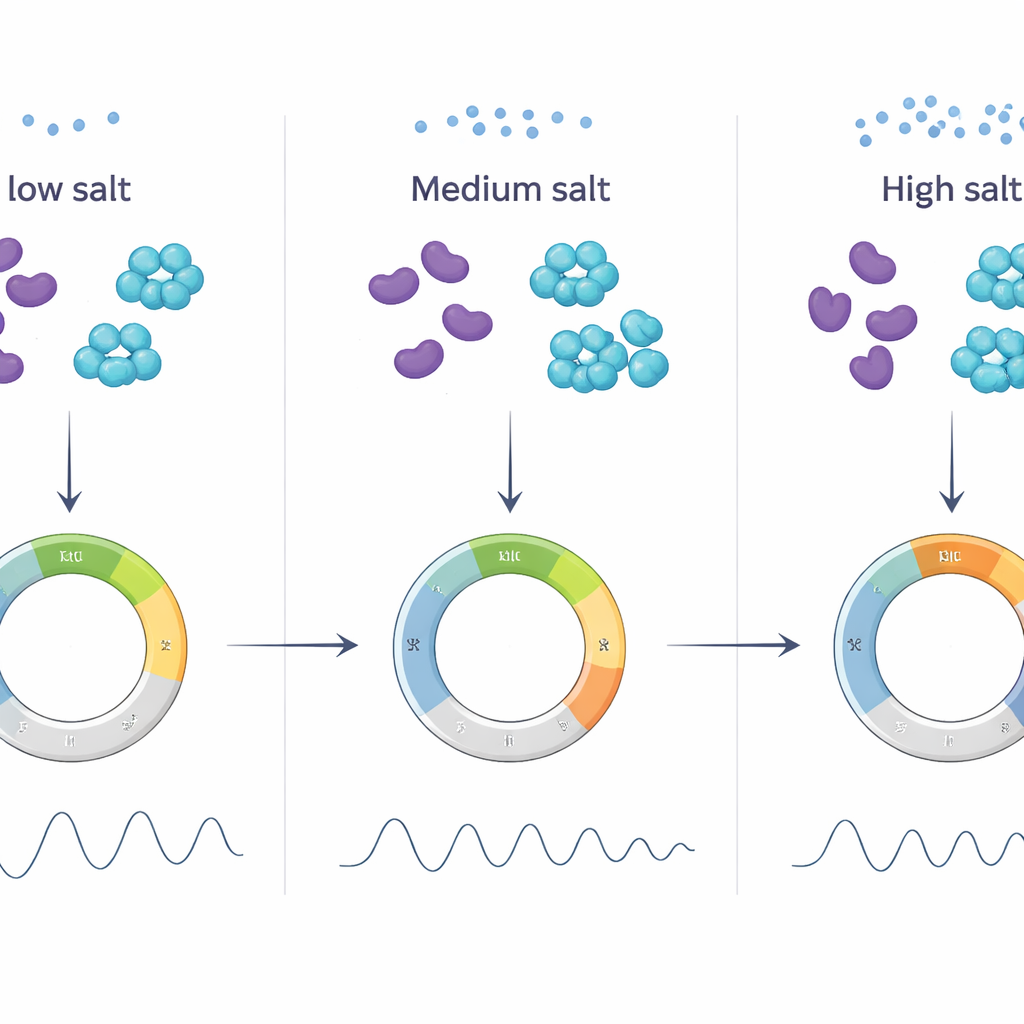
How salt nudges a finely balanced timing system
KaiB is unusual because it can assemble into different groupings (oligomers) and can flip between two distinct shapes, only one of which actively engages with KaiC to help reset the cycle. Using chemical cross‑linking, the researchers found that higher salt levels favor formation of KaiB tetramers, hinting that salt shifts the balance between its different forms. They then examined how both KaiB and salt affected one of the clock’s most intriguing traits: temperature compensation—the ability to keep a nearly 24‑hour period even when temperature changes. Varying KaiB alone left this property mostly intact across 25 °C and 35 °C. In contrast, altering salt partially disturbed temperature compensation: the measure of temperature sensitivity (Q₁₀) rose linearly with salt concentration, meaning the clock’s timing became more temperature‑dependent in saltier conditions.
What this means for clocks in changing environments
Taken together, the findings paint a picture in which salt subtly retunes the circadian clock by shifting the internal balance of KaiB forms that control KaiC’s cycle. Under normal physiological conditions, temperature helps hold this balance in a regime that keeps the clock period steady from day to day. When salt levels move away from that sweet spot, the clock not only runs faster but also becomes a bit more sensitive to temperature. In real organisms, such shifts could lead to daily rhythms that no longer align perfectly with the external day–night cycle, potentially disadvantaging cells in competitive environments. The work highlights how something as familiar as salt can influence the molecular gears of timekeeping and may help explain why clock proteins have diversified across species living in very different habitats.
Citation: Kim, E., Adams, M., Tyree, S. et al. Effects of sodium chloride on circadian period and temperature compensation of KaiC phosphorylation. Sci Rep 16, 10319 (2026). https://doi.org/10.1038/s41598-026-40224-z
Keywords: circadian clock, sodium chloride, cyanobacteria, Kai proteins, temperature compensation