Clear Sky Science · en
Morphological character evolution and ancestral state reconstruction in phylactolaemate bryozoans
Tiny freshwater builders with a big evolutionary story
Bryozoans are microscopic animals that live together in colonies, quietly coating stones, plants, and sticks in ponds and rivers. This study looks at one special freshwater branch of the group, called phylactolaemates. By tracing their body shapes, muscles, and life cycles across all modern families, the authors reconstruct how these overlooked animals evolved and how their colonies and bodies adapted to different freshwater homes.
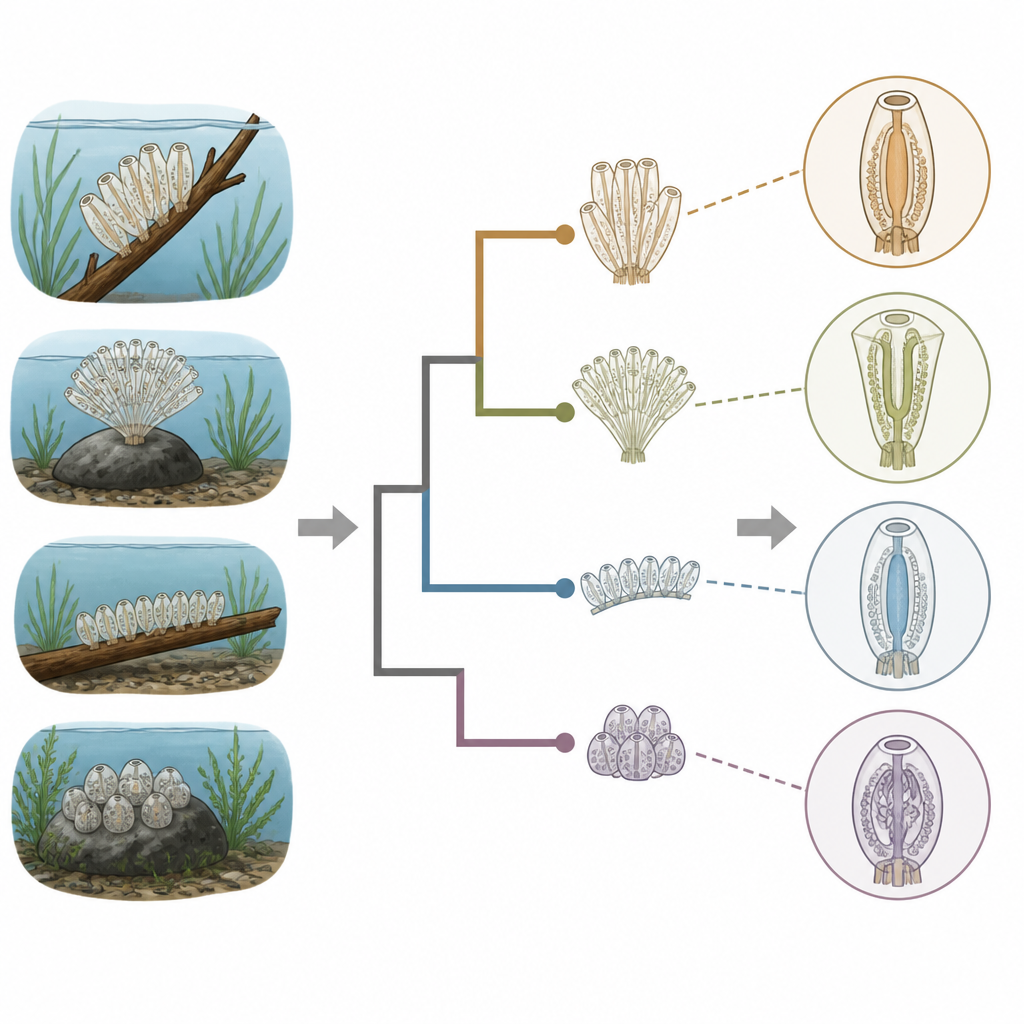
Freshwater colonies and how they grow
Phylactolaemate bryozoans build colonies from repeated individual units, each sitting inside a flexible outer tube and carrying a crown of tentacles for feeding. Colonies can look like upright bushes, creeping caterpillars, or dense cushions. Using a broad survey of living species and old descriptions, the authors show that the ancestral colonies were probably made of zooids spaced relatively far apart along simple, serial branches rather than packed together. The outer covering was likely non-encrusting and not heavily hardened, with later lineages independently evolving sticky, particle-coated walls or gelatinous mats that form thick, jelly-like masses on submerged surfaces.
Body design that stays stable while details shift
Inside each zooid, the general body layout is surprisingly stable across the group. A ring of ciliated tentacles surrounds the mouth and leads to a U-shaped gut, all pulled in and out by strong retractor muscles anchored in the body wall. The authors map dozens of muscular features onto a modern genetic family tree and find that the basic two-layered body wall and the general pattern of muscles around the opening are ancient and conserved. A few lineages added extra layers of body wall muscles or altered the balance between circular and longitudinal fibers, likely fine-tuning how fast and how far the animals can extend or retract when feeding or avoiding danger.
A complex feeding crown with repeating themes
The base of the tentacle crown is the most intricate region, housing both the main nerve center and a small flap-like organ over the mouth called the epistome. Across families, the epistome almost always contains a fluid-filled cavity with surrounding and crossing muscle layers, suggesting this muscular arrangement is ancestral. The tentacles themselves carry paired muscle sets and nerves arranged in a repeating pattern. While all species share this basic plan, they differ in the size and attachment of muscle bases, the way tentacles link to the supporting arms, and the presence of thin membranes stretched between tentacles. These subtle variations, such as whether a gap exists between front tentacles, appear to have evolved repeatedly and may relate more to feeding flow and local habitat than to deep family relationships.
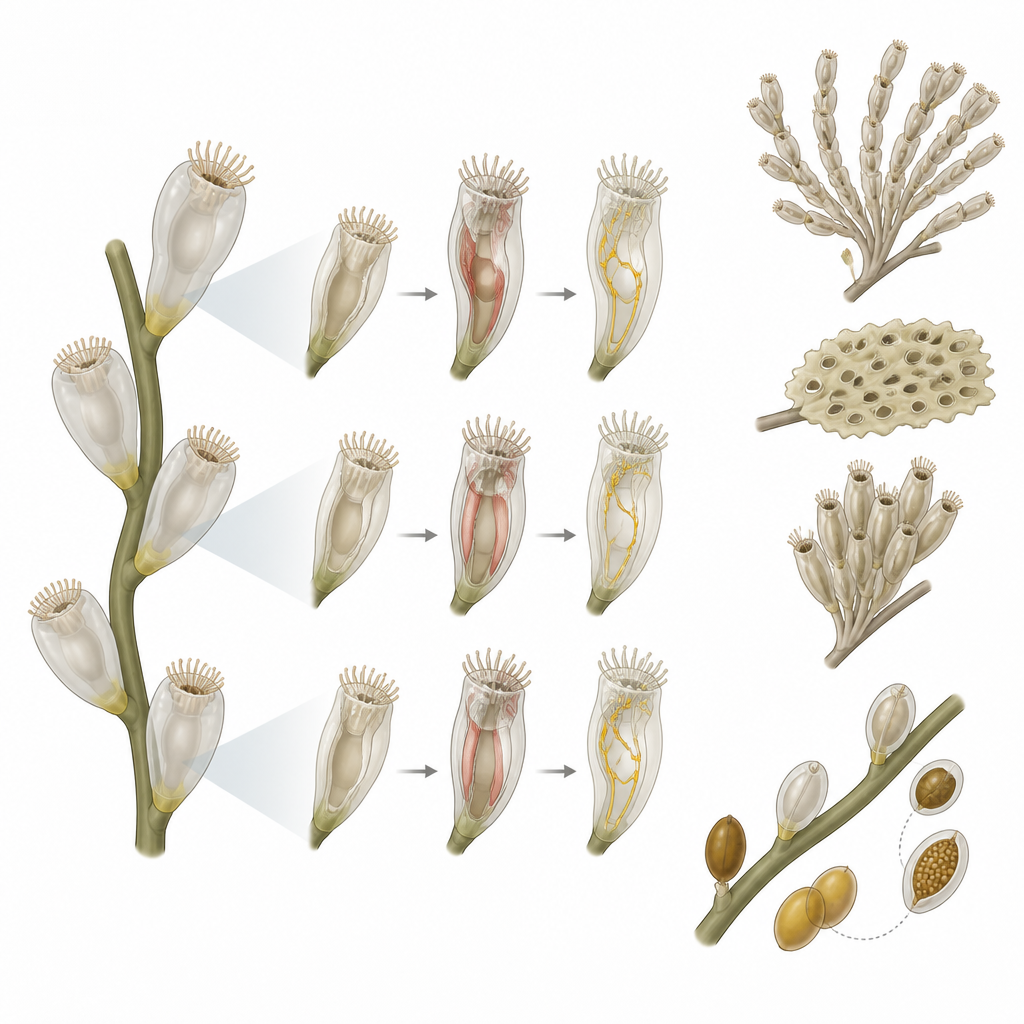
Resting capsules, larvae, and nervous systems
Freshwater bryozoans survive winter or drought using tough internal buds called statoblasts, which can drift, stick to surfaces, or lie dormant until conditions improve. The study concludes that simple floating statoblasts came first, with more specialized forms that cling to substrates or lose their outer float appearing independently in multiple lineages. Larvae also show patterned variation: most species brood ciliated, swimming larvae with one to four internal feeding units, with the numbers clustering by family. In contrast, the nervous system stays highly uniform. All species share a hollow central nerve center, a ring around the throat, and similar nerve bundles running into each tentacle and through the body wall, indicating strong conservation of basic neural organization through time.
What this tells us about evolution in quiet waters
By combining historical descriptions, new imaging work, and modern genetic trees, the authors piece together a likely ancestor: a colony of widely spaced, soft-walled zooids with a conservative muscle and nerve layout, simple floating statoblasts, and a ciliated larva. Over time, different lineages layered on tweaks in colony shape, outer coverings, statoblast form, and small-scale muscle patterns, often in parallel. To a non-specialist, the main message is that these modest freshwater animals balance deep shared heritage with repeated, local innovations, shaped by how they attach, feed, and survive in changing lakes and streams.
Citation: Bibermair, J., Saadi, A.J. & Schwaha, T. Morphological character evolution and ancestral state reconstruction in phylactolaemate bryozoans. Sci Rep 16, 15106 (2026). https://doi.org/10.1038/s41598-026-40223-0
Keywords: bryozoans, freshwater colonies, morphological evolution, ancestral state reconstruction, statoblasts