Clear Sky Science · en
Study on the adaptability and stability of MICP improved vegetation slope protection
Why stronger green slopes matter
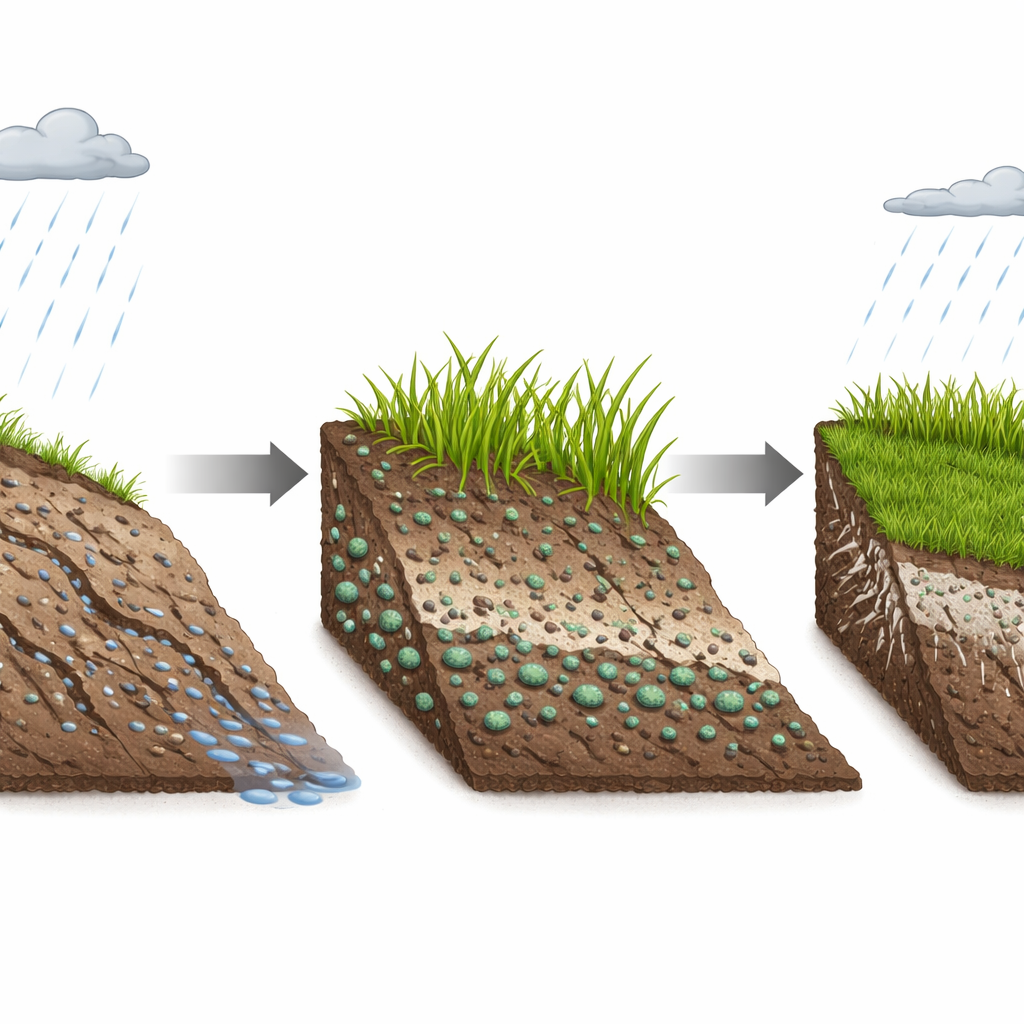
Across the world, new highways, railways and urban expansion cut into hillsides, leaving bare slopes that are easily washed away by rain. Engineers often plant grass to hold the soil, but young roots need time to form a strong web, so slopes can still fail in the early months. This study explores a new nature-inspired helper for plants: friendly microbes that grow a thin mineral "glue" in the soil. Together, roots and microbes could turn fragile cut slopes into tougher, greener barriers against erosion and landslides.
Microbes that grow stone in the soil
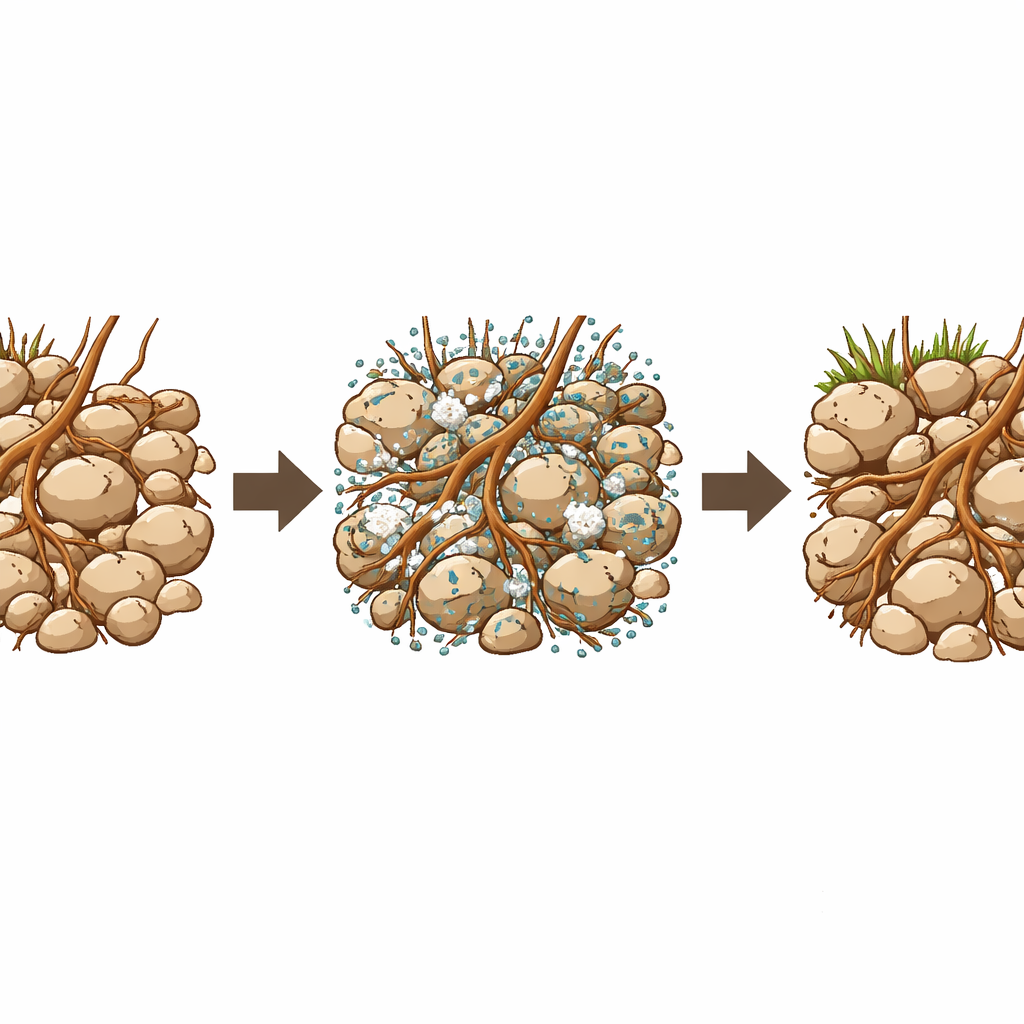
The researchers focused on a process called microbially induced calcium carbonate precipitation, or MICP. Certain bacteria, here Sporosarcina pasteurii, can turn dissolved chemicals into tiny crystals of calcium carbonate, the same mineral found in limestone and seashells. When these microbes are added to soil along with a suitable nutrient and calcium-rich solution, the mineral crystals form in the pores between grains. Over time, they act like a natural cement, binding particles together and wrapping around plant roots. The team wanted to know: can this micro-scale mineral growth work hand in hand with vegetation to protect real slopes, without harming plant growth?
Choosing the right grass partners
The study used a clay-rich soil common on slopes in southwestern China and tested two hardy grasses with short life cycles: tall fescue, which tolerates a wide range of soil acidity, and Paspalum notatum, which prefers more neutral conditions. Seeds were sown in small soil dishes and regularly sprayed with a mixture of bacteria and reaction solution at different strengths and with different numbers of applications. Over 40 days, the team tracked how many seeds germinated and how vigorously they grew. They found that low-strength solutions had little effect, but higher strengths and more frequent spraying reduced seed germination, especially for the less tolerant Paspalum. Tall fescue proved more resilient to the increased saltiness and surface crusting caused by mineral formation, marking it as the better partner for microbe-assisted slope planting.
Rainfall tests on tiny slopes
To find out whether these microscopic changes truly improve erosion control, the researchers built small model slopes and exposed them to artificial rainstorms. Soil samples reinforced with roots alone lost more than four-fifths of their mass under scouring at a moderate slope. When the microbial treatment was added four times, the soil loss fell sharply to about one-third; with six applications, erosion dropped to just a small fraction of the original mass. Visual inspection showed that a thin, pale mineral skin formed on the surface, shielding the soil from direct raindrop impact while roots anchored the interior. Steeper slopes still eroded more than gentle ones, but even there the microbe–root combination clearly slowed down the washing away of soil.
How roots and mineral glue share the load
The team also asked how much stronger the soil became when both roots and microbially grown minerals were present. They prepared small cylinders of soil with different amounts of roots, treated them with the bacterial and mineral solutions, and then squeezed them in a triaxial testing device that mimics pressures inside a slope. The stress–strain curves showed a strain-hardening behavior: as the samples were deformed, they carried more and more load without a sudden break. With greater root content, more calcium carbonate formed, filling voids and tightening contacts between grains. Two key measures of shear strength, cohesion and friction angle, both increased, but cohesion rose much more strongly—more than doubling between untreated and best-treated samples. Comparing identical root contents with and without MICP, the microbial treatment added around 70–80% extra strength to the root–soil composite.
What this means for safer, greener slopes
Put simply, the study shows that carefully tuned microbial treatments can help plants hold slopes together far more effectively. There is a trade-off: very strong or too frequent applications can hinder seed germination, but low to moderate doses, especially with robust grasses like tall fescue, allow vegetation to establish while microbes quietly build a mineral scaffold around roots. The result is a living, self-reinforcing layer that better resists rain splash, runoff and shearing forces inside the soil. For engineers and land managers, this combined approach offers a promising way to reduce erosion and landslide risk while enhancing ecological restoration, turning vulnerable cut slopes into durable, vegetated defenses.
Citation: Bu, C., Wang, Y., Huang, W. et al. Study on the adaptability and stability of MICP improved vegetation slope protection. Sci Rep 16, 13327 (2026). https://doi.org/10.1038/s41598-026-40222-1
Keywords: slope stabilization, soil erosion control, microbial soil treatment, vegetation engineering, calcium carbonate cementation