Clear Sky Science · en
Research on the construction and dynamic adaptation algorithm of cognitive graph multimodal knowledge network for enterprise management communication
Why smarter company decisions matter
Modern companies swim in data: emails, sensor readings, images, reports and social media all describe what is happening in factories and supply chains. But because this information lives in separate systems, managers often act on gut feeling or old reports instead of what is happening right now. This paper presents a new way to weave all those scattered signals into a single, living map of cause and effect, helping firms react faster to problems like chip shortages and broken shipments, and to coordinate better with suppliers at every level.
Turning scattered clues into one connected picture
The authors start by asking how to connect very different types of information about a business — text, numbers, images and time-series signals from machines. They build a multimodal knowledge network that treats each piece of information as part of a shared story rather than as an isolated file. To do this, they extend a language model so it can better understand technical terms, especially in Chinese, by looking not just at words in sentences but also at how characters are written. They then align text with sensor and image data using an attention mechanism that learns which signals belong together. The result is a large graph of entities and events — such as suppliers, machines, risks and outcomes — connected by links that describe how one influences another. 
A living map that updates itself with events
Traditional diagrams of company processes are static: once drawn, they quickly go out of date. This study instead treats the knowledge graph as a living cognitive map. Each connection in the graph has a weight that reflects how strong or relevant that relationship is right now. When new events occur — a shipment delay, a machine alarm, a price spike — these weights are adjusted automatically rather than by hand. Old information slowly fades, but not too quickly, while fresh signals can sharply strengthen or weaken certain links. The system also checks how trustworthy new data seems compared with past patterns, filtering out low-confidence signals such as noisy sensors or abnormal records, and only injecting new subgraphs when their consistency passes a set threshold.
Quantum-style thinking for messy business reality
Real-world business concepts are often fuzzy. For example, “supplier risk” can mean late deliveries today and bankruptcy years later, both at once. To capture this, the authors borrow ideas from quantum theory. Instead of giving each entity a single fixed meaning, they represent it as a superposition of possible states in a complex-valued space. Relations between entities act like reversible transformations, helping the system model subtle, changing links without collapsing them into a single label. This design improves the system’s ability to predict missing links in the graph and to foresee how risks might spread through a supply chain, outperforming several established graph embedding methods in both accuracy and robustness.
From knowledge network to real-time support in a chip crisis
To test the approach, the authors apply it to an automotive manufacturer facing a severe chip shortage. The knowledge network is fed with production records, supplier logs, sensor streams, medical data for cross-domain tests, and more. On top of the graph, they build an intelligent decision system that combines rule-based reasoning with case-based reasoning: it can follow explicit rules when they are available and can also search past cases to propose similar response plans. When chip-related alerts arrive, the event-driven mechanism reshapes the risk paths in the cognitive map, highlights the most threatened routes through suppliers and logistics, and suggests alternative sourcing and transport options. 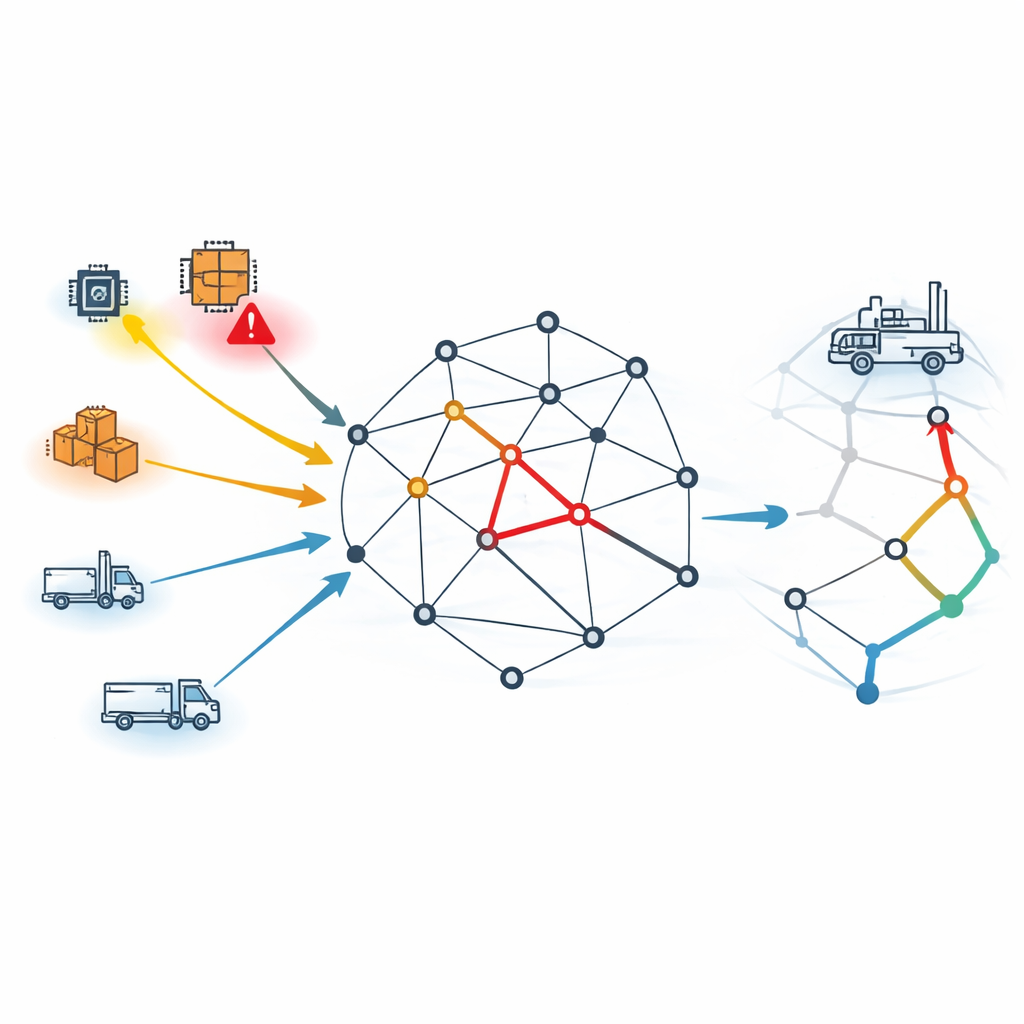
Real-world gains in speed, accuracy, and collaboration
The results show marked improvements. In the chip shortage scenario, the system reaches just over 92% accuracy in predicting how risk will travel through the supply chain and which paths are most likely to lead to production stoppages. Average response time to sudden risks drops by nearly three-quarters, and order on-time delivery and inventory turnover both rise sharply. Collaboration effects are strongest among lower-tier suppliers and logistics providers, where turnover increases by more than two-thirds and transport delays are cut in half. At the same time, the method generalizes across domains better than competing techniques, suggesting that the same framework could support other areas such as medical risk warning or energy management.
What this means for everyday business decisions
In plain terms, this work shows how a company can turn oceans of raw, inconsistent data into a single, adaptable map that explains “if this happens here, that will likely happen there.” By fusing text, images and machine signals, giving concepts flexible meanings, and letting relationships update themselves whenever new events occur, the proposed system makes risk pathways visible before damage is done. Although it demands more computing power than simpler tools, it offers a way to move from slow, experience-driven reactions to timely, evidence-based decisions that keep supply chains flowing and teams aligned when conditions change.
Citation: Ma, M., Wang, Y. & Sun, W. Research on the construction and dynamic adaptation algorithm of cognitive graph multimodal knowledge network for enterprise management communication. Sci Rep 16, 10193 (2026). https://doi.org/10.1038/s41598-026-40221-2
Keywords: multimodal knowledge graph, supply chain risk, cognitive map, dynamic decision support, quantum embedding