Clear Sky Science · en
A 3D comparison of planned versus achieved anterior tooth position in clear aligner treatment
A Clear Look at Invisible Braces
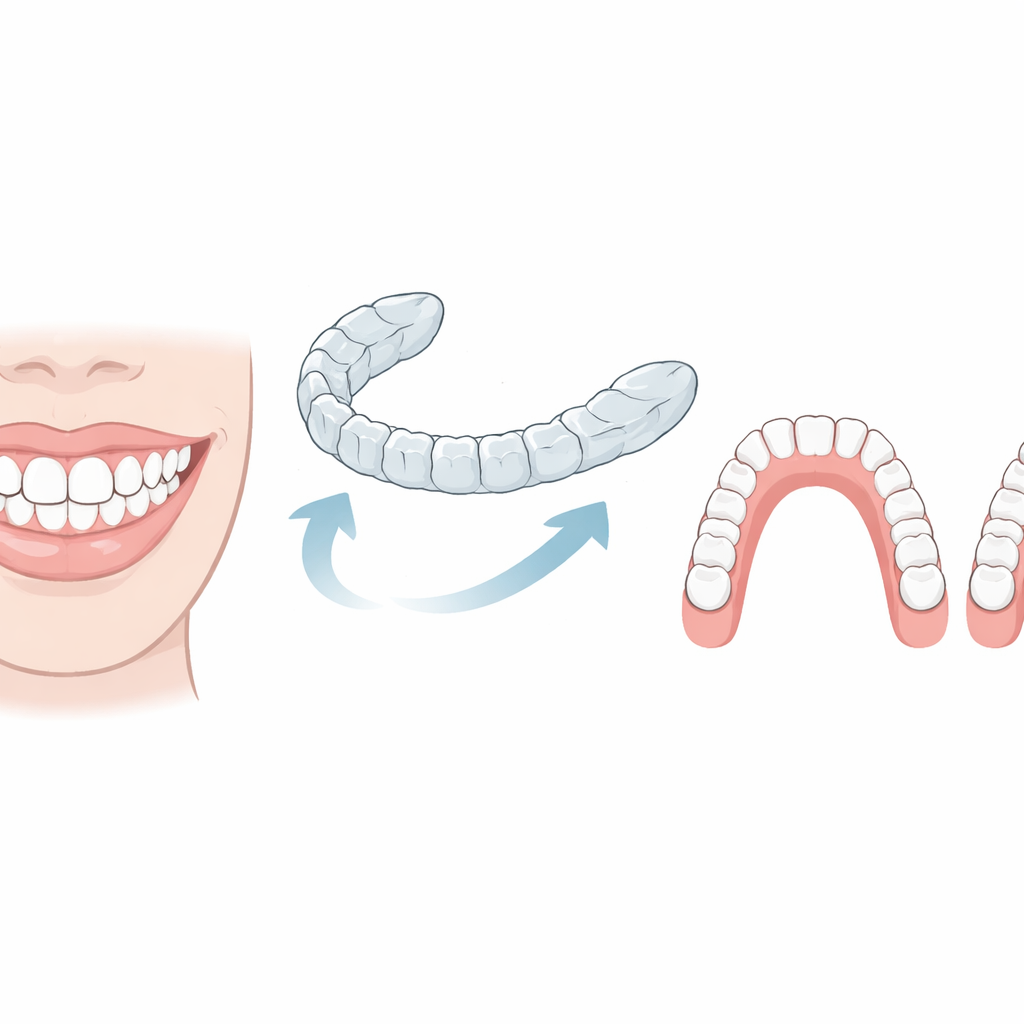
Many adults choose clear, removable aligners to straighten their front teeth because they are discreet and convenient. But how closely do these plastic trays actually match the perfect smile promised on the computer screen? This study takes a careful three‑dimensional look at what was planned versus what really happened to patients’ front teeth after the very first full set of Invisalign aligners, before any extra “fine‑tuning” was added.
Why Front Teeth Matter So Much
The front teeth are the stars of any smile: they frame the lips, shape the profile, and help with biting and speech. Clear aligners are now widely used to adjust these teeth, but earlier research suggested that not every type of movement is equally easy to achieve. Rotating a tooth, tipping it slightly inward or outward, or moving it up and down into the jaw can all behave differently under aligner forces. Many studies also mix together results from the first aligner series and from later refinements, making it hard for patients and dentists to know what to expect from the initial treatment alone. This study set out to measure, in detail, how accurately the first series of aligners positioned the front teeth compared with the digital plan.
How the Teeth Were Measured in 3D
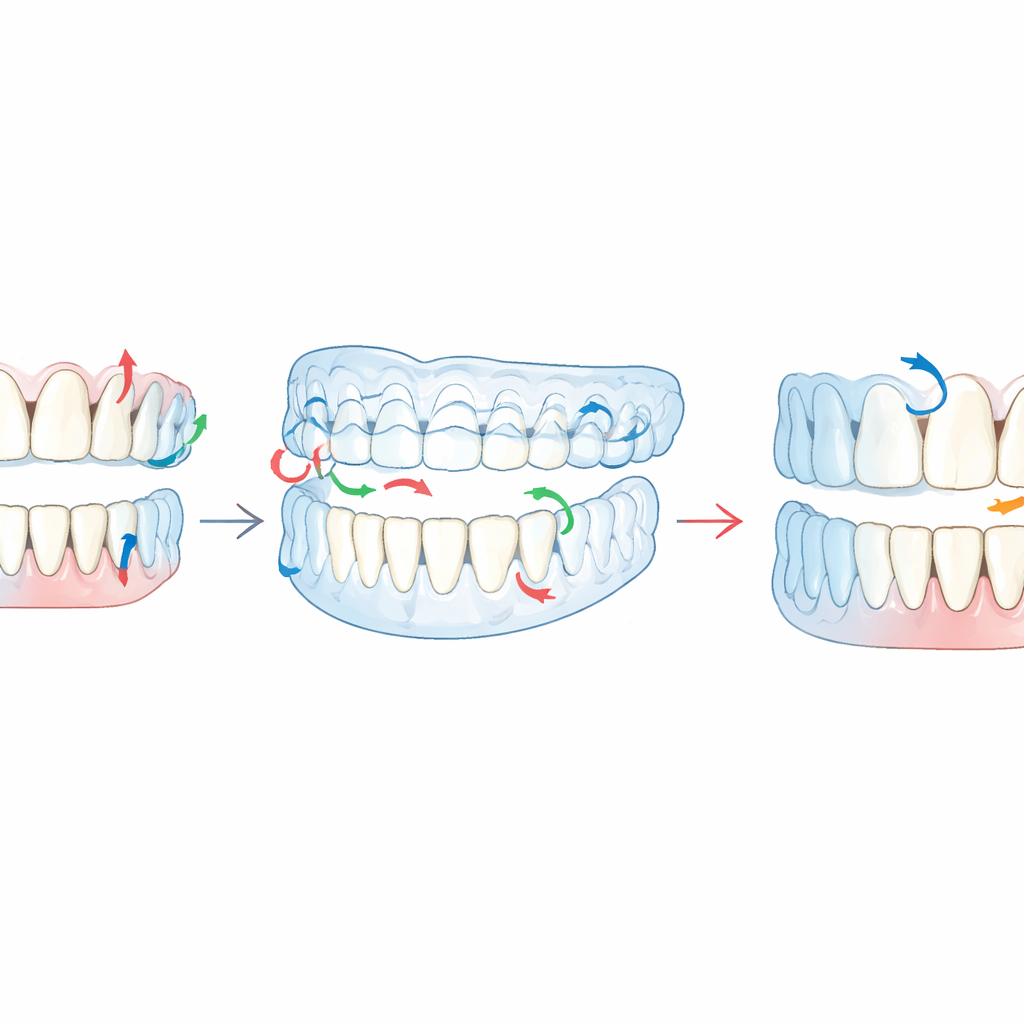
Researchers followed 40 adults, all treated with Invisalign for mild to moderate crowding of the front teeth. For each person, the team collected three high‑resolution digital scans of the teeth: one before treatment, one at the end of the first full aligner series, and one representing the company’s predicted final result. Using specialized 3D software, they carefully lined up these models and created a coordinate system in the mouth, so that each tooth’s movement could be measured in space. They focused on 480 upper and lower front teeth, tracking four key movements: vertical shifts (intrusion, pushing teeth further into the jaw, and extrusion, pulling them out), rotation around the long axis of the tooth, forward‑backward tilting along the row of teeth, and in‑out tilting toward the lips or the tongue.
What the Aligners Got Right—and Wrong
Across all front teeth and all movements, the first set of aligners achieved just over half (about 50%) of what the computer plan predicted. The upper front teeth were slightly less accurate than the lower ones. Some movements were fairly reliable: tipping teeth toward the tongue or lips, and many small rotations, matched the plan reasonably well. For example, tipping the lower canine teeth toward the tongue reached more than three‑quarters of the intended movement. On the other hand, moving upper front teeth vertically into the jaw—an important step for reducing a deep overbite—was far less predictable, with only about a quarter of the planned intrusion actually achieved for the upper central incisors. Extruding incisors, and rotating or tipping the more rounded canine teeth, also showed lower precision.
What This Means for Treatment Planning
The detailed pattern of results helps explain everyday experiences in orthodontic practice. The study confirms that clear aligners are better at gently tipping and rotating certain teeth than at pushing upper front teeth deeper into the jaw. It also shows that even when the final smile looks much improved, the teeth often fall short of the exact digital plan after the first series of trays alone. Because the researchers separated out each type of movement and each tooth, they could highlight where aligners are naturally strong and where they struggle, especially for movements that require tight vertical control of the bite.
Takeaway for Patients and Clinicians
For people considering or already wearing clear aligners, this study offers a realistic message: the first set of trays can move front teeth in the right direction, but they rarely deliver the “perfect” planned positions on their own. In particular, using aligners alone to push upper front teeth upward to fix a deep overbite is difficult and often incomplete. Dentists and orthodontists can use this knowledge to build in planned overcorrections, add special attachments, and expect additional refinement trays to finish the job. In everyday terms, clear aligners are effective tools—but not magic. Achieving a truly polished, well‑balanced smile usually requires a second round of adjustments beyond the first clear plastic set.
Citation: Saif, B.S., Rao, C., Wanqing, H. et al. A 3D comparison of planned versus achieved anterior tooth position in clear aligner treatment. Sci Rep 16, 11985 (2026). https://doi.org/10.1038/s41598-026-40219-w
Keywords: clear aligners, Invisalign accuracy, anterior tooth movement, 3D dental scanning, orthodontic treatment outcomes