Clear Sky Science · en
Realistic 3D morphology reshapes insect heat budgets
Why bee body shape matters for warmth
Honey bees have to keep their bodies in a comfortable temperature range to fly, forage, and pollinate our crops. Scientists often use computer models to predict how quickly insects gain or lose heat, which helps us understand how they will cope with hotter or colder climates. But these models usually treat insects as simple shapes, like spheres and cylinders, rather than as the intricate three‑dimensional creatures they really are. This study asks a basic but crucial question: does that shortcut about body shape actually change the story of how bees stay warm or cool?
Looking beyond simple shapes
Most past work on insect temperature has relied on rough size estimates, such as assuming a bee’s chest is a perfect ball and its head and abdomen are smooth tubes. Those guesses feed into formulas that calculate how much heat a bee gains from its surroundings and how much it loses to the air. The authors point out that no one had carefully checked how far off these shape shortcuts might be. With new imaging tools now able to capture every bump and curve of tiny animals at low cost, it has become possible to compare real body forms with these simple stand‑ins.
Capturing real bees in 3D
The team used photogrammetry, a method that builds a three‑dimensional model from many overlapping photographs, to create detailed digital versions of worker honey bees from museum collections. By rotating each specimen and photographing it from many angles, they reconstructed accurate models of the head, middle body, and abdomen, and then measured each part’s true surface area and volume. They also measured the same bees with calipers and applied the traditional geometric formulas, allowing a direct, one‑to‑one comparison between the shortcut method and the realistic 3D approach.
How much the shortcuts shrink bees
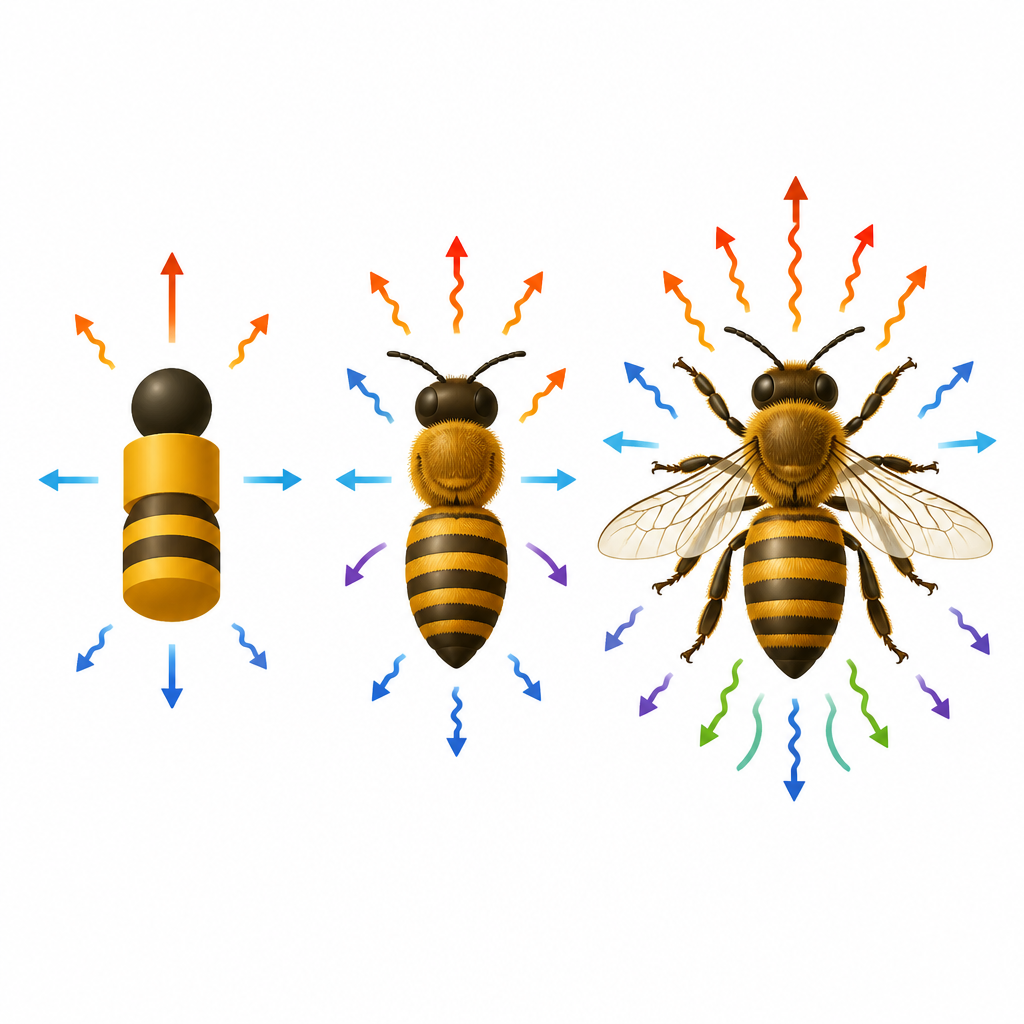
When the researchers compared the results, the simple shape method consistently made the bees “smaller” than they really were. For the head and mid‑body, the geometric approach underestimated both surface area and volume by roughly one‑third to one‑half. The abdomen, which naturally resembles a tube and cone, was closer to the truth, but the combined body parts still came out too small overall. When legs and wings were added to the 3D models, total surface area jumped by almost half, showing how much of the bee’s heat‑exchanging surface is usually ignored. Despite these size differences, the way surface area scaled with volume across bees stayed in line with basic geometric expectations, meaning the main issue is not the pattern but the absolute values.
What mismeasured bees mean for heat flow
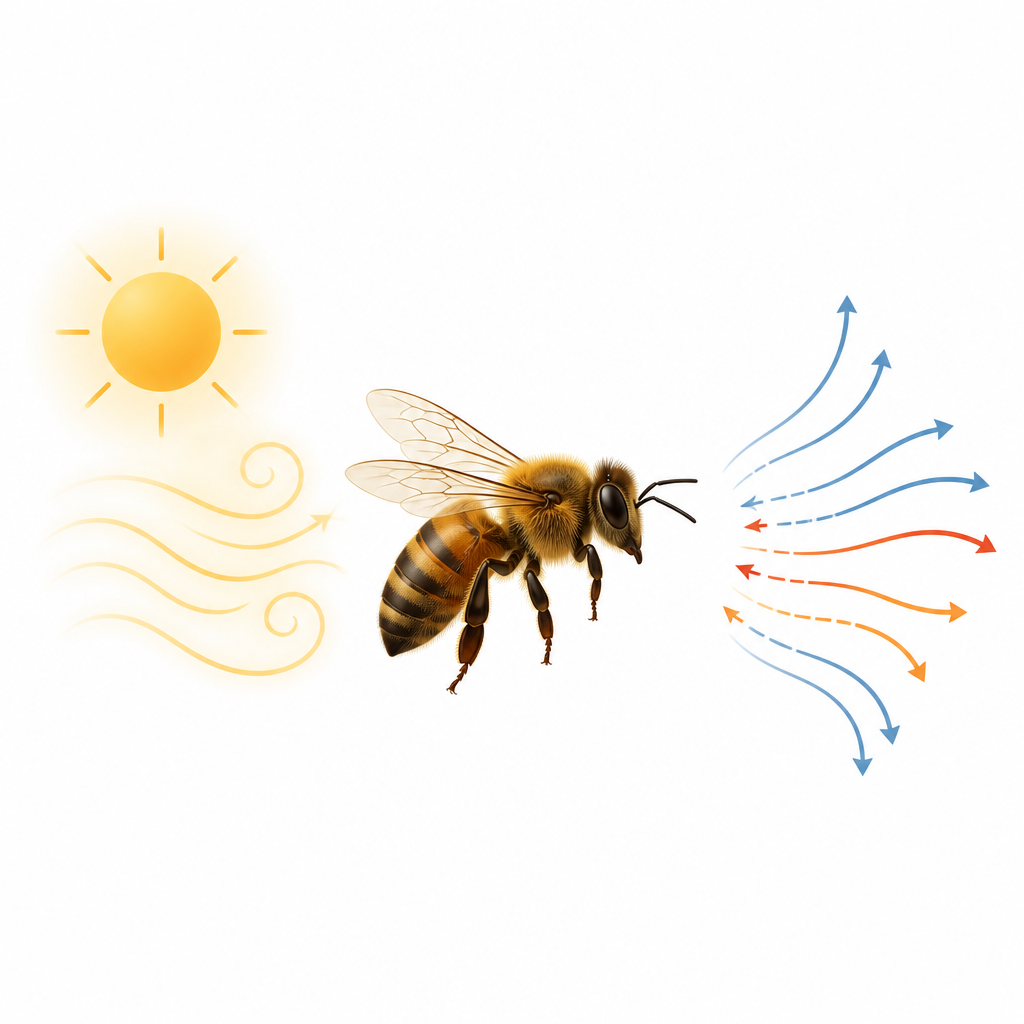
The authors then asked how these size errors ripple through a commonly used heat budget for flying honey bees. They plugged the corrected surface areas from their 3D models into existing equations that describe how bees produce heat through metabolism, lose heat by evaporation, and exchange heat with their surroundings through radiation and moving air. They found that underestimating surface area especially distorted the part of the model dealing with long‑wave radiation, a key route by which bees shed heat at higher air temperatures. In the traditional model, air movement and radiation swap roles as the main way bees lose heat around moderate temperatures. With realistic 3D sizes, radiation remains the dominant route across the full range of temperatures examined.
Why this matters for bees and a warming world
To a lay reader, the takeaway is straightforward: if we shrink bees on paper, we misjudge how they heat up and cool down in real life. This study shows that relying on overly simple shapes can mislead us about which physical processes help bees avoid overheating or chilling, especially at cooler temperatures and likely even more so in sunlight. By embracing realistic 3D body measurements, scientists can build more accurate models of how honey bees and other insects interact with a changing climate. That, in turn, improves our ability to anticipate when and where these vital pollinators will face thermal stress.
Citation: Ostwald, M.M., Johnson, M.G., Youngblood, A. et al. Realistic 3D morphology reshapes insect heat budgets. Sci Rep 16, 14929 (2026). https://doi.org/10.1038/s41598-026-40212-3
Keywords: honey bee thermoregulation, insect heat balance, 3D morphology, photogrammetry, climate impacts on insects