Clear Sky Science · en
Mechanical behavior of tooth-class II restoration complex with various restorative materials using linear and non-linear finite element analysis
Why Your Dental Filling Material Matters
Most of us think of a filling as a simple patch for a cavity, but the choice of material can change how your tooth bends and where it might eventually crack. This study uses advanced computer simulations to look inside a filled tooth and ask a practical question: do common filling materials—composite resin, ceramic, amalgam, and gold—load your tooth differently, and could that help explain why some teeth crack more often than others?
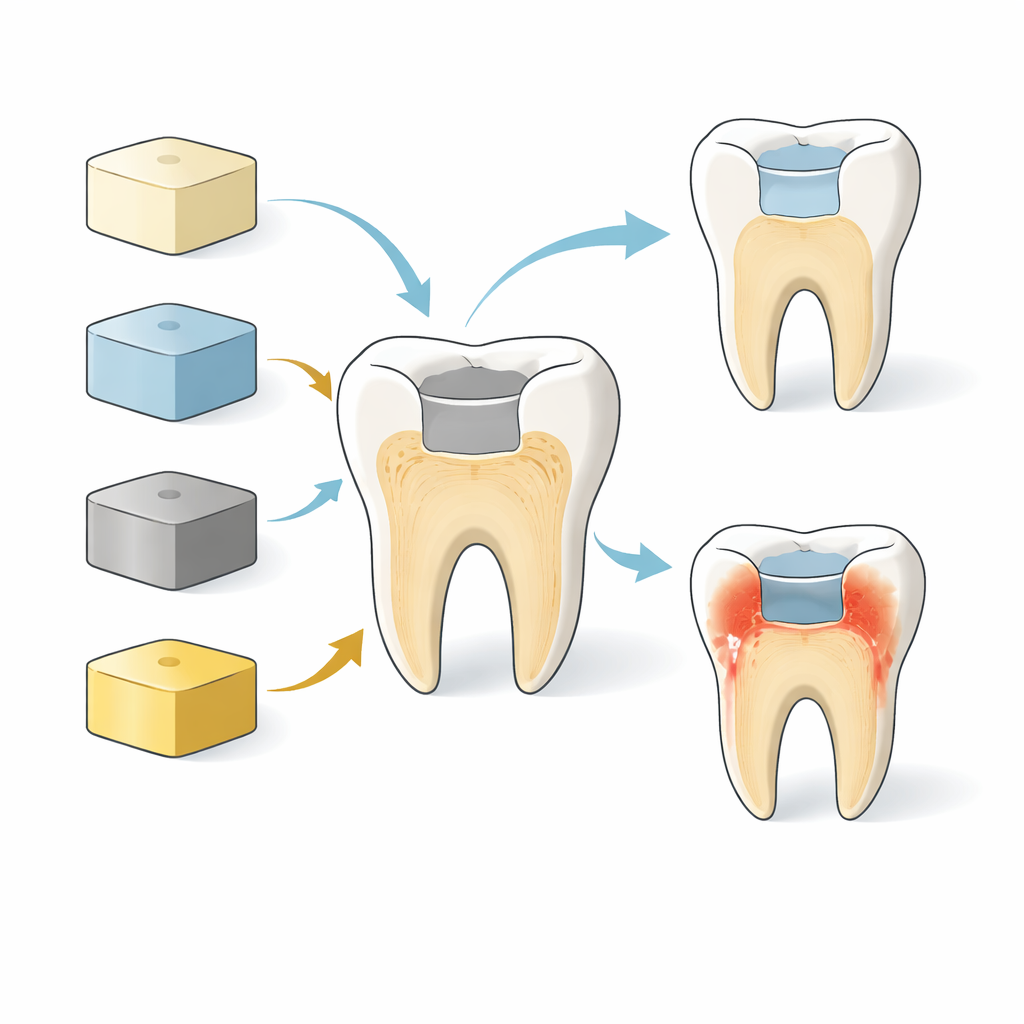
Looking Inside a Repaired Tooth
The researchers focused on a lower back molar, a tooth that takes some of the strongest bites in the mouth. They created a detailed three-dimensional model of the tooth crown, including its hard outer enamel and softer inner dentin, and then designed a typical “class II” restoration, the kind used when decay reaches the area between neighboring teeth. Into this same cavity shape they virtually placed four different fillings—composite resin, ceramic, amalgam, and gold—so that any differences they saw would come from the material and how it connects to the tooth, not from the size or design of the repair.
Bonded Versus Non-Bonded Repairs
In modern dentistry, tooth-colored composite resins and many ceramics are bonded tightly to the tooth, acting almost like an extension of it. Amalgam and gold, by contrast, are usually held in mainly by their shape and friction, not by strong glue-like bonding. Earlier computer studies often assumed that all materials were perfectly bonded, which does not match how metal fillings behave in real mouths. Here, the team set up their simulations to more closely mimic reality: composite and ceramic were treated as firmly attached, while amalgam and gold were allowed to slip and separate slightly at their contact with the tooth, reflecting a looser, non-bonded connection.
How the Tooth Flexes Under Bite Forces
The model was subjected to a realistic chewing load distributed over several contact points on the biting surface. The computer then calculated how much the tooth and filling deformed and where the highest internal stresses occurred. Composite resin itself bent the most, owing to its relative softness, but surprisingly, ceramic restorations led to the smallest bending of the surrounding enamel and dentin. Amalgam and gold did not deform dramatically as materials, yet the tooth tissues around them flexed more. The key difference lay at the interface: when the filling could move independently, the tooth behaved more like a weakened beam, concentrating bending at the edges of the cavity.
Where Stresses Build Up and Cracks May Start
The simulations showed that the highest stresses in enamel and dentin appeared in teeth restored with amalgam, closely followed by gold, while ceramic produced the lowest stresses and composite fell in between. In amalgam-filled teeth, stress in the outer enamel was about 80 percent higher than with ceramic, and stress in the inner dentin was more than double. These concentrated forces tended to appear near the junction between enamel and dentin, just below the filling, which is a known hotspot for crack formation. Importantly, the metals themselves remained below their own yield limits, meaning they were not close to permanent damage; instead, the tooth tissue carried the extra load because the non-bonded fillings did not share stresses as effectively.
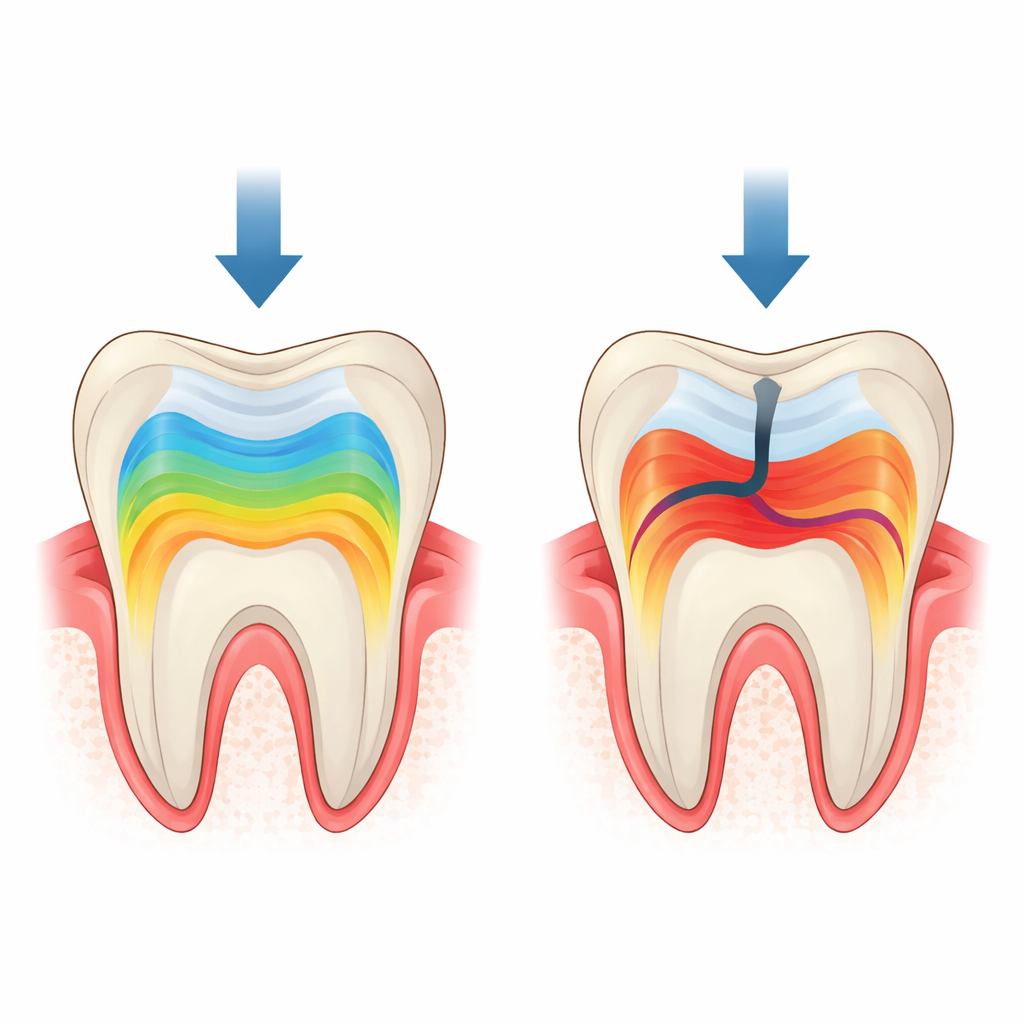
What This Means for Real Teeth
The findings offer a mechanical explanation for clinical reports that teeth with amalgam or gold inlays are more prone to cracking than those restored with bonded resin or ceramic. When a filling is tightly bonded, the tooth and restoration flex together, spreading chewing forces more evenly. When the filling can slide or gap slightly, as with typical metal inlays, bending focuses in the tooth itself, raising the risk of tiny cracks that can grow over time. While this work is based on computer modeling rather than long-term patient follow-up, it suggests that how well a filling is connected to the tooth may be just as important as the material’s strength, and helps explain why modern bonded restorations can be kinder to the remaining tooth structure.
Citation: Yu, YH., Jeon, MJ., Shin, SJ. et al. Mechanical behavior of tooth-class II restoration complex with various restorative materials using linear and non-linear finite element analysis. Sci Rep 16, 10150 (2026). https://doi.org/10.1038/s41598-026-40204-3
Keywords: dental fillings, tooth cracks, finite element analysis, restorative materials, enamel stress