Clear Sky Science · en
Study on the stability of nano-polycrystalline Ag films in thermal and humid environment
Why shiny mirrors can turn dull
Highly reflective silver coatings are the hidden workhorses in satellite telescopes, space cameras, and advanced communication systems. These ultra-thin silver films help gather faint starlight and transmit data efficiently, but on Earth they must first survive months of assembly and testing in warm, humid air. This study asks a practical question with big implications for space technology and precision optics: how, exactly, do these nanostructured silver mirrors slowly tarnish and deform in a steamy atmosphere, and what controls that damage over time? 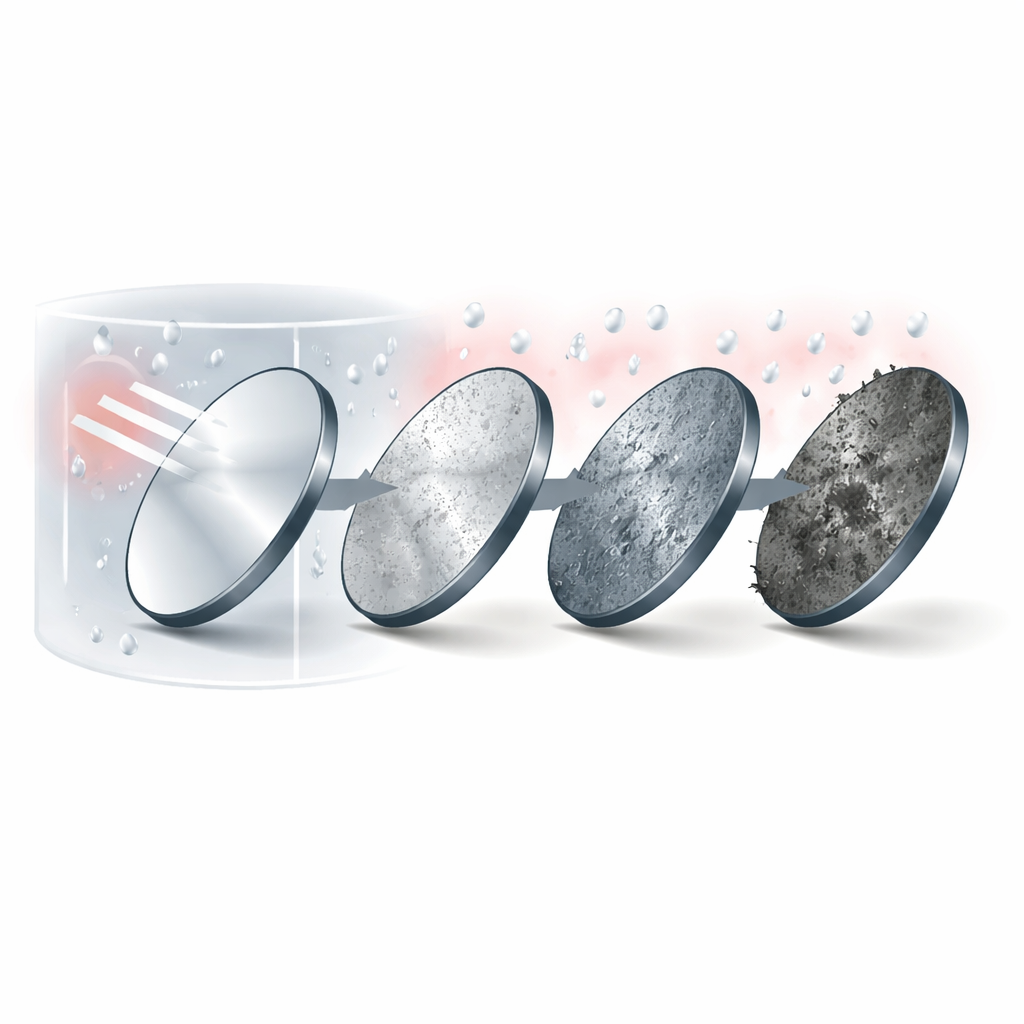
The special silver behind sharp space views
The researchers focus on nanopolycrystalline silver films, a carefully engineered form of silver made of many tiny crystalline grains. These films are prized because they reflect a broad range of wavelengths extremely well while emitting very little heat, making them ideal for high-performance optical systems. However, even when covered with protective coatings, real mirrors always contain microscopic flaws such as pinholes and pores. Warm, moist air can seep through these weak spots, leading to gradual chemical attack that dulls the mirror and can ultimately make an expensive optical system unusable. A clear picture of how this degradation unfolds has been missing, limiting efforts to design truly durable mirrors.
A long, harsh aging test for silver films
To capture the full life story of these coatings, the team fabricated 130-nanometer-thick silver films using a high-precision vacuum system that combines electron-beam evaporation with ion-assisted deposition, which helps pack the grains densely. They then placed the coated samples into a controlled chamber held at about 50 °C and 95% relative humidity for six months. Every two months, they measured changes in the film’s chemistry, surface landscape, light reflectivity, and internal stress. Using techniques such as Raman spectroscopy and X-ray photoelectron spectroscopy, they tracked which silver compounds formed; atomic force microscopy revealed how the surface roughened; optical instruments quantified the drop in reflectivity; and curvature measurements showed how mechanical stress inside the film shifted over time. 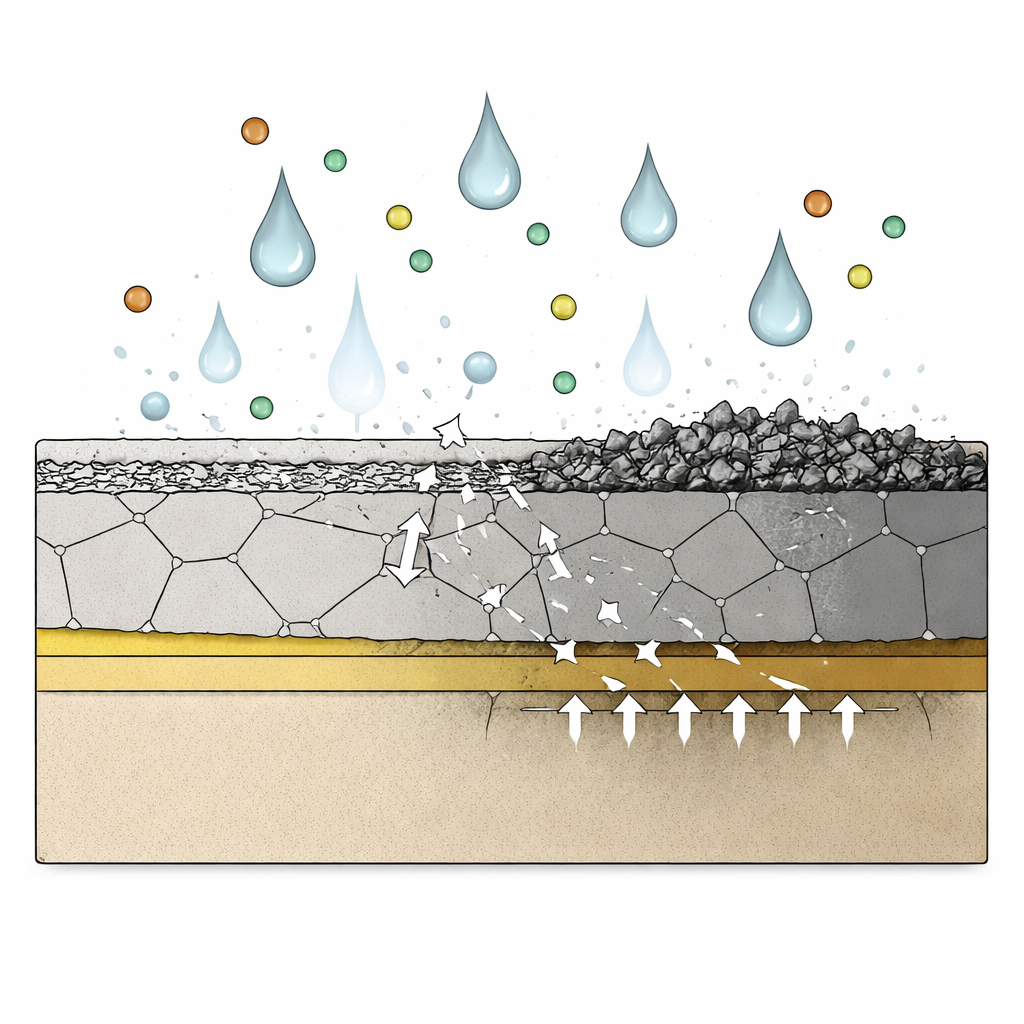
How water and gases quietly reshape silver
The results show that a thin water layer forms on the silver surface in this hot, humid environment, acting as a sponge for corrosive gases containing sulfur and chlorine. Silver atoms near the surface dissolve into this water layer as ions and migrate along grain boundaries, then reassemble into new compounds. Over months, the surface accumulates mainly silver sulfide, plus silver oxide and silver chloride, which appear not as a smooth skin but as spike-like clusters that grow upward, making the surface much rougher. Average grain size increases and the overall texture becomes more jagged and matte. At the same time, the film’s internal stress flips from being stretched (tensile) to squeezed (compressive) as these bulkier corrosion products form and expand, reshaping the underlying metal structure.
Why brightness fades but not equally for all colors
The mirror’s ability to reflect light fades in stages. In the first months, reflectance changes slowly; after two to four months, it drops sharply in the ultraviolet and visible range, while the near-infrared region is affected much less. By fitting detailed optical measurements with a “five-phase” model—including the glass substrate, an underlying oxide layer, the silver film, a silver sulfide layer, and a rough mixed top layer—the authors reconstruct how a silver sulfide layer thickens from about 1.6 nanometers to over 12 nanometers. They find that the loss of brightness is driven not only by increased roughness scattering light but even more by stronger absorption in the new surface compounds, which sap energy from the light instead of reflecting it cleanly.
What this means for future high-performance mirrors
To a non-specialist, the central message is straightforward: in warm, humid air, even carefully engineered silver mirrors slowly convert their shiny outer skin into a darker, more stressful mix of corrosion products, and this transformation follows a predictable path. Water and trace gases first rearrange the silver at the nanoscale, building up silver sulfide and oxide spikes, thickening a tarnish layer, and gradually flipping the film from safely balanced to dangerously compressed. By mapping this process in detail and capturing it in a quantitative model, the study offers designers of space and precision optics a roadmap for predicting when and how silver coatings will fail, and a scientific basis for developing smarter protective strategies rather than relying on trial and error.
Citation: Li, Y., Wang, S., Song, X. et al. Study on the stability of nano-polycrystalline Ag films in thermal and humid environment. Sci Rep 16, 10083 (2026). https://doi.org/10.1038/s41598-026-40200-7
Keywords: silver thin films, optical coatings, humidity corrosion, mirror durability, surface degradation