Clear Sky Science · en
Evaluation of static oxidation characteristics and analysis of displacement efficiency during air injection in light oil reservoirs
Why pushing oil with air matters
Much of the world’s easily produced oil is already gone, leaving behind large volumes trapped in tight, stubborn rock. This study explores a low-cost idea: using ordinary air, not expensive specialty gases, to push more light oil out of underground reservoirs. By watching how crude oil slowly reacts with oxygen at modest temperatures, and how that chemistry affects the flow of oil through rock, the researchers show when air injection can be an efficient, practical tool to boost production in low-permeability fields.
Air as a cheap underground helper
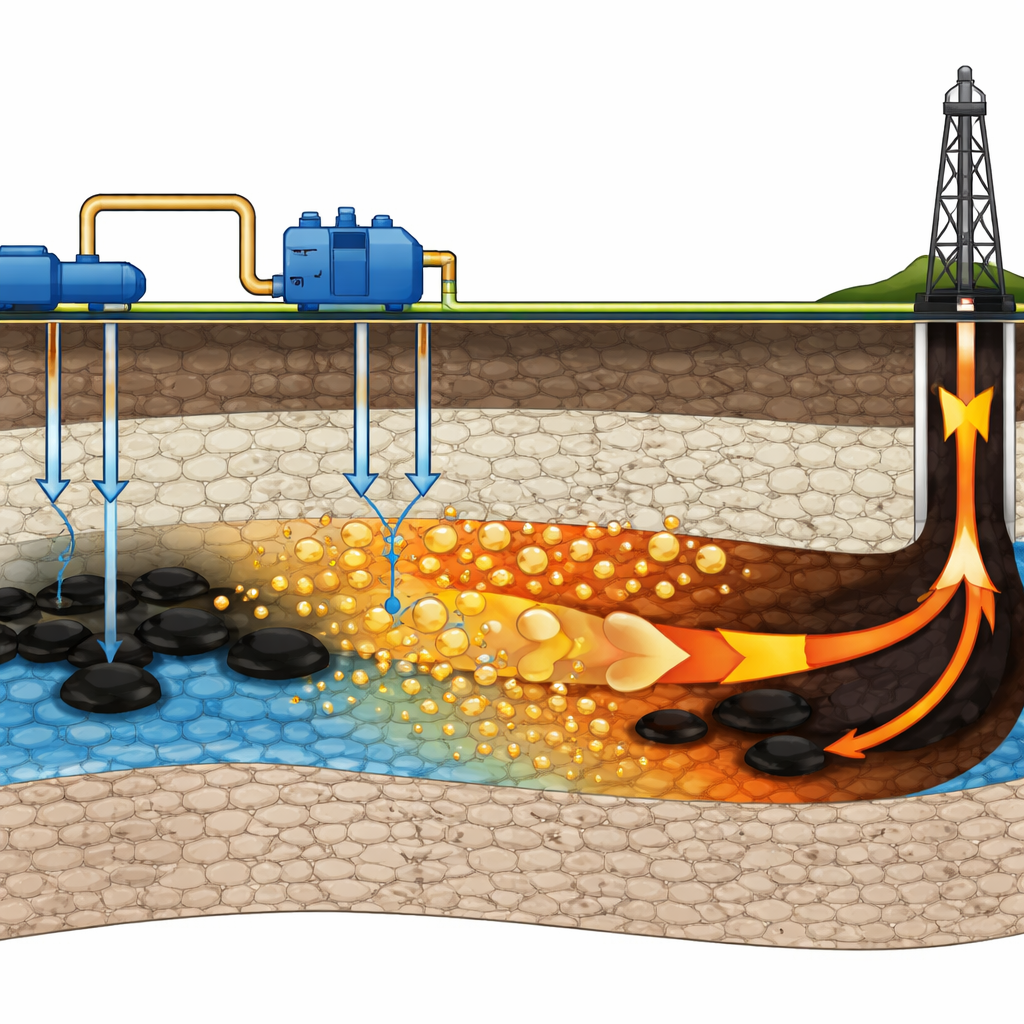
Traditional methods to squeeze more oil from the ground often rely on water flooding or on injecting gases like carbon dioxide or natural gas. These techniques can be costly, water-intensive, or limited by gas supply. Air, by contrast, is nearly free, available on site, and attractive for remote or water-scarce regions. When air is pumped into a light oil reservoir, the oxygen in it reacts gently with the crude oil in a process called low-temperature oxidation, generating additional gases and changing the oil’s makeup. This study focuses on a light oil reservoir in China’s Xinjiang region, asking under what conditions this quiet chemistry helps or hinders getting more oil out.
Watching oil slowly change in the lab
To isolate the chemistry, the team first ran high-pressure “static” experiments: crude oil from the field was sealed in a long, heated steel tube and exposed to air or oxygen-poor air for days to months. They then measured how much oxygen was consumed, what gases formed, how the oil’s density and thickness (viscosity) changed, and how its light, medium, and heavy components shifted. They varied five key factors that mimic real reservoir conditions: reaction time, water content in the rock, oxygen level in the injected gas, how rich the oil was in medium-size components, and whether reservoir rock minerals were present.
When chemistry thickens or thins the oil
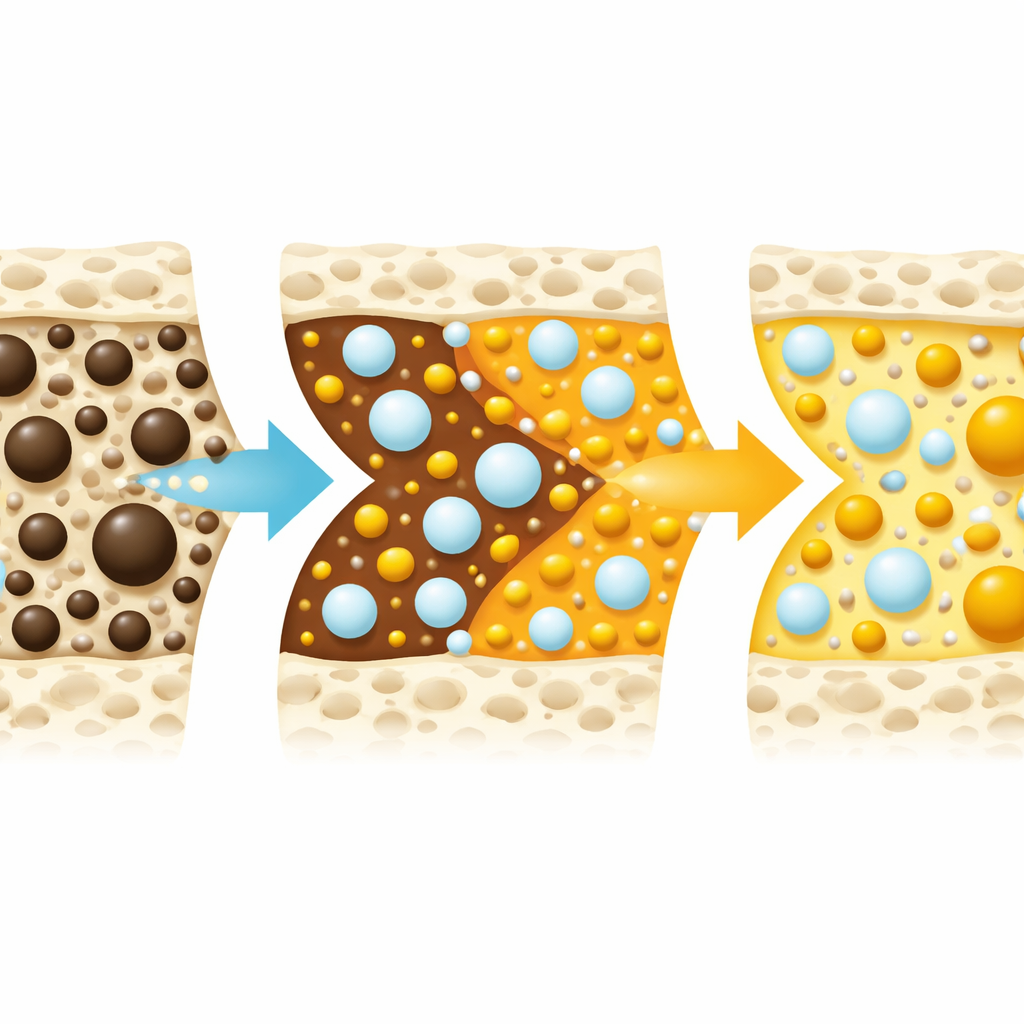
The results show that the oxygen–oil reaction moves in stages. Early on, oxygen is used up quickly, and carbon dioxide is produced, as the lighter and medium parts of the oil react to form heavier, more complex molecules. This makes the oil denser and more viscous—potentially harder to move. Over time, as the most reactive components are consumed, the process slows. Water in the rock acts like a brake: at high water saturations, oxygen and oil meet less efficiently, so both oxygen use and carbon dioxide generation drop, and the oil’s properties barely change. Lowering the oxygen content of the injected gas has a similar damping effect. Enriching the oil with stable, medium-sized components also weakens the reaction, because these molecules are less eager to react.
How minerals can turn the reaction around
Adding finely crushed reservoir rock to the tests changed the picture. The rock contains clay minerals with reactive surfaces that act like natural catalysts. In their presence, instead of mainly building heavier molecules, the oxidation favoured breaking larger oil molecules into smaller ones. This shift increased the share of medium components and reduced oil density and viscosity—essentially “lightening” the oil and making it easier to flow. Comparing all the test conditions together, the study shows that rock minerals tend to deepen and redirect the reaction, while water, lower oxygen, and more medium components tend to calm it, affecting not just reaction speed but also which products dominate.
Air flooding through tight rock
Next, the researchers tested how these chemical insights play out when air actually flows through rock. They used long artificial rock cores spanning a range of low permeabilities and mimicked real reservoir pressure and temperature. After first flooding the cores with water, they injected air at controlled rates and tracked pressure, gas and liquid production, and oil recovery. Across all cores, air flooding produced an “oil bank”: once gas broke through, oil production rose sharply as air expanded and re-mobilized oil that water had left behind, including oil trapped in tiny pores that water could not reach.
Which rocks benefit most
Permeability—the ease with which fluids move through rock—proved crucial. In the tightest cores, gas faced strong resistance from tiny pore throats, leading to high pressure buildup and early formation of preferential gas channels that bypassed much of the oil. In somewhat more permeable cores within the same low-permeability range, gas advanced more evenly, delaying gas channeling and sweeping out more oil. In these cores, air flooding added over a dozen percentage points of extra recovery after water flooding. The authors stress that this behavior differs from that of medium- to high-permeability reservoirs, where higher permeability often speeds unwanted gas breakthrough.
What this means for future oil fields
Overall, the study ties together slow, low-temperature oxidation chemistry and the large-scale flow of oil and gas in rock. It shows that air injection can be particularly promising in certain low-permeability light oil reservoirs, especially where natural rock minerals help “lighten” the oil and where permeability is high enough to avoid severe gas trapping, but still low enough to control gas channeling. By clarifying how water content, oxygen level, oil composition, and rock minerals steer both the reactions and the flow, the work offers a framework for choosing when and how to use air injection to cheaply boost oil recovery from stubborn fields.
Citation: Liu, Z., Yang, B., Zhang, S. et al. Evaluation of static oxidation characteristics and analysis of displacement efficiency during air injection in light oil reservoirs. Sci Rep 16, 12640 (2026). https://doi.org/10.1038/s41598-026-40187-1
Keywords: air injection, low-temperature oxidation, light oil reservoir, enhanced oil recovery, low-permeability rock