Clear Sky Science · en
A novel AI-enhanced microwave sensor employing defected ground structure for non-invasive glucose monitoring
Why painless sugar checks matter
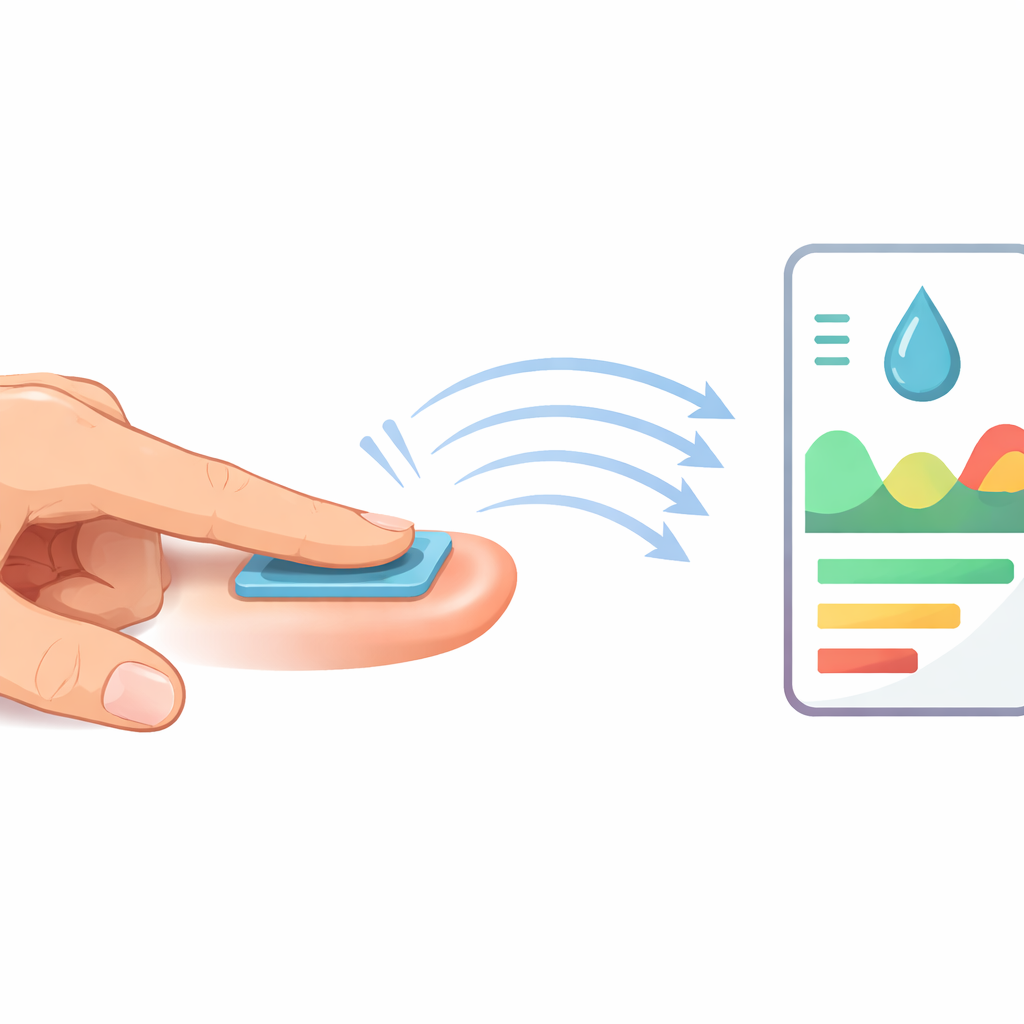
For millions of people living with diabetes, keeping blood sugar in a safe range means pricking their fingers several times a day. Over time, the pain, hassle, and cost push many to test less often than doctors recommend, raising the risk of blindness, nerve damage, and heart disease. This study explores a very different approach: a small electronic patch that reads blood sugar from outside the body using gentle radio waves instead of needles. If such sensors prove accurate on real skin, they could turn glucose checks into something as simple as touching a card reader.
A tiny antenna with a special pattern
At the heart of the work is a flat metal antenna about the size of a thumb, shaped like a hexagon and tuned to send and receive microwave signals in the 4–5 GHz range. Rather than shining light into the skin, this device uses low-power radio waves similar to those in Wi‑Fi, but carefully controlled so they are far below safety limits. When a finger rests on the patch, some of the energy enters the layers of skin, fat, and blood, and then returns to the antenna. How strongly the antenna “rings” at a particular frequency depends on the electrical properties of those tissues, which in turn are influenced by how much sugar is dissolved in the blood.
Turning chaos into a sensing advantage
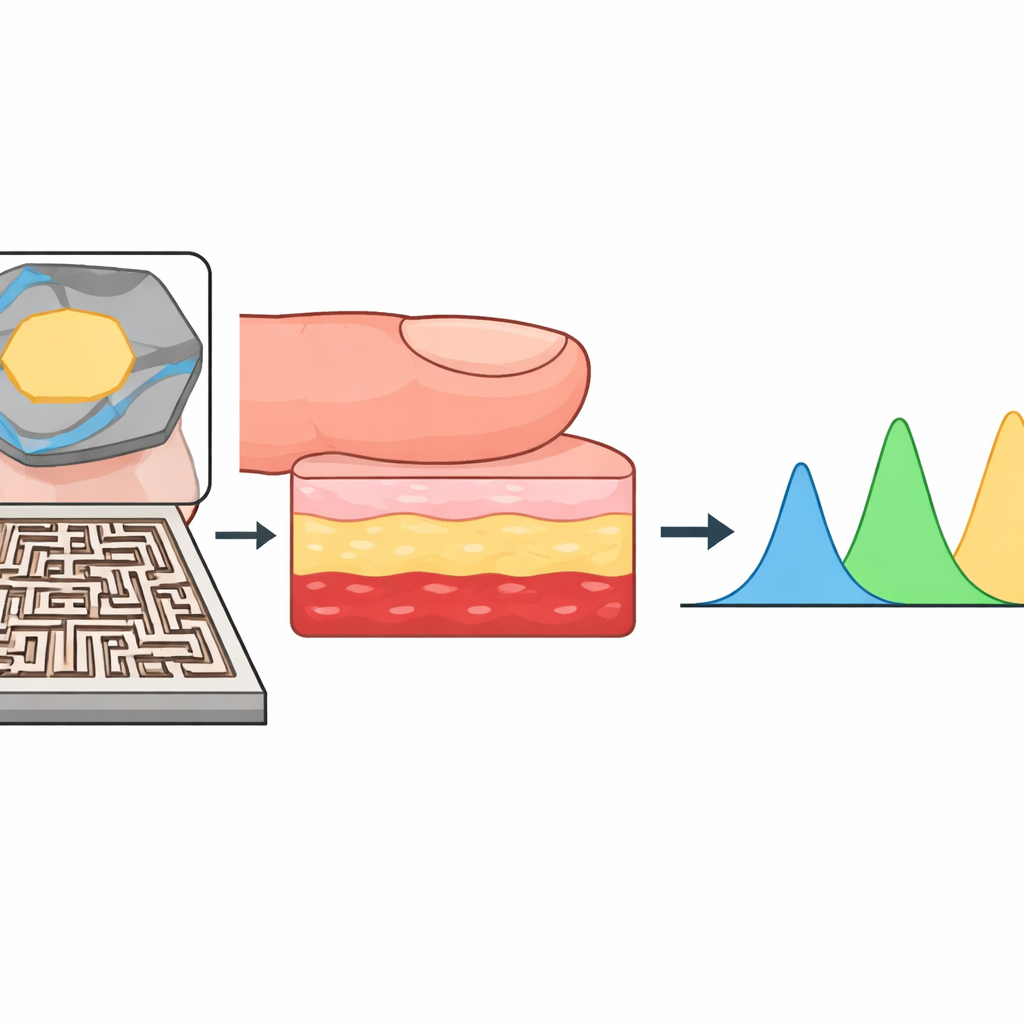
The most unusual part of the design is hidden on the underside of the antenna. Instead of a solid metal backing, the team carved a maze-like pattern inspired by a mathematical system known as the Duffing chaotic attractor. This intricate layout forces electric currents to travel along long, twisting paths, storing more energy and concentrating the radio field right where the finger touches the sensor. Tests and computer simulations show that this “chaotic” backing sharpens the antenna’s resonance, like tightening the strings of a musical instrument, making it much more responsive to tiny changes in the properties of nearby tissue than a conventional, unpatterned metal plate.
Building a realistic finger in the lab
Because it is difficult and risky to jump straight to experiments on people, the researchers first created a stand‑in for a human fingertip. They cast solid layers that mimic skin and fat using mixtures of water, gelatine, salt, oil, and detergent, following recipes that match how real tissue interacts with microwaves. For the “blood” layer, they prepared water-based solutions containing different amounts of glucose to represent low, normal, and high blood sugar. These three layers were stacked together and pressed against the antenna, with great care taken to keep temperature and measurement conditions constant.
How sugar levels change the signal
When the fake finger was in place, the antenna’s main resonance shifted upward in frequency compared with its behavior in air. More importantly, as the team increased the glucose concentration from 50 to 200 mg/dL—a range that spans dangerous lows, everyday targets, and high values common in poorly controlled diabetes—the resonance moved steadily in one direction. Higher sugar levels produced clearly higher resonance frequencies and slight changes in how sharply the antenna responded. By tracking these shifts, the researchers calculated that the device’s signal changed, on average, by about 0.95 MHz for every 1 mg/dL change in glucose, with a strong mathematical link between sugar level and frequency across the tested range.
What this could mean for daily life
The study shows that a compact microwave antenna with a carefully engineered, chaos-inspired metal pattern can reliably distinguish between low, normal, and high glucose levels in realistic finger models, all without breaking the skin. The radio energy absorbed by the tissue stayed well within international safety limits, and the sensor’s behavior in the lab closely matched computer predictions. While real-world use will require further steps—such as compensating for body temperature, motion, and other blood components, and testing on volunteers—the work lays the groundwork for future wearable devices that might one day let people check their blood sugar simply by placing a finger on a patch, sparing them countless needle sticks.
Citation: Tekşen, F.A., Aygül, S., Çolak, B. et al. A novel AI-enhanced microwave sensor employing defected ground structure for non-invasive glucose monitoring. Sci Rep 16, 9943 (2026). https://doi.org/10.1038/s41598-026-40171-9
Keywords: non-invasive glucose monitoring, microwave sensor, wearable diabetes technology, blood sugar sensing, antenna-based biosensor