Clear Sky Science · en
Research on the influence of micro-pile layout of stability of landslide resistance
Why tiny piles matter for big hillside moves
Landslides are among the most damaging natural hazards on Earth, often triggered or worsened by earthquakes. Traditional ways of holding unstable slopes in place—such as massive concrete walls or large piles—are effective but costly, slow to build, and hard to use in cramped or rugged terrain. This study looks at a newer, slimmer kind of support called micro-piles and asks a simple but crucial question: how should these small piles be arranged inside a slope so they work best at keeping the ground from giving way?
Smaller supports with big potential
Micro-piles are slender, steel-reinforced columns of concrete, usually less than a third of a meter wide, drilled into the ground and grouted in place. Because they are narrow and installed with relatively light equipment, they can be placed quickly and flexibly even on steep or crowded sites. Over decades of use, engineers have learned that micro-piles can successfully shore up slopes, foundations, and excavations. Yet most research has focused on how single piles behave or on the overall strength of pile groups, not on how different geometric layouts of many micro-piles change the way a landslide responds to shaking.
Testing a real hillside in virtual form
The authors focused on a real landslide from a resettlement project in Haiyuan County, Gansu Province, an area with notable earthquake risk. They built a detailed computer model of a cross-section of the slope, representing the bedrock, a weaker sliding band, and the overlying soil. First, they simulated how this hillside behaves without any reinforcement under both ordinary gravity and an earthquake-like shaking sequence tailored to local seismic conditions. The results showed that the slope hovered right at the edge of failure even before shaking, and that under seismic loading its safety dipped into the unsafe range—clear evidence that extra support would be needed in reality. 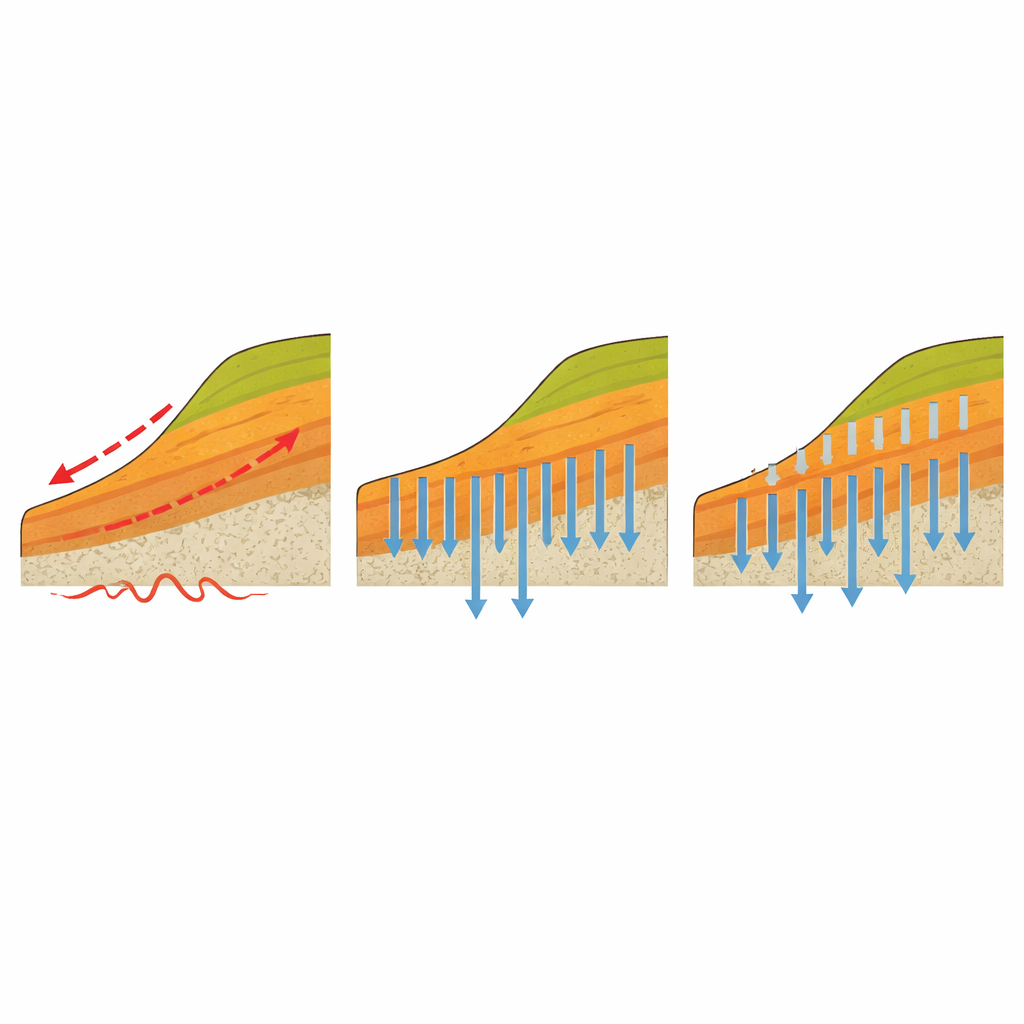
Trying different ways to place the piles
Next, the team added micro-piles into the middle to lower part of the slope, where supports are most practical and effective. All piles had the same length and material properties; what changed was how they were arranged. The researchers compared a simple parallel grid—rows and columns lined up like a checkerboard—with several versions of a staggered “quincunx” layout, where each row is offset relative to the one in front of it, resembling the five dots on a die. They evaluated each layout using three yardsticks: a safety factor that measures how close the slope is to sliding, the bending forces in the piles (a key sign of how hard they are working and how close they are to damage), and how earthquake accelerations change at various points on the slope surface.
What really changes when piles are rearranged
The simulations revealed a subtle but important pattern. Rearranging the piles had only a modest effect on the overall safety factor and on the way earthquake accelerations were amplified across the slope. Once a reasonable number of piles were present, all layouts kept the slope’s safety comfortably above the critical level during shaking, and the acceleration patterns at the surface looked broadly similar. In contrast, the internal bending forces in the piles reacted strongly to layout. The quincunx patterns spread the load more evenly between front and back rows, avoiding strong peaks in any single row. Stress maps inside the soil showed how the staggered arrangement encouraged “arching” of the soil between piles, forcing the landslide forces to be reduced step by step as they passed from one row to the next, instead of concentrating in a narrow band. 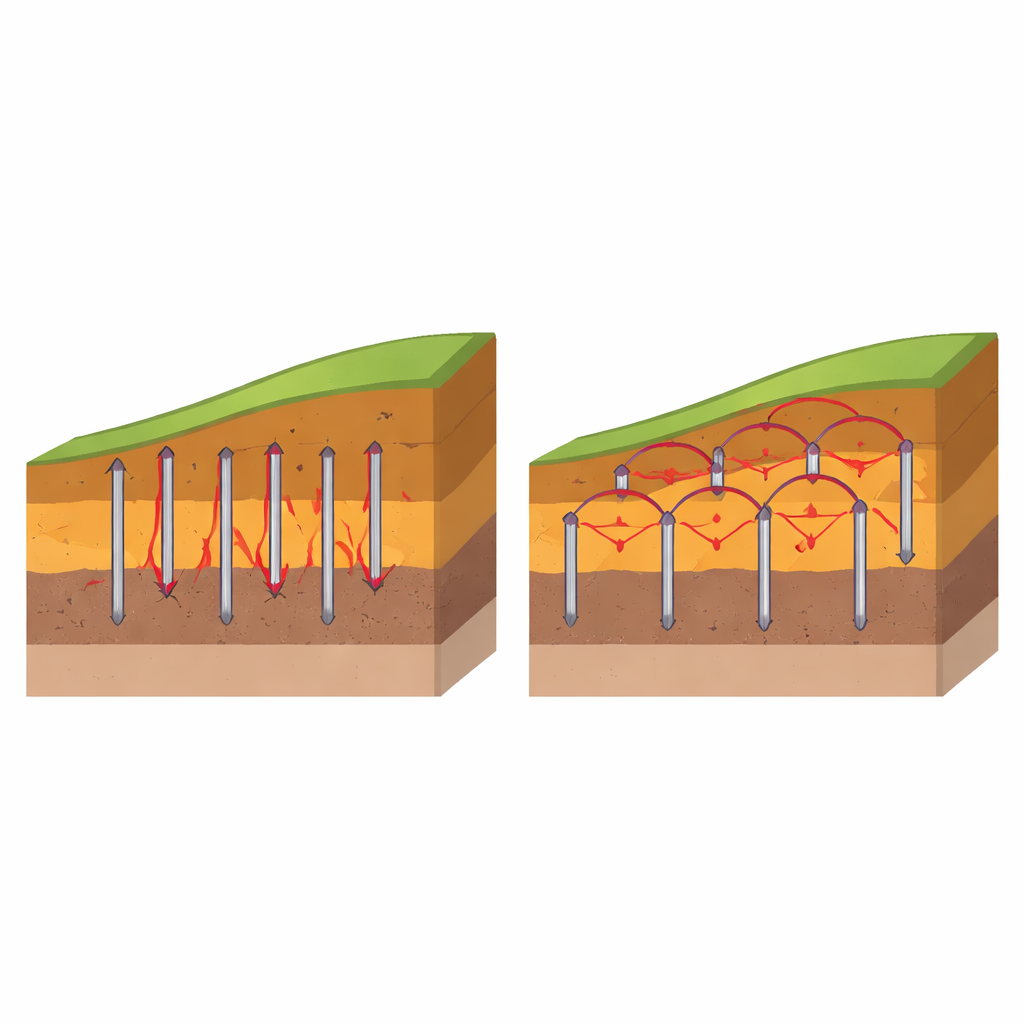
The best pattern for a safer slope
Among the layouts tested, the most effective used a quincunx pattern in which the spacing between rows gradually decreased from front to back. This combination made the pile group and surrounding soil behave more like a single, interlocked body. It kept the piles within safe bending limits, reduced harmful stress concentrations in the soil, and still delivered the needed overall stability under earthquake shaking. For engineers, the key takeaway is that, once the number and size of micro-piles are set, the exact pattern has limited influence on global safety but a strong influence on how forces are shared inside the ground. A carefully designed staggered layout can make the same amount of material work smarter, not harder, offering a practical guide for future landslide protection projects in earthquake-prone regions.
Citation: Li, H., Yang, M. & Lan, Z. Research on the influence of micro-pile layout of stability of landslide resistance. Sci Rep 16, 13191 (2026). https://doi.org/10.1038/s41598-026-40147-9
Keywords: landslide mitigation, micro-piles, slope stability, earthquake engineering, geotechnical design