Clear Sky Science · en
Feasibility and application of an adsorption model for coal pore structure analysis through N2 adsorption
Why tiny spaces in coal matter
Coal may look like a solid black rock, but under the microscope it is more like a sponge full of tiny holes. These hidden spaces control how much methane gas coal can hold and how easily that gas can escape into mines or be produced as a fuel. This study asks a simple but important question: how can we most accurately “see” and measure these invisible pores, so that we can better predict gas storage, gas leaks, and the safety and efficiency of coal mining and coalbed methane production?
Looking inside coal with cold gas
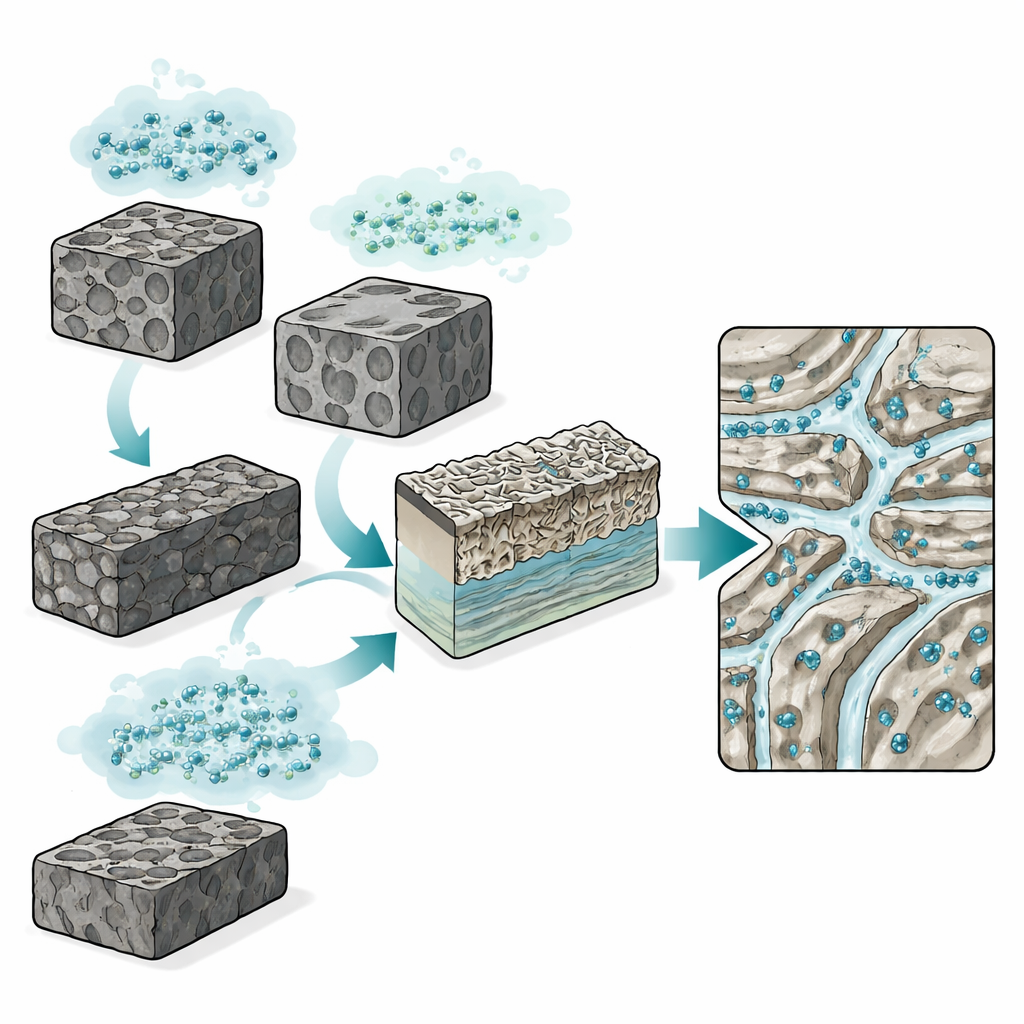
The researchers examined six coal samples from Chinese mines that spanned low, medium, and high degrees of coalification, from softer gas coal to hard anthracite. They used a well-established lab technique called low‑temperature nitrogen adsorption, in which nitrogen gas at very low temperature is allowed to flow around powdered coal. The more gas the coal surface can hold at different pressures, the more we learn about how many pores there are, how big they are, and how they are connected. The measured “isotherms” – curves showing gas uptake versus pressure – already hinted that low and medium rank coals contain many mid‑sized pores, while the hardest coals are dominated by extremely small ones.
Old yardsticks for pores fall short
To turn these gas‑uptake curves into a picture of pore size and volume, scientists rely on mathematical models. Traditional models, such as BET and BJH, imagine smooth, ideal surfaces and simple pore shapes. They work reasonably well for medium‑sized pores, but they struggle with the smallest cavities, which are crucial in coal. Newer density‑functional‑theory models go down to the molecular level, but a commonly used version still assumes perfectly smooth, uniform walls inside the pores. Real coal is nothing like that: its internal surfaces are rough, chemically varied, and arranged in complicated networks. When the team compared several models across all six samples, they found that many of these older tools either overestimated or underestimated key properties like surface area and pore volume, especially in the hardest, most altered coals.
A sharper model for rough reality
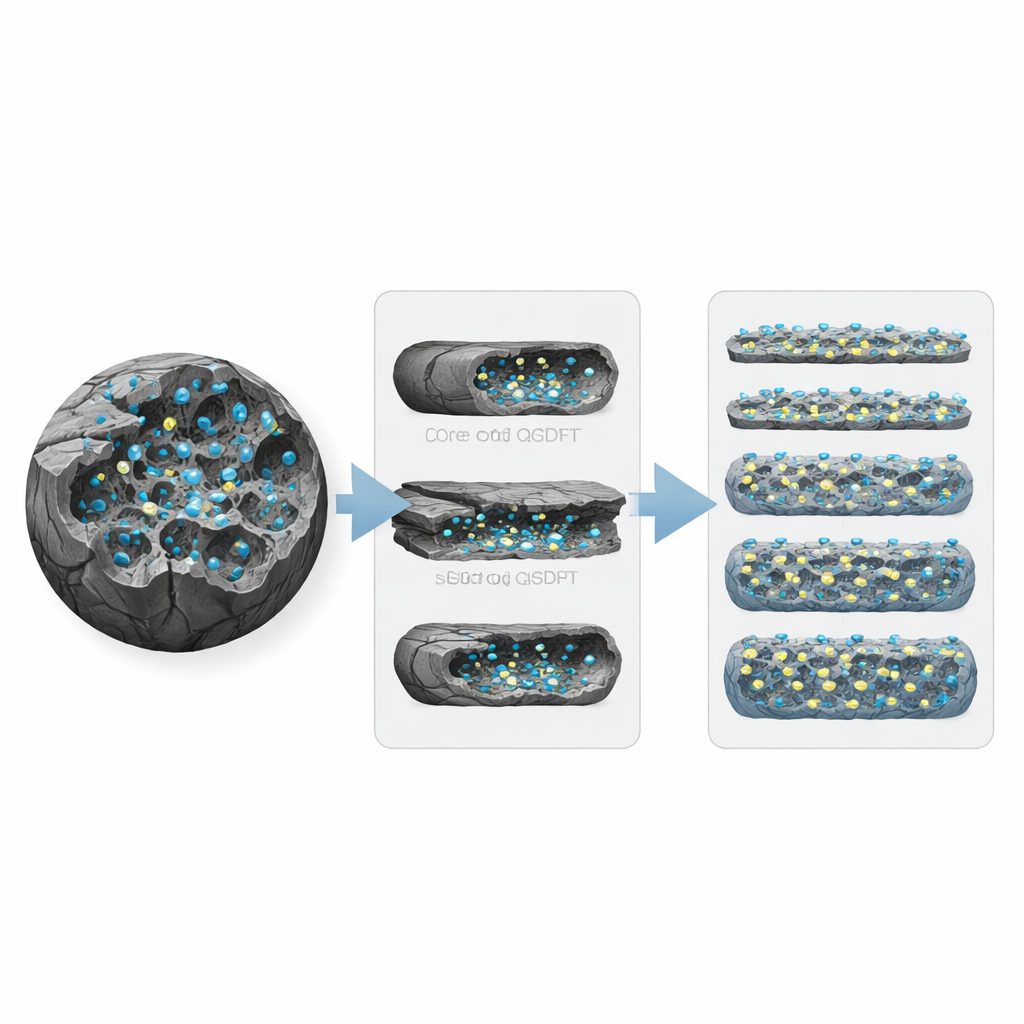
The heart of the study is a refined approach called Quenched Solid Density Functional Theory, or QSDFT. Unlike models that picture mirror‑smooth channels, QSDFT builds surface roughness and energetic “patchiness” directly into the calculation. The researchers fitted this model, along with others, to the nitrogen data and evaluated how far each one deviated from the measurements. Across coal ranks, QSDFT consistently produced the smallest errors, often below a fraction of a percent, while more idealized models could be off by more than ten percent in some hard coals. By further tuning QSDFT to different pore shapes, the team showed that low and medium rank coals are best described as having mostly cylindrical pores, whereas high‑rank coals require a mix of thin slits and cylinders to match reality.
How pore patterns change as coal matures
With a reliable model in hand, the authors then mapped out how pore sizes are distributed in each coal. In low and medium rank coals, they observed two major bands of pores: very small ones around one to two billionths of a meter, and a second group of larger, mid‑sized pores from about five to thirty‑five nanometers. In the highest rank coals, the picture shifted: the strongest signal came from pores only a few nanometers wide, with mid‑sized pores spread more thinly. When they added up the volume across sizes, pores smaller than ten nanometers dominated in all samples, confirming that these tiny spaces are the main storage sites for gas. Very large pores made up only a small share of the total, contributing relatively little to gas holding capacity.
What this means for gas and safety
For non‑specialists, the takeaway is that not all coal is equal when it comes to trapping and releasing methane. As coal matures from soft to hard, its internal architecture shifts from bottle‑shaped mid‑sized pores to denser networks of ultra‑small slits and channels. This evolution changes how gas is stored and how quickly it can move, affecting both energy recovery and the risk of sudden gas outbursts underground. By using a model that better matches the coal’s true rough, disordered interior, this study offers a more trustworthy map of those hidden spaces. That improved picture can help engineers design safer mining practices and more efficient coalbed methane extraction, making better use of an old fuel while reducing the chances of dangerous gas accidents.
Citation: Liu, J., Xu, D., Zhao, L. et al. Feasibility and application of an adsorption model for coal pore structure analysis through N2 adsorption. Sci Rep 16, 11942 (2026). https://doi.org/10.1038/s41598-026-40118-0
Keywords: coal pores, methane storage, nitrogen adsorption, pore size distribution, QSDFT modeling