Clear Sky Science · en
Uncovering the structural influence of urban park landscapes on psychological restoration via graph learning
Why park design matters for your mind
In busy cities, many people instinctively head to a park to clear their heads. But not every patch of grass or row of trees feels equally calming. This study asks a surprisingly practical question: what is it about the detailed layout of an urban park—the way trees, paths, lawns, water and buildings are arranged—that makes some places more mentally refreshing than others? By combining psychology with modern artificial intelligence, the researchers show how subtle differences in park structure can shape how well a place helps us relax, recover from stress and refocus.
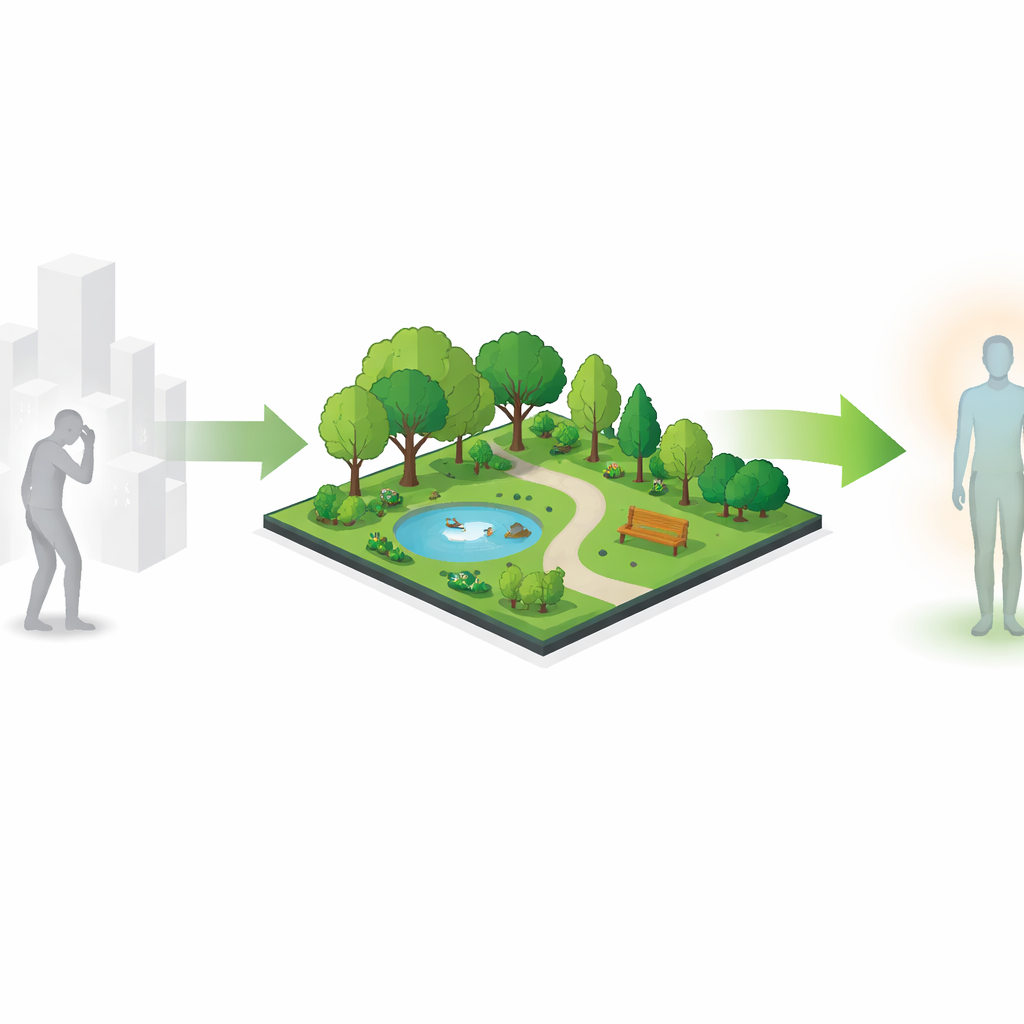
Looking at parks through people’s eyes
The team started by building a new image collection called ParkScape-PR, made up of 1,346 photographs of urban parks taken from a normal walking viewpoint. These images span different types of parks, from neighborhood greens to cultural and ecological parks, and include changes in weather and seasons. Nineteen students rated every image on how much they liked it and how restorative it felt, using a standard questionnaire that captures how well a scene clears the mind, induces relaxation, and restores attention. The result is a detailed “restoration score” for each park view, grounded in real human impressions rather than guesswork.
Turning scenes into networks of park elements
To move beyond vague labels like “green” or “natural,” the researchers broke each image down into the specific things people can see: trees, shrubs, lawns, paths, benches, buildings, water and more. Using a mix of automatic tools and careful checking, they outlined each object and assigned it to one of 18 categories. They then used a large language model to help describe how these elements are arranged in space—for example, a tree above a bench, or a lawn adjacent to a path. This information is stored as a network, or graph: each object is a point, and each spatial relationship is a connection. They also added depth information, capturing whether elements sit in the foreground, middle distance or background, because layered views and a sense of spatial depth are known to support a feeling of escape.
An AI “Perceiver” that predicts how calming a scene feels
With this structural description in hand, the team built a predictive model they call Perceiver. Rather than treating each image as a flat grid of pixels, Perceiver reads the graph of objects and relations, along with a compact summary of depth. It then learns to predict the seven psychological ratings for each image. Using modern graph neural network techniques, the model captures how combinations of elements and their positions jointly shape a viewer’s reaction. In tests, Perceiver reliably reproduced people’s ratings, and a version that ignored depth information performed noticeably worse. This suggests that not just what is in the scene, but how far away and how layered it appears, is crucial for mental restoration.
A “Miner” that reveals which patterns matter most
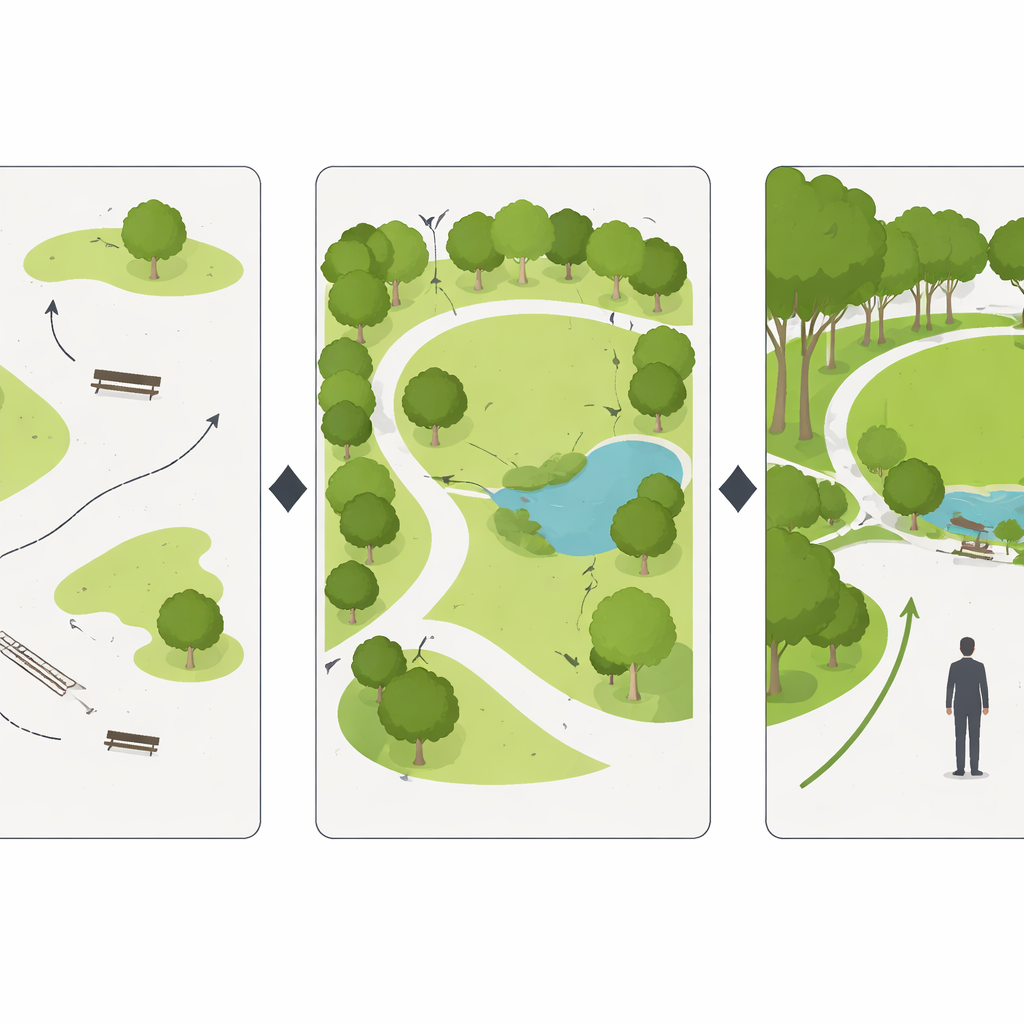
Prediction alone is not enough for designers; they also need to know why some layouts work better. To uncover this, the researchers created a companion tool called Miner. Miner treats Perceiver as a fixed judge and then gently “dims” or “highlights” individual objects and relationships in the graph to see which ones most affect the predicted restoration score. From this, it extracts a simplified “perceptual subgraph” that keeps only the most influential elements and connections. Across many images, Miner shows that single features like “tree” or “lawn” are not enough to explain calming effects. Instead, particular pairings and arrangements stand out—for example, sunny sky above trees and lawns, trees framing open grass next to a path, and natural elements in front of or adjacent to human facilities like benches and walking routes.
What makes a park view feel truly restorative
By analyzing these distilled networks, the study offers concrete guidance for planners and designers. Highly restorative scenes tend to have diverse natural elements—trees, shrubs, lawns and sometimes water—arranged in a coherent, layered structure. Trees and canopy often frame views rather than block them, creating a sense of shelter with an open prospect over grass or water. Paths curve gently and connect focal areas, while benches and other facilities are nestled near greenery instead of surrounded by hard surfaces. In graph terms, these scenes show rich but orderly connections, with key natural features acting as hubs. Less restorative scenes may contain similar ingredients but in sparse, fragmented or visually cluttered arrangements. The authors argue that the secret of a calming park lies not simply in adding more green, but in carefully shaping the spatial relationships among elements so that the whole composition quietly guides the eye and mind toward restoration.
Citation: Zhang, Y., Li, Y., Yin, Y. et al. Uncovering the structural influence of urban park landscapes on psychological restoration via graph learning. Sci Rep 16, 14135 (2026). https://doi.org/10.1038/s41598-026-40102-8
Keywords: urban parks, mental restoration, landscape design, graph neural networks, environmental psychology