Clear Sky Science · en
Structural integrity of the anterior thalamic radiation predicts alpha oscillations and inattention during visual encoding
Why this study matters for everyday attention
Many children with attention-deficit/hyperactivity disorder (ADHD) struggle to stay focused and remember what they see, such as items on a page or instructions on a screen. This study asks a simple but powerful question: could tiny wiring differences deep inside the brain help explain why some children’s attention wavers, by changing the brain’s natural rhythms?
Hidden brain rhythms that shape what we see
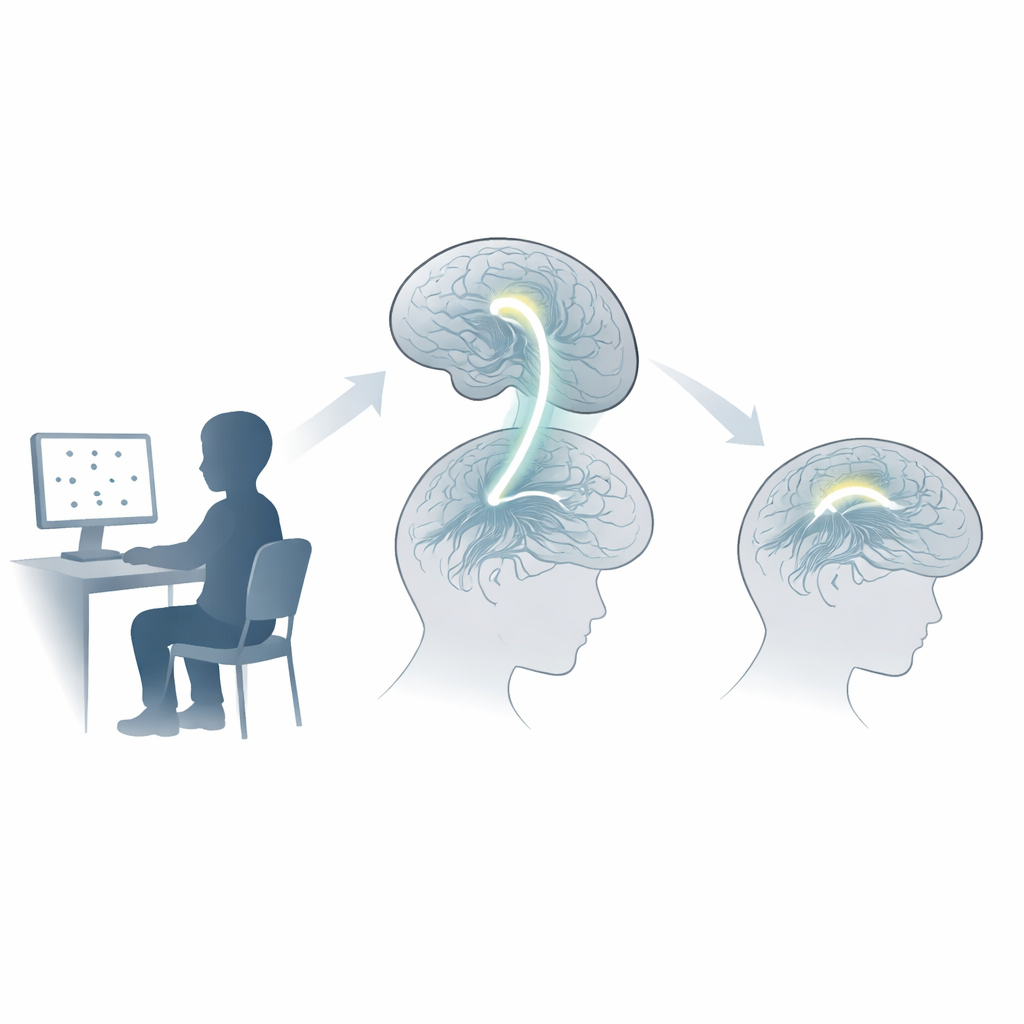
When we pay attention, the brain does not work in a steady hum; instead, its activity rises and falls in waves. One of the most important patterns is called the alpha rhythm, a gentle pulsing over the back of the head that changes when we focus on visual information. In healthy children, alpha activity briefly dips when they are taking in a new image, a shift thought to help open the “gate” for incoming sights. Prior work has shown that this dip is weaker in many children with ADHD, suggesting that their brains may not switch into an ideal state for encoding what they see and need to remember.
White matter highways as attention routes
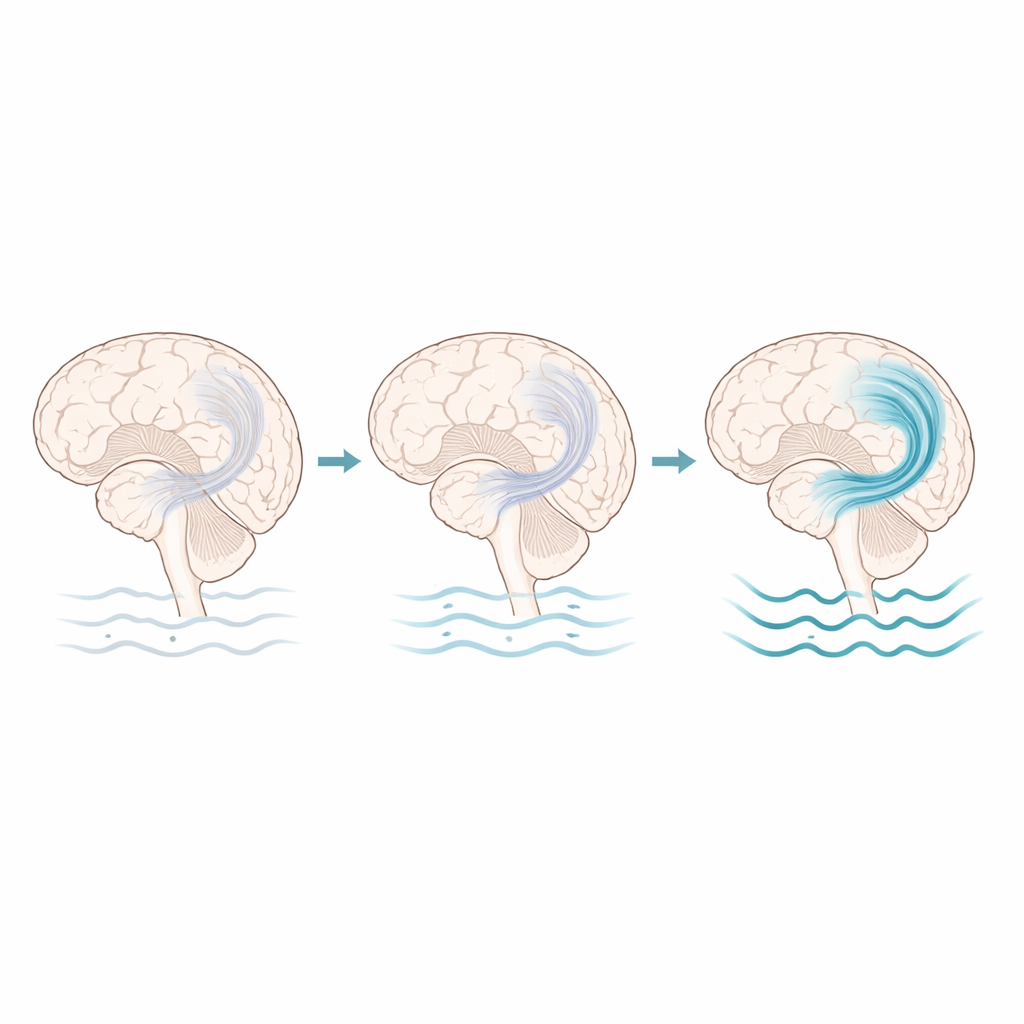
The brain’s gray outer surface does much of the information processing, but deeper inside are white matter “highways” that allow distant regions to talk to each other quickly and in sync. The researchers focused on three key routes that could influence visual attention. One carries visual signals from the eye’s relay station to the back of the brain. A second route, the anterior thalamic radiation, links a central hub region to the front of the brain, where planning and control take place. A third pathway connects frontal and parietal areas involved in shifting and maintaining attention. By examining how water diffuses along these fibers using MRI, the team could estimate how orderly and intact these pathways are in each child.
Putting brain wiring and brain waves to the test
The study followed 115 children aged 7 to 14, some with ADHD and some typically developing. While wearing an EEG cap to record brain activity, the children completed a simple visual memory game: they viewed patterns of yellow dots, kept their locations in mind during a pause, and then judged whether a later green dot matched one of the earlier spots. Separately, they underwent diffusion MRI scans so scientists could measure the structure of the three white matter pathways. The researchers then asked whether differences in these brain highways could predict how strongly each child’s alpha rhythm shifted during the moment of visual encoding.
A key route between deep brain and frontal control
The results pointed to one pathway in particular. Children with ADHD showed signs of less robust wiring in both the anterior thalamic radiation and the front–parietal pathway, but only the anterior thalamic radiation strongly predicted how much their alpha rhythm changed during visual encoding. Children whose fibers along this deep-to-frontal route looked more organized showed a larger, healthier alpha shift, regardless of diagnosis. Further analysis suggested that this pathway’s integrity was linked to inattentive symptoms indirectly: better wiring supported stronger alpha modulation, which in turn was associated with fewer real-world inattention problems reported by parents.
What this means for understanding inattention
These findings support a view of attention problems in ADHD that goes beyond surface behavior. Rather than being only a matter of willpower or moment-to-moment distraction, inattention may partly stem from how well key deep-brain pathways are built and how effectively they tune the brain’s natural rhythms during demanding tasks. By highlighting the role of the anterior thalamic radiation in shaping alpha oscillations, this work suggests that future treatments—whether cognitive training, medication, or brain-based interventions—might aim to strengthen or compensate for this specific network to boost children’s ability to focus and remember what they see.
Citation: Diaz-Fong, J.P., McGough, J., McCracken, J.T. et al. Structural integrity of the anterior thalamic radiation predicts alpha oscillations and inattention during visual encoding. Sci Rep 16, 9905 (2026). https://doi.org/10.1038/s41598-026-40086-5
Keywords: ADHD, attention, working memory, brain rhythms, white matter