Clear Sky Science · en
Machine learning and response surface analysis of mean drop size and dispersed phase holdup in an L-shaped pulsed sieve plate column
Cleaning up nuclear materials with smarter mixing
Turning uranium ore into usable nuclear fuel requires carefully separating valuable metals from a soup of other chemicals. One of the key steps uses special columns where two liquids flow past each other and droplets shuttle the metal from one liquid to the other. This study looks at a new L-shaped version of these columns and uses modern data tools to predict how droplets behave inside them. Understanding and controlling these tiny droplets can make nuclear fuel purification safer, more efficient, and easier to scale up.
A sideways turn for separation columns
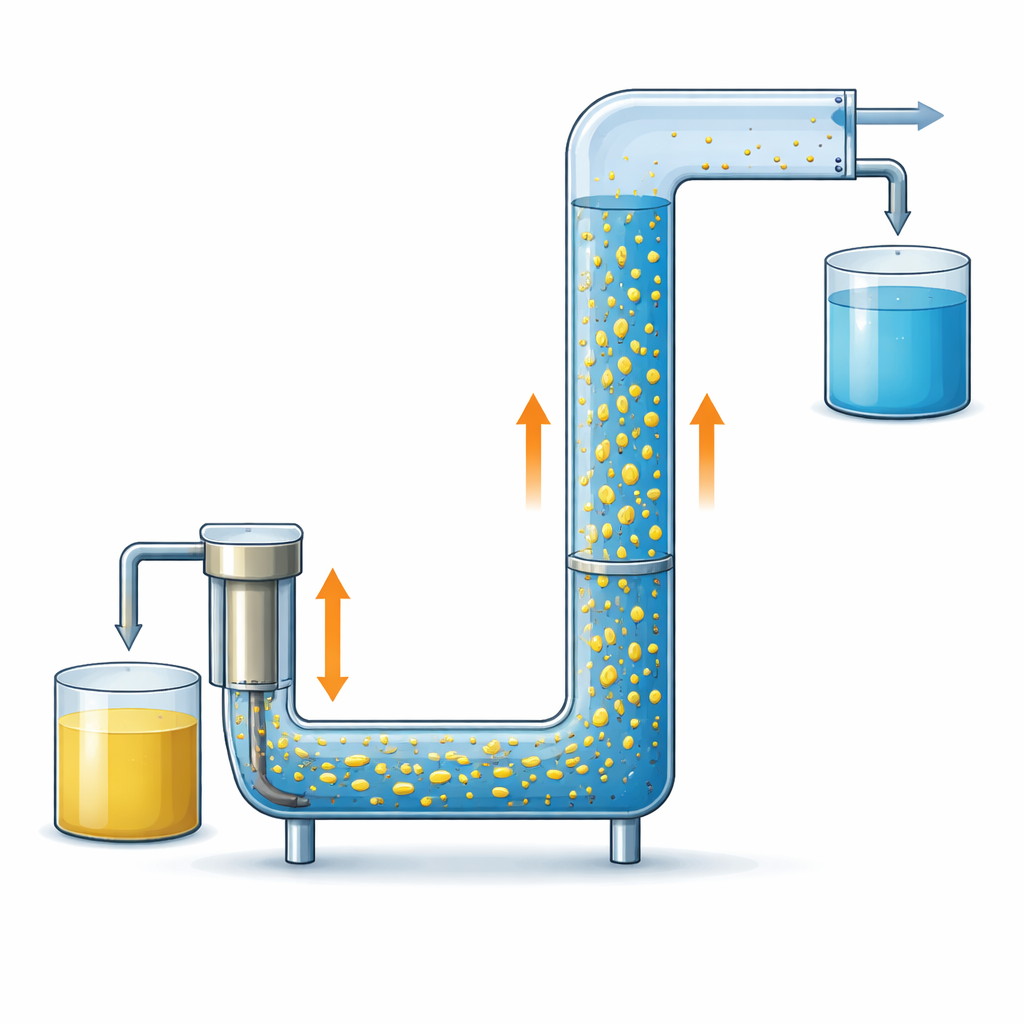
Traditional solvent-extraction columns stand straight up, relying on gravity to help separate two liquids that do not mix, such as water-based acid and an organic solvent. Horizontal columns, by contrast, are easier to install in shielded buildings and simpler to maintain, but they lose some of gravity’s help. The L-shaped pulsed sieve-plate column combines both ideas: a horizontal section joined to a vertical one. Inside, perforated plates and rhythmic pressure pulses break one liquid into droplets that rise through the other liquid. This hybrid layout can shorten the overall height while improving capacity, making it attractive for handling radioactive mixtures used in yellowcake (uranium) purification.
Why droplet size and crowding matter
Inside these columns, performance hinges on two related features of the droplets. The first is their average size, captured by a measure called the Sauter mean drop diameter, which weights droplets by both their size and surface area. Smaller droplets create more contact area between the liquids, speeding up how fast metals can transfer from one liquid to the other. The second feature is how much of the column volume is actually filled with the dispersed droplets, a quantity called dispersed phase holdup. High holdup means lots of droplets and more contact, but too much can choke the flow and lead to flooding. In the L-shaped column, both droplet size and holdup change between the horizontal and vertical sections and depend on how hard the column is pulsed, how fast each liquid flows, and on fluid properties like density, viscosity, and interfacial tension between the two liquids.
Probing droplets in a nuclear-relevant mixture
The researchers studied four liquid pairs chosen to mimic real yellowcake purification conditions: a simple kerosene–water system and three mixtures of nitric acid with kerosene containing different amounts of the solvent TBP, a standard uranium extractant. They first measured key properties of each system, such as how dense, viscous, and mutually attracting the liquids were. Then they ran the L-shaped column over a range of flow rates and pulsation intensities, carefully keeping conditions below the point where the column floods. Using high-resolution photography at several locations in both the horizontal and vertical legs, they measured more than 1500 droplets per test, including slightly squashed, ellipsoidal shapes, to calculate the mean droplet diameter. To find the fraction of the column occupied by the dispersed phase, they used interface-tracking methods and geometry of the column cross-section. Together, these experiments built a rich dataset tying operating conditions and fluid properties to droplet size and holdup.
Teaching models to predict complex behavior
Because these relationships are highly tangled and non‑linear, the team compared two modern modeling approaches. Response surface methodology uses carefully planned experiments to fit smooth polynomial equations linking inputs and outputs. Artificial neural networks, inspired by brain-like networks of interconnected nodes, can learn more intricate patterns directly from data. Here, five inputs – flow rates of each liquid, pulsation strength, interfacial tension, and TBP content – were used to predict four outputs: droplet size and holdup in both the horizontal and vertical sections. After testing many neural network designs, the authors found that a compact network with two hidden layers gave extremely accurate predictions, with correlation coefficients very close to one. The statistical response-surface models also performed well but were generally less precise, especially for describing how crowded the droplets became.
From data patterns to practical rules
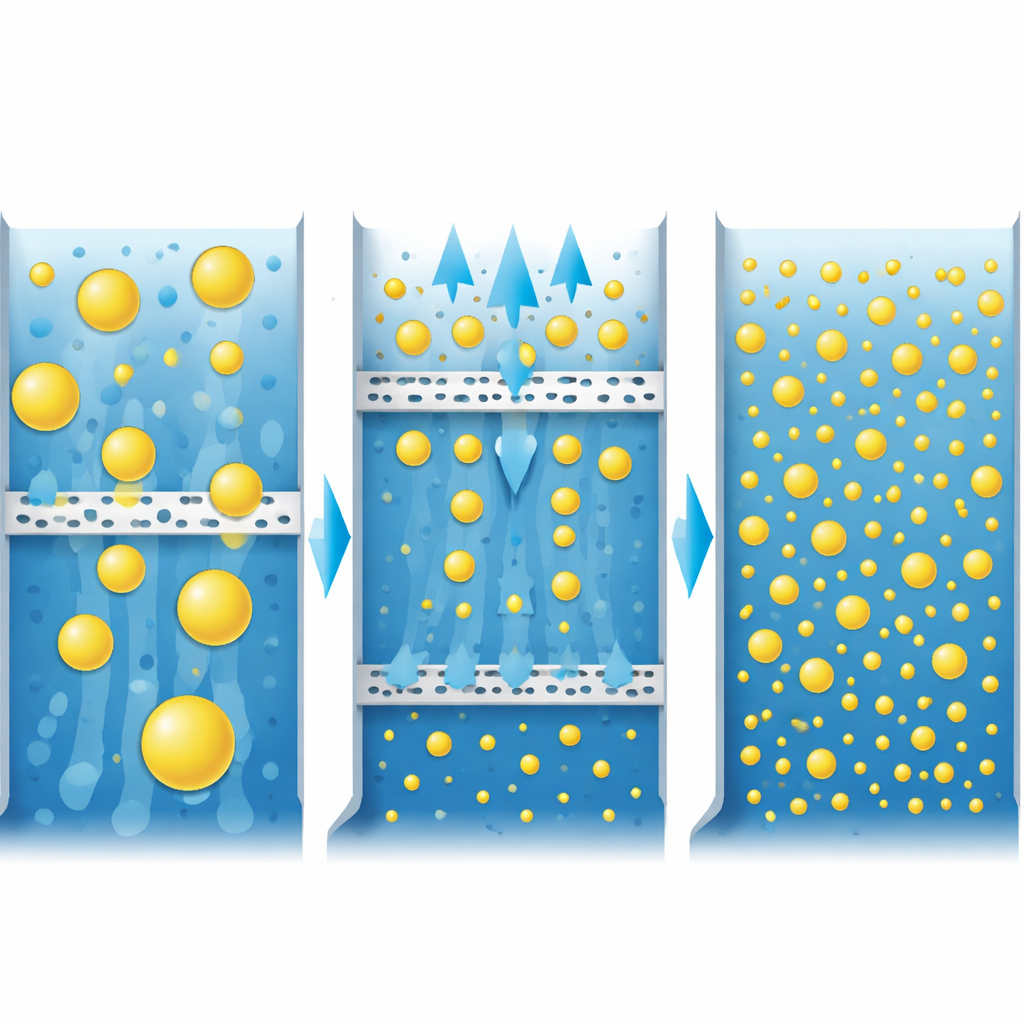
Beyond black-box prediction, the authors wanted formulas engineers could plug into design calculations. They used dimensional analysis to combine the most important physical quantities into dimensionless groups, then fitted new semi‑empirical equations for both droplet size and holdup in the horizontal and vertical legs. These simple expressions matched experiments within about 7–9% on average, much better than older formulas developed for other column geometries. The trends they captured are intuitive: stronger pulsing tends to break droplets into smaller ones and reduce holdup; higher interfacial tension makes droplets larger and holdup higher; and boosting the flow rate of the dispersed liquid both enlarges droplets and packs more of them into the column.
What this means for real-world cleanup
For non-specialists, the take‑home message is that the authors have created a reliable “map” from operating conditions to droplet behavior in a promising new extraction device for nuclear fuel processing. Their experiments show how to tune pulse strength, flow rates, and solvent formulation to strike a balance between many small droplets (good for extraction) and manageable holdup (good for safe, stable operation). The neural‑network model serves as a high‑accuracy predictor for detailed analysis, while the simpler equations can guide day‑to‑day engineering decisions and scale‑up from laboratory columns to semi‑industrial or industrial units. In short, this work helps turn a complex, pulsing, two‑liquid system into something that can be designed and optimized with confidence.
Citation: Ardestani, F., Bahmanzadegan, F. & Ghaemi, A. Machine learning and response surface analysis of mean drop size and dispersed phase holdup in an L-shaped pulsed sieve plate column. Sci Rep 16, 14555 (2026). https://doi.org/10.1038/s41598-026-40081-w
Keywords: liquid-liquid extraction, pulsed sieve-plate column, droplet size, artificial neural networks, yellowcake purification