Clear Sky Science · en
Synergistic effects of detuning and auxiliary qubits on quantum synchronization
Why keeping quantum clocks in step matters
When we shrink technology down to the scale of atoms, even something as simple as keeping time becomes tricky. Quantum devices rely on fragile phase relationships—essentially, how the "ticks" of tiny quantum clocks line up with one another. If these phases drift, sensors lose precision and communication channels become unreliable. This paper explores a new way to keep the phase of a single quantum bit, or qubit, locked in place for long periods by cleverly using both extra helper qubits and a carefully tuned environment.
Many tiny clocks sharing one noisy world
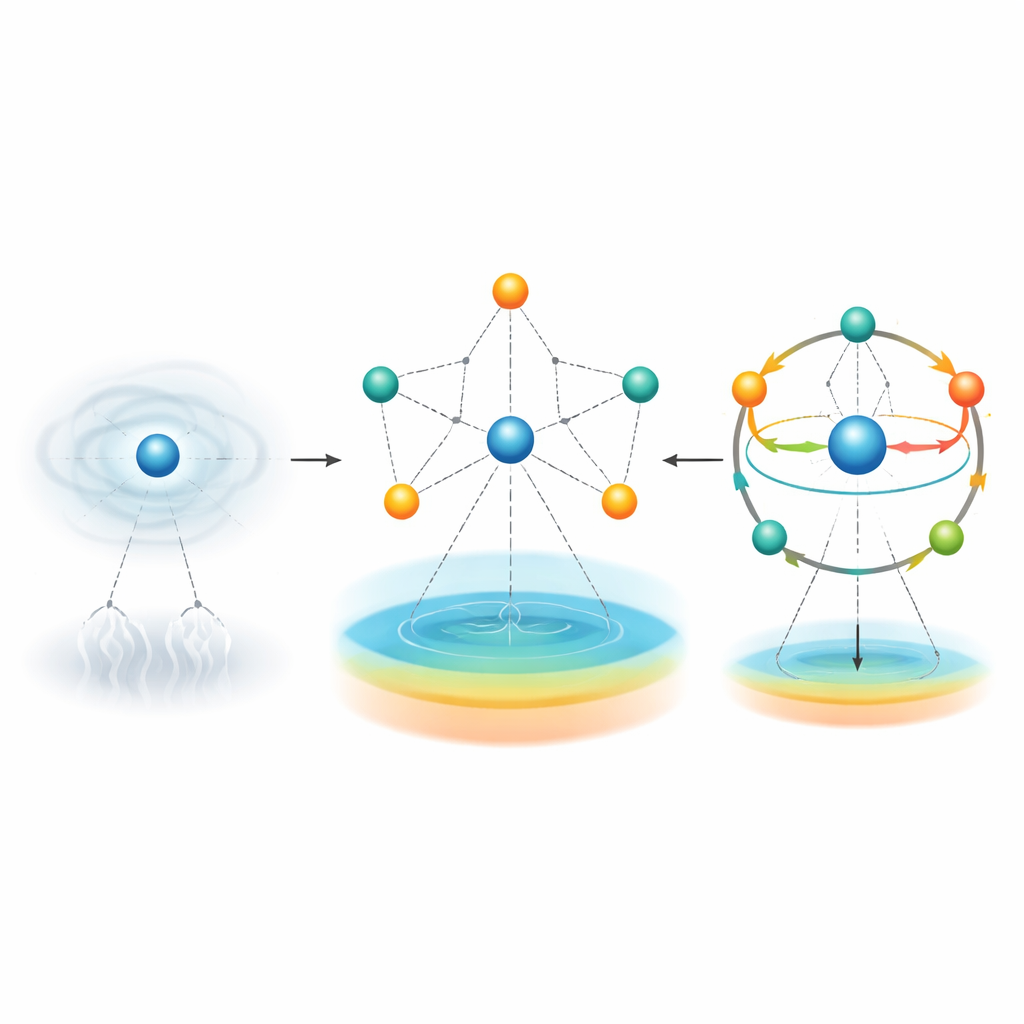
The authors study a setup where several identical qubits all interact with the same surrounding medium, called a reservoir. One of these qubits is the "target" whose phase they want to control; the others serve as auxiliary helpers that never get excited themselves. Instead of treating the environment as a simple, forgetful sink, they model it as a structured reservoir that can temporarily store and return information. This structure is key: depending on how strongly the qubits couple to it, and on a parameter called detuning (how far the qubit’s natural frequency is shifted from the reservoir’s center), the environment can either wash away phase information or help feed it back into the qubit.
How detuning and memory team up
To see whether the qubit’s phase is stable or wandering, the researchers use a tool called the Husimi Q-function, which shows how likely the qubit is to be found with a given phase. A flat, featureless pattern means the phase has become random; a sharp, lasting peak means phase locking. In a simple, memoryless (Markovian) environment, the Q-function quickly spreads out, and changing the detuning barely helps—the environment just drains coherence away. Even adding helper qubits only slows, but does not stop, this phase diffusion. The situation changes radically when the environment has strong memory (non-Markovian). Now, information flows back and forth between qubits and reservoir, and the Q-function shows revivals. The crucial discovery is that, in this regime, a nonzero detuning can synchronize with the reservoir’s memory timescale so that these revivals constructively stabilize the phase, producing a long-lived peak even when only a couple of auxiliary qubits are present.
Measuring and mapping quantum phase locking
The team goes beyond visual inspection and defines a synchronization measure that isolates the phase-coherent part of the qubit’s behavior. When this measure is zero, the qubit is desynchronized; when it settles to a nonzero value, the phase is locked. In the non-Markovian regime, they find that with no detuning the measure oscillates and slowly decays unless many auxiliaries are added. As soon as modest detuning is introduced, these oscillations die out and the measure approaches a stable plateau, almost independent of how many helper qubits are used. By scanning over detuning and coupling strength, they produce tongue-shaped regions in parameter space, reminiscent of classical “Arnold tongues,” that mark where stable phase localization occurs. Increasing the number of auxiliary qubits broadens these regions by strengthening the effective memory of the environment.
Watching quantum motion on the Bloch sphere
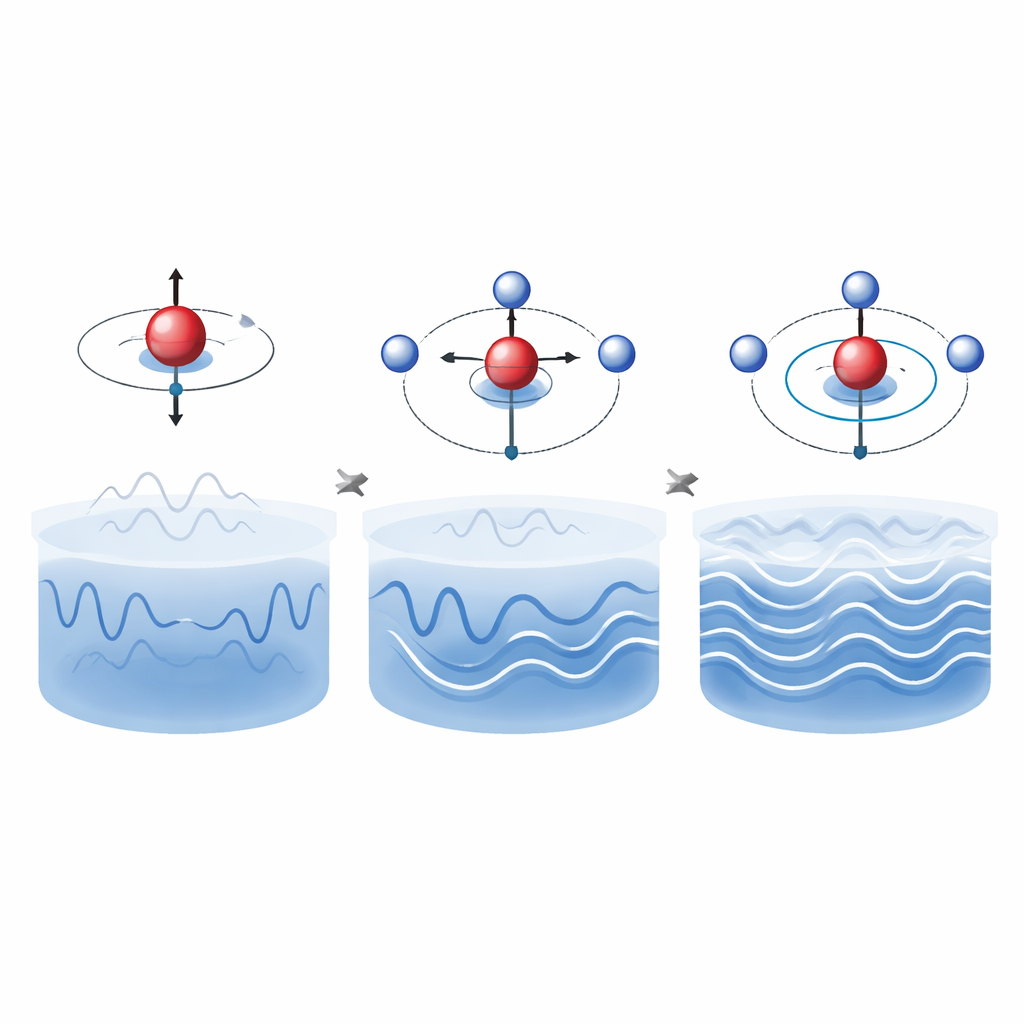
The authors also track the qubit’s motion using the Bloch sphere, a geometric picture where any qubit state is a point inside a sphere. Without detuning, the point spirals toward a fixed location as coherence is lost, with environmental memory causing only temporary loops that eventually shrink. Adding more auxiliary qubits can even freeze the qubit near its starting point through a quantum Zeno-like effect, which protects the state but does not create sustained, clock-like motion. With detuning in a memory-rich environment, however, the trajectory evolves into long-lived, nearly closed orbits: a geometric signature of steady phase rotation and locking. Too many auxiliaries again leads to freezing, revealing that true synchronization requires a balance between memory enhancement and over-measurement.
From theory to future quantum machines
Although the work is theoretical, it connects closely to current experiments in superconducting circuits, trapped ions, and atoms in optical cavities—platforms where both dissipation and detuning can be engineered with high precision. The central message is that phase stability in quantum systems need not rely on brute-force protection with many helper qubits at exact resonance. Instead, a carefully chosen detuning, combined with a reservoir that remembers, can transform fragile revivals into robust, long-lived synchronization using relatively modest resources. For non-specialists, this means there is now a clearer recipe for designing quantum devices—such as sensors, communication links, and phase-based logic elements—that stay "in step" far longer than would otherwise be possible.
Citation: Houshmand Almani, A.H., Mortezapour, A. & Nourmandipour, A. Synergistic effects of detuning and auxiliary qubits on quantum synchronization. Sci Rep 16, 11013 (2026). https://doi.org/10.1038/s41598-026-40052-1
Keywords: quantum synchronization, non-Markovian environment, detuning control, auxiliary qubits, phase locking